I wrote not long ago about discovering that my great-grandmother Rosie Sitzman and her sister Mary Sitzman had different fathers. I had a little time this week, and started going through the DNA tests for my dad and his siblings and looking for matches that had ancestry from Bohemia or Czechoslovakia, that didn't have their second cousin in the shared match list. That way, the odds were more likely that they were related through Rosie's mystery father. I was able to find at least five or six leads, so I sent off emails to them, hoping at least someone would write back.
This weekend, I got an email back! One of the matches identified a few other matches as her first cousin and father, which gave me a little family group to work from. That was really helpful, because her cousin had a family tree that gave me enough data to identify some of their ancestors in census records in Wisconsin. With that info, I traced them back to their immigrant ancestor - John Miller, born 3 March 1883 in Kathrina, Bohemia/Czechoslovakia.
I found John's birthdate and birth place in his WWI and WWII draft registrations, where the info came directly from him, which made the info more reliable. Knowing that, I went looking in the Bohemian archives at the Porta fontium website (www.portafontium.eu) and found the most likely candidate for the village of Kathrina - Sankt Katharina, a little village that's actually part of my great-great-grandmother's hometown of Rosshaupt! The right family in the right place at the right time! I couldn't believe my luck.
I went looking through the birth records for Sankt Katharina and Rosshaupt, and with some help from the German-Bohemian mailing list I'm on, I soon had most of three generations of John Miller's ancestry identified, and even a few ancestors from the fourth generation. His family name was, as I suspected, originally Müller (I wish I could take a German class so I could pronounce these names correctly). He also has the surnames Dobner, Radl, and Heger in his tree, none of which appear in my Zitzmann line. So this is all really good news, it's additional evidence that I really am on the track of my elusive great-great-grandfather. But as I began researching this family, I ran into some roadblocks.
For starters, John's mother Anna Radl was born to a single mother. Anna's birth record lists her mother (also named Anna Radl) and maternal grandparents, but the father's section is totally blank. That leaves a big chuck of John's family tree empty. Then, to complicate things even further, John's paternal grandfather, Michael Müller, was also born to a single mother (also named Anna, as it turned out). Thus John's pedigree has two big holes in it that local records probably won't help with (if the parents later married, they would sometimes add the father's info in later, but they didn't here).
It's still early into my research on this family, so I'm not giving up by any means. Many years ago, when I first learned my great-grandma was born to a single mom, I thought "well, that's one blank I'll never be able to fill," but that was before the advent of DNA and genetic genealogy. Now, I've got at least a partial family tree for someone that I am reasonably sure is related to me through that mystery great-great-grandfather. I have names, exact dates, and specific places for vital events of his relatives! That is huge!! It looks like he, or at least his extended family, was from the same area that Rosie and her mom and sister were from, which makes sense. It's also a bit comforting to know that too, that my ancestor wasn't some vagabond who vanished into the ether. Even though his name isn't on the records, his DNA is, which links him to his family. I really hope someday I'll be able to find his name, as he's the only second-great-grandparent I haven't identified in my tree. And I don't like having white space in my family tree. :)
One other thing this research has taught me - there's a reason we keep saying test all the relatives you can afford. If I had tested just myself, I wouldn't have had enough DNA to match some of these matches. I tested my dad and three of his siblings, all of whom show these matches as related, but they all share different amounts of DNA with them - my uncle shares the most (over 200 cM with with father of that family group I mentioned earlier), one aunt shares less than half of that (barely 90 cM) and my dad and another aunt are about halfway between the two. Thus I now know to use my uncles test when dealing with these matches, as he shares the most DNA from that line, and is most likely to be the test that picks up matches the best. It's like having four fishing poles in the same pond with different bait - you don't know which will work best or what you'll catch, but the more lines you have out there, the better the odds that something will bite. (and yes, for any of you that really understand fishing, I clearly don't. But it's the best I could come up with late on a Sunday night.)
Showing posts with label genetic genealogy. Show all posts
Showing posts with label genetic genealogy. Show all posts
Sunday, August 11, 2019

Sunday, July 7, 2019
They let me in!
A few years ago, I learned that I have ancestors among the Filles du Roi, kind of Quebec's version of the Mayflower immigrants. I was fascinated by the story of these brave women leaving France to help colonize Quebec, some maybe seeking a better life or more opportunities in the new world (though given its underpopulated state, I'm not sure what opportunities they were expecting). As I began researching my French-Canadian ancestry, I found several of these Filles du Roi in my family tree. I thought this was really cool, and wanted a way to commemorate these ancestors.
After a few minutes of searching on Google, I found a lineage society called "La Société des Filles du roi et soldats du Carignan," based out of Virginia interestingly enough, not Quebec like I would have imagined. I asked them if I would be able to join, given that my link to my French-Canadian ancestors was discovered through DNA research and not via paper trail genealogy. Surprisingly, they hadn't seen genetic genealogy used to prove a relationship to a specific individual. They knew about ethnicity results, and how that could show a general relationship to an ethnic group, but they hadn't seen it applied to a specific individual and family. I wrote back, and sent them a proof argument I'd written a few years ago, where I showed how I came to the conclusion that I was a descendant of William Vadnais. They wrote back and said the argument was very interesting, and I should apply for membership!
It took me a while to get my documentation together. Part of the delay was the amount of documentation I felt I needed to prove the connection between my chosen ancestor, Marie Boisleau (born about 1651 in Dercé, Vienne, France) and me, her ninth-great-grandson. That's 12 generations covering over 300 years, and I wanted to prove every birth, marriage, and death in the chain that I could. Then I realized that some of my documents were pretty poor quality images, so I needed to go dig up better images of them. Then came the task of filling out the application with all these names, dates, and places. But I kept at it, and eventually I had everything together. I sent it off, and didn't hear anything for a while. Then just yesterday, I got an email back welcoming me to the society!
The society seems to have some cool benefits, chief of which is access to the society's newsletter. As I don't have a ton of personal research time, this is a great way to get access to information (hopefully a lot of historical context too) on this branch of my family tree without having to spend a ton of time learning it all on my own. They also have a really cool medallion you can buy, which would be neat to have. Most of all, I'm just excited that I was able to apply for this organization in a way they hadn't seen before, and was able to prove my ancestry well enough to be accepted. It makes me feel like I really do know what I'm doing, and it gives me a way to honor and celebrate another branch of my family history. I have a few other lineage societies I'm interested in joining - there's one for descendants of War of 1812 soldiers (my ancestor Elisaph Sanford was one), descendants of Civil War Union Veterans (I have at least two of those), and one I just learned about for descendants of American Farmers. At first I thought that was a joke, because who doesn't have ancestors in the US that were farmers? But then, don't all of our ancestors deserve to be celebrated and remembered, even (perhaps especially) those that don't seem to have the glamorous or noteworthy story or background? So yeah, lots still to do. Which is why I love this work!
After a few minutes of searching on Google, I found a lineage society called "La Société des Filles du roi et soldats du Carignan," based out of Virginia interestingly enough, not Quebec like I would have imagined. I asked them if I would be able to join, given that my link to my French-Canadian ancestors was discovered through DNA research and not via paper trail genealogy. Surprisingly, they hadn't seen genetic genealogy used to prove a relationship to a specific individual. They knew about ethnicity results, and how that could show a general relationship to an ethnic group, but they hadn't seen it applied to a specific individual and family. I wrote back, and sent them a proof argument I'd written a few years ago, where I showed how I came to the conclusion that I was a descendant of William Vadnais. They wrote back and said the argument was very interesting, and I should apply for membership!
It took me a while to get my documentation together. Part of the delay was the amount of documentation I felt I needed to prove the connection between my chosen ancestor, Marie Boisleau (born about 1651 in Dercé, Vienne, France) and me, her ninth-great-grandson. That's 12 generations covering over 300 years, and I wanted to prove every birth, marriage, and death in the chain that I could. Then I realized that some of my documents were pretty poor quality images, so I needed to go dig up better images of them. Then came the task of filling out the application with all these names, dates, and places. But I kept at it, and eventually I had everything together. I sent it off, and didn't hear anything for a while. Then just yesterday, I got an email back welcoming me to the society!
The society seems to have some cool benefits, chief of which is access to the society's newsletter. As I don't have a ton of personal research time, this is a great way to get access to information (hopefully a lot of historical context too) on this branch of my family tree without having to spend a ton of time learning it all on my own. They also have a really cool medallion you can buy, which would be neat to have. Most of all, I'm just excited that I was able to apply for this organization in a way they hadn't seen before, and was able to prove my ancestry well enough to be accepted. It makes me feel like I really do know what I'm doing, and it gives me a way to honor and celebrate another branch of my family history. I have a few other lineage societies I'm interested in joining - there's one for descendants of War of 1812 soldiers (my ancestor Elisaph Sanford was one), descendants of Civil War Union Veterans (I have at least two of those), and one I just learned about for descendants of American Farmers. At first I thought that was a joke, because who doesn't have ancestors in the US that were farmers? But then, don't all of our ancestors deserve to be celebrated and remembered, even (perhaps especially) those that don't seem to have the glamorous or noteworthy story or background? So yeah, lots still to do. Which is why I love this work!
Wednesday, May 29, 2019
This just got more complicated
A few years ago, I found my great-grandmother Rosie Sitzman, her mom Mary, and her older sister Mary, attempted to enter the US. After a few days, they were deported due to Mary being a single mother with two little children and no likely means of support. That got me thinking - who was Rosie and Mary's father? Why wasn't he on the boat with them? Why did the girls have their mother's surname? I had no answer for these questions, so I went digging.
I ordered the Social Security applications for both Rosie and Mary, and both of them said their father's name was Chris Schmidt. There were definitely a lot of Germans in Rozvadov where they came from, and likely a lot of Schmidts. If that was their father's name, finding him would be like trying to find a John Smith in London. Not a pleasant thought for sure.
As I got more involved in DNA, and learned more about other lines of my family history, I started wondering in the back of my mind if Rosie and Mary did in fact have the same father. I have learned from experience both in my own family and through my work that it is not unusual for children in these situations to have different fathers. I realized that the only way to determine this would be to find a descendant of Mary and have them take a DNA test. Fortunately, in going through the Wagner family pictures with my Grandma Blossom a few years ago, I got to see loads of pictures of Mary, her daughter Ellen, and Ellen's children, so I knew who I needed to test.
I checked with a couple relatives, and got a phone number for one of Ellen's daughters. After a little phone tag, we talked for a while (super nice lady!!) and she agreed to do the test. Fast forward a few months, and the results came in. By this time, I had results for my dad, his brother, and two sisters, so I had a pretty good set of people to check this cousin against. I set the scenario up on DNAPainter.com, and ran it through their What Are The Odds? tool, once with Rosie and Mary being full sisters, and once with them being half-sisters. The full sisters scenario came out with a probability of zero - my dad and his sibs did not share enough DNA with their second cousin for Rosie and Mary to be full sisters. I ran it again, with Rosie and Mary being half-sisters, and the probability was one, meaning the relationships are possible. So that seems to pretty well confirm it - Rosie and Mary had different fathers.
This complicates things a bit. One of the reasons I had for getting my dad and his sibs tested was to try to identify Rosie and Mary's father. I had hoped that by testing one of Mary's descendants, she'd be kind of a triangulation point for Bohemian matches to help in this process. I can still do that, but only for relatives connected to Rosie and Mary's mother Mary. I think my plan now is to test the children of Blossom's brother, Howie Wagner. That will give me Wagner/Shute/Groff etc DNA, which I already have a ton of matches to. But those relatives are also the only other repository of Rosie's DNA out there, and hence the only other people who I know have the DNA of Rosie's father. Just one of them would give me about another 7% of mystery dad's DNA (I have about 23% of his DNA covered by testing 4 of my dad's generation, and adding one of Uncle Howie's kids into the mix would boost my coverage of Rosie's DNA, and hence my coverage of her dad's DNA). I've already got one of those kids, Chuck, tested. He passed away a couple years ago, so he's not available to test at Ancestry. Hopefully one or more of his siblings will be cooperative and help me in this research.
So yeah, like I said, it's more complicated now, but still doable. Wish me luck!
I ordered the Social Security applications for both Rosie and Mary, and both of them said their father's name was Chris Schmidt. There were definitely a lot of Germans in Rozvadov where they came from, and likely a lot of Schmidts. If that was their father's name, finding him would be like trying to find a John Smith in London. Not a pleasant thought for sure.
As I got more involved in DNA, and learned more about other lines of my family history, I started wondering in the back of my mind if Rosie and Mary did in fact have the same father. I have learned from experience both in my own family and through my work that it is not unusual for children in these situations to have different fathers. I realized that the only way to determine this would be to find a descendant of Mary and have them take a DNA test. Fortunately, in going through the Wagner family pictures with my Grandma Blossom a few years ago, I got to see loads of pictures of Mary, her daughter Ellen, and Ellen's children, so I knew who I needed to test.
I checked with a couple relatives, and got a phone number for one of Ellen's daughters. After a little phone tag, we talked for a while (super nice lady!!) and she agreed to do the test. Fast forward a few months, and the results came in. By this time, I had results for my dad, his brother, and two sisters, so I had a pretty good set of people to check this cousin against. I set the scenario up on DNAPainter.com, and ran it through their What Are The Odds? tool, once with Rosie and Mary being full sisters, and once with them being half-sisters. The full sisters scenario came out with a probability of zero - my dad and his sibs did not share enough DNA with their second cousin for Rosie and Mary to be full sisters. I ran it again, with Rosie and Mary being half-sisters, and the probability was one, meaning the relationships are possible. So that seems to pretty well confirm it - Rosie and Mary had different fathers.
This complicates things a bit. One of the reasons I had for getting my dad and his sibs tested was to try to identify Rosie and Mary's father. I had hoped that by testing one of Mary's descendants, she'd be kind of a triangulation point for Bohemian matches to help in this process. I can still do that, but only for relatives connected to Rosie and Mary's mother Mary. I think my plan now is to test the children of Blossom's brother, Howie Wagner. That will give me Wagner/Shute/Groff etc DNA, which I already have a ton of matches to. But those relatives are also the only other repository of Rosie's DNA out there, and hence the only other people who I know have the DNA of Rosie's father. Just one of them would give me about another 7% of mystery dad's DNA (I have about 23% of his DNA covered by testing 4 of my dad's generation, and adding one of Uncle Howie's kids into the mix would boost my coverage of Rosie's DNA, and hence my coverage of her dad's DNA). I've already got one of those kids, Chuck, tested. He passed away a couple years ago, so he's not available to test at Ancestry. Hopefully one or more of his siblings will be cooperative and help me in this research.
So yeah, like I said, it's more complicated now, but still doable. Wish me luck!
Friday, August 18, 2017
Genes Day Friday - My LivingDNA results are in!
When last I wrote about LivingDNA, I had just gotten the email saying testing had begun. At the time, they gave me an estimated completion date of September 13. Imagine my surprise when I checked my email this morning and saw that my results were ready! They have seriously overdelivered at every step of the process so far, so I've got high expectations for these results now.
So I logged in to see what they had to say. The Ancestry section has three options - Family Ancestry, Fatherline, and Motherline. Each section gives you a little tour of the info provided (though Fatherline tour said "motherline" instead of "fatherline" on each section, probably just a typo). The infographics were cool, easy to follow, and gave you the option to explore more. What I liked best is that both Fatherline and Motherline lead with the information you really want - your haplogroup (and subclade for Y-DNA). My mtDNA haplogroup is H, no surprise there. FTDNA's full sequence test listed the haplogroup as H3v-T16093C, so I wonder if LivingDNA did a full sequence test, or just lots of SNPs. FTDNA gave me a list of differences from both RSRS and rCRS values, and the list from LivingDNA only has one value in common with rCRS. So I'm guessing they did a SNP test rather than a full sequence, which is fine. They got the haplogroup right, so I'm not doubting their data, just wondering what their list of differences means in comparison with my FTDNA values. I'll have to look into this.
Looking at the Y-DNA info, once again they lead with the info you want first - haplogroup and subclade. They put me in haplogroup R-U106, subclade R-Z159. Back when I did my paternal grandfather's Y-DNA test at FTDNA in 2012, I had to purchase the Z159 SNP test, so to see that this SNP is included at LivingDNA is awesome. The coverage map for the Y-DNA is interesting, because it shows where in the world your haplogroup is predominantly from. For my haplogroup, the top country of origin is England. That matches what I've seen at FTDNA, where most of my grandpa's 12 marker matches are from England. Interestingly, Ireland isn't even on the list of countries my haplogroup is from. I'm sure there are U106 descendants in Ireland, but maybe the haplogroup shows up in less than 7% of the male population? That adds to my suspicion that my Gibsons were pretty recent transplants to Ireland and originally came from England or Scotland (Scotland shows up in the list at 15%, by the way).
Then there's the autosomal results, or Family Ancestry as they call it here. This part works kind of like 23andMe, where they have Complete, Standard, and Cautious levels Complete means they've assigned every percent of your DNA to areas where it's most similar to. Standard is their "best guess" level of assignment, with some areas still labeled "unassigned". Cautious is the level where they have the most certainty. The Great Britain and Ireland section of my Complete view down to the sub-regional level looks like this:

Most of these are areas I know very little about. I know Aberdeenshire is in Scotland, but for some reason, when I click on it, it highlights Ireland as well. But between these areas, I have ancestry from all of Ireland, most of England, and chunks of Scotland and Wales. Pretty awesome! I realize that this is the speculatory level, and not all of these areas may actually be in my family tree. So I took a look at the cautious level as well, and this is what I saw:
 This is a lot more conservative in terms of pinpointing the areas of Great Britain my ancestors came from. But I still have most of England, all of Ireland, and chunks of Scotland and Wales highlighted. I'm very much excited by this! I took a class on English and Welsh family history at BYU, as well as one on Irish and Scottish family history. The history of all these countries is fascinating, and it looks like I might have ties to them all!
Some other interesting points from the ethnicity breakdowns:
On the cautious level, only my ancestry in Great Britain is identified by place - everything else is labeled European. When I first logged in, there was a notice or disclaimer that said basically "You're one of the first to take this test, and your results will be refined as we add more tests to our database." So hopefully as their database grows, the cautious level will become more certain for non-UK areas. Even though I took this test specifically with the intention of gaining more insight into my UK roots, I do hope that Europeans from other areas, especially France and Scandinavia, will test as well. I just like seeing the information get better in all areas basically.
Also, all three levels showed me as having 1.7% "Chuvashian-related ancestry." I have never heard of Chuvashia or Chuvashian before, so I had to look it up. According to Wikipedia, Chuvashia, or the Chuvash Republic, is part of Russia and home to the Chuvash people, a Turkic ethnic group. Apparently their history goes back to at least the 7th and 8th centuries AD. I'm thinking that my Joseph ancestors, who lived in Poland and Ukraine (or where those countries are now, anyways) are where my Chuvashian ancestors came into my family tree. None of my other branches were anywhere near there in the last couple hundred years.
One thing that really stands out - no French ancestry. I should have somewhere around 13% French ancestry, as my maternal grandmother is 1/2 French-Canadian. I don't know if they are lumping French and German together, but the standard level shows me as having 2.8% German ancestry, and 39.5% Scandinavian. Mathematically, I should have about 16% Scandinavian ancestry, and a LOT more German than 3%. I have German ancestry from all four grandparents - my paternal grandfather is half German, my paternal grandmother is somewhere between half and 3/4 German, my maternal grandmother was 1/4 German, and my maternal grandfather was 1/8 German. I know that gets watered down a little bit before it gets to me, but not to the extent of 3%. I'm curious to see how these numbers will adjust in the future as the database grows.
So that's my first glace at my LivingDNA test results. LOTS of information!! So much to take in. I really want to look more closely at the English ancestry, and go through my family tree and see where my likely English and Welsh ancestors are. Also, I thought there was going to be matching to cousins, but I don't see that option yet. Maybe that will be opened up later on. When they open that up, I hope they include a chromosome browser. I would love to see one that mixes both ethnicity and common segments, so I can see the DNA I share with someone AND what the projected ethnicity of that segment is. Wouldn't that be awesome?
All in all, I am totally satisfied that I took this test. $99 was a huge deal, and even the current discount price of $119 is more than reasonable for all this data. For a relatively new DNA testing company, these guys have really hit the ground running. Can't wait to see what refinements and improvements are in store.
So I logged in to see what they had to say. The Ancestry section has three options - Family Ancestry, Fatherline, and Motherline. Each section gives you a little tour of the info provided (though Fatherline tour said "motherline" instead of "fatherline" on each section, probably just a typo). The infographics were cool, easy to follow, and gave you the option to explore more. What I liked best is that both Fatherline and Motherline lead with the information you really want - your haplogroup (and subclade for Y-DNA). My mtDNA haplogroup is H, no surprise there. FTDNA's full sequence test listed the haplogroup as H3v-T16093C, so I wonder if LivingDNA did a full sequence test, or just lots of SNPs. FTDNA gave me a list of differences from both RSRS and rCRS values, and the list from LivingDNA only has one value in common with rCRS. So I'm guessing they did a SNP test rather than a full sequence, which is fine. They got the haplogroup right, so I'm not doubting their data, just wondering what their list of differences means in comparison with my FTDNA values. I'll have to look into this.
Looking at the Y-DNA info, once again they lead with the info you want first - haplogroup and subclade. They put me in haplogroup R-U106, subclade R-Z159. Back when I did my paternal grandfather's Y-DNA test at FTDNA in 2012, I had to purchase the Z159 SNP test, so to see that this SNP is included at LivingDNA is awesome. The coverage map for the Y-DNA is interesting, because it shows where in the world your haplogroup is predominantly from. For my haplogroup, the top country of origin is England. That matches what I've seen at FTDNA, where most of my grandpa's 12 marker matches are from England. Interestingly, Ireland isn't even on the list of countries my haplogroup is from. I'm sure there are U106 descendants in Ireland, but maybe the haplogroup shows up in less than 7% of the male population? That adds to my suspicion that my Gibsons were pretty recent transplants to Ireland and originally came from England or Scotland (Scotland shows up in the list at 15%, by the way).
Then there's the autosomal results, or Family Ancestry as they call it here. This part works kind of like 23andMe, where they have Complete, Standard, and Cautious levels Complete means they've assigned every percent of your DNA to areas where it's most similar to. Standard is their "best guess" level of assignment, with some areas still labeled "unassigned". Cautious is the level where they have the most certainty. The Great Britain and Ireland section of my Complete view down to the sub-regional level looks like this:

Most of these are areas I know very little about. I know Aberdeenshire is in Scotland, but for some reason, when I click on it, it highlights Ireland as well. But between these areas, I have ancestry from all of Ireland, most of England, and chunks of Scotland and Wales. Pretty awesome! I realize that this is the speculatory level, and not all of these areas may actually be in my family tree. So I took a look at the cautious level as well, and this is what I saw:

Some other interesting points from the ethnicity breakdowns:
On the cautious level, only my ancestry in Great Britain is identified by place - everything else is labeled European. When I first logged in, there was a notice or disclaimer that said basically "You're one of the first to take this test, and your results will be refined as we add more tests to our database." So hopefully as their database grows, the cautious level will become more certain for non-UK areas. Even though I took this test specifically with the intention of gaining more insight into my UK roots, I do hope that Europeans from other areas, especially France and Scandinavia, will test as well. I just like seeing the information get better in all areas basically.
Also, all three levels showed me as having 1.7% "Chuvashian-related ancestry." I have never heard of Chuvashia or Chuvashian before, so I had to look it up. According to Wikipedia, Chuvashia, or the Chuvash Republic, is part of Russia and home to the Chuvash people, a Turkic ethnic group. Apparently their history goes back to at least the 7th and 8th centuries AD. I'm thinking that my Joseph ancestors, who lived in Poland and Ukraine (or where those countries are now, anyways) are where my Chuvashian ancestors came into my family tree. None of my other branches were anywhere near there in the last couple hundred years.
One thing that really stands out - no French ancestry. I should have somewhere around 13% French ancestry, as my maternal grandmother is 1/2 French-Canadian. I don't know if they are lumping French and German together, but the standard level shows me as having 2.8% German ancestry, and 39.5% Scandinavian. Mathematically, I should have about 16% Scandinavian ancestry, and a LOT more German than 3%. I have German ancestry from all four grandparents - my paternal grandfather is half German, my paternal grandmother is somewhere between half and 3/4 German, my maternal grandmother was 1/4 German, and my maternal grandfather was 1/8 German. I know that gets watered down a little bit before it gets to me, but not to the extent of 3%. I'm curious to see how these numbers will adjust in the future as the database grows.
So that's my first glace at my LivingDNA test results. LOTS of information!! So much to take in. I really want to look more closely at the English ancestry, and go through my family tree and see where my likely English and Welsh ancestors are. Also, I thought there was going to be matching to cousins, but I don't see that option yet. Maybe that will be opened up later on. When they open that up, I hope they include a chromosome browser. I would love to see one that mixes both ethnicity and common segments, so I can see the DNA I share with someone AND what the projected ethnicity of that segment is. Wouldn't that be awesome?
All in all, I am totally satisfied that I took this test. $99 was a huge deal, and even the current discount price of $119 is more than reasonable for all this data. For a relatively new DNA testing company, these guys have really hit the ground running. Can't wait to see what refinements and improvements are in store.
Friday, January 27, 2017
Genes Day Friday - My AncestryDNA Results: Ethnicity Breakdown
It's been a few weeks since my AncestryDNA results came back, so I thought I'd take a minute to start looking at them, see what they have to say. In this first installment, I'm taking a quick look at the part everyone seems to think of first/most when they think of DNA tests for genealogy - the ethnicity results.
My genetic genealogy research thus far has taught me that ethnicity results can reveal a lot, both by what you see and what you don't see. It was one of my grandparents' ethnicity results that tipped me off that something was not as it should be, and led me to one of the most shocking discoveries in all of my family history research. Thankfully, with my own results, there was nothing so earth-shattering. But it has been interesting to analyze.

So according to Ancestry, my genetic heritage comes from three main areas - Europe West, Scandinavia, and Ireland. Knowing what I know from paper trail research, this sounds pretty good so far. Let's take a look at my pedigree and compare. FYI, the names of living ancestors have been removed to protect the innocent.

Let's take the smallest of the three main percentages first. Ireland is where my paternal grandfather's father's side is from. Four of my 3rd-great-grandparents - the Gibsons, Cains, and Mulhearns - all came from Ireland, Gibsons from County Fermanagh, Cains from County Tyrone, and Mulhearns from parts as yet unknown. (Nice rhyming!) Ireland got 6% of my genetic heritage, while my Irish ancestry is about 1/8, or 12.5%. So what gives? Given that my Gibson surname isn't your typical Irish name, I have a sneaking suspicion that they were originally from England. When I went to a workshop put on by the Ulster Historical Foundation, and bought a book called 'Men and arms' - The Ulster settlers, c. 1630. It's all about military men from England moving into Ireland in the early 1600s. There were even records of at least 3 Gibsons moving into County Fermanagh. I kind of fancied that my Gibson ancestors were among them, moving into Ulster, and settling down in County Fermanagh for a couple hundred years, until they moved to Canada. I have no proof of that, of course, so I'll need to do further research and see if I can't go back beyond Henry Gibson and see where those Gibsons originated from before they got to Ireland.
Scandinavian was the next highest percentage, with almost 20%. I have a lot of Norwegian ancestry on my maternal grandfather's side - his last name was Bergstad, if that tells you anything. On that side, I have Olsons and Hammers and Fadnesses and Sjursens and all kinds of good Norwegian names. Out of my 32 great-grandparents, 5 of them were Norwegian, 4 of them born in Norway and one being the child of Norwegian immigrants. Mathematically that works out to about 16%, so that's right on the money. I'm ok with a little extra Viking blood in my veins!
Now for Europe West. Ancestry defines their Europe West area as covering "Belgium, France, Germany, Netherlands, Switzerland, Luxembourg, Liechtenstein," and also "England, Denmark, Italy, Slovenia, Czech Republic." If I stick with just France and Germany, that covers 17 of my 32 3rd-great-grandparents (counting the Germans from outside of Germany as Germans). Then I have a couple of English or presumed-English/Scottish lines counting for another 6 of the 32. So that's 23 out of 32, or about 71%. Ancestry gives me 65%, so that's pretty dang close!
I know that ethnicity estimates are exactly that - estimates. As Judy Russell has said more than once, these numbers are really good for conversation pieces and not much else at this point. But on the whole, I think my numbers look pretty good when compared to my paper trail genealogy. And that is really encouraging, both in germs of genetic genealogy matching paper genealogy, and paper genealogy matching the DNA report. I'm looking forward to even more detailed analysis as these tools get more and more precise and refined.
My genetic genealogy research thus far has taught me that ethnicity results can reveal a lot, both by what you see and what you don't see. It was one of my grandparents' ethnicity results that tipped me off that something was not as it should be, and led me to one of the most shocking discoveries in all of my family history research. Thankfully, with my own results, there was nothing so earth-shattering. But it has been interesting to analyze.

So according to Ancestry, my genetic heritage comes from three main areas - Europe West, Scandinavia, and Ireland. Knowing what I know from paper trail research, this sounds pretty good so far. Let's take a look at my pedigree and compare. FYI, the names of living ancestors have been removed to protect the innocent.

Let's take the smallest of the three main percentages first. Ireland is where my paternal grandfather's father's side is from. Four of my 3rd-great-grandparents - the Gibsons, Cains, and Mulhearns - all came from Ireland, Gibsons from County Fermanagh, Cains from County Tyrone, and Mulhearns from parts as yet unknown. (Nice rhyming!) Ireland got 6% of my genetic heritage, while my Irish ancestry is about 1/8, or 12.5%. So what gives? Given that my Gibson surname isn't your typical Irish name, I have a sneaking suspicion that they were originally from England. When I went to a workshop put on by the Ulster Historical Foundation, and bought a book called 'Men and arms' - The Ulster settlers, c. 1630. It's all about military men from England moving into Ireland in the early 1600s. There were even records of at least 3 Gibsons moving into County Fermanagh. I kind of fancied that my Gibson ancestors were among them, moving into Ulster, and settling down in County Fermanagh for a couple hundred years, until they moved to Canada. I have no proof of that, of course, so I'll need to do further research and see if I can't go back beyond Henry Gibson and see where those Gibsons originated from before they got to Ireland.
Scandinavian was the next highest percentage, with almost 20%. I have a lot of Norwegian ancestry on my maternal grandfather's side - his last name was Bergstad, if that tells you anything. On that side, I have Olsons and Hammers and Fadnesses and Sjursens and all kinds of good Norwegian names. Out of my 32 great-grandparents, 5 of them were Norwegian, 4 of them born in Norway and one being the child of Norwegian immigrants. Mathematically that works out to about 16%, so that's right on the money. I'm ok with a little extra Viking blood in my veins!
Now for Europe West. Ancestry defines their Europe West area as covering "Belgium, France, Germany, Netherlands, Switzerland, Luxembourg, Liechtenstein," and also "England, Denmark, Italy, Slovenia, Czech Republic." If I stick with just France and Germany, that covers 17 of my 32 3rd-great-grandparents (counting the Germans from outside of Germany as Germans). Then I have a couple of English or presumed-English/Scottish lines counting for another 6 of the 32. So that's 23 out of 32, or about 71%. Ancestry gives me 65%, so that's pretty dang close!
I know that ethnicity estimates are exactly that - estimates. As Judy Russell has said more than once, these numbers are really good for conversation pieces and not much else at this point. But on the whole, I think my numbers look pretty good when compared to my paper trail genealogy. And that is really encouraging, both in germs of genetic genealogy matching paper genealogy, and paper genealogy matching the DNA report. I'm looking forward to even more detailed analysis as these tools get more and more precise and refined.
Friday, December 2, 2016
Genes Day Friday - One more DNA test
As should be painfully obvious by now, I'm addicted to genetic genealogy and DNA tests. Having tested more than a dozen relatives, I've been amazed at all that I've learned about my family history through DNA.
When I got into genetic genealogy a few years ago, I learned there are two overriding principles that govern who to test - test the oldest generations first, and fish in every pond you can afford to. As to the first point, I soon saw the wisdom in such council - not even a year after testing my paternal grandmother, she passed away unexpectedly. Fortunately I was able to make some very signifcant discoveries in her ancestry through the DNA testing, and share them with her before she died. As my knowledge of the genetic history of my family increased, I found I needed more tests to answer questions that came up. I now have a pretty large pool of tests to work with. Some of them will need to be upgraded in the future (I only have one mt-DNA test at the full sequence level), and some additional tests will need to be ordered, but all the DNA I need from older generations is stored at the labs, and the additional tests and upgrades can be ordered as time and finances allow.
For the second point, I've done a pretty good job of that too. I tested my wife at Ancestry.com, most of my paternal and maternal family at 23andMe (back before the "new experience"), and more paternal and maternal family at FTDNA (as well as having the 23andMe and Ancestry results transferred over). And of course, everything has been uploaded to Gedmatch for maximum matching opportunities. So I feel pretty confident about the fishing in multiple ponds, except for one - Ancestry.
So far, my wife's test is the only one I have at Ancestry. And while many people who test at Ancestry take their data to FTDNA and Gedmatch, many more do not. I could be wrong, but Ancestry seems to be the "test here if you want us to do the work for you" lab. They still don't have a chromosome browser, even though the genetic genealogy community has been demanding one for years. They have the least in terms of tools to work with on their site, though the matching DNA to user's trees feature is pretty awesome. But overall, they seem more geared to helping people make fast and easy discoveries, even though they may not be 100% accurate (as Roberta Estes can tell you). But even with all those issues, I still want to get my lure in the Ancestry waters and find those cousins who for whatever have tested there and only there and won't spread their data elsewhere.


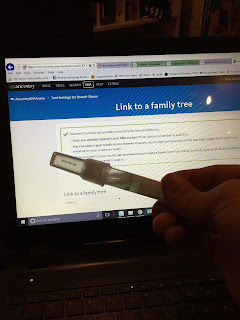

I put it in the mail Wednesday night, so now all I have to do is wait. I really hate waiting, but in this case, I am so totally swamped with stuff to do, I probably won't even notice the time go by. Ancestry said it normally takes 6-8 weeks for results to come back, so I won't be getting any results for Christmas unless they REALLY overdeliver. But things will hopefully slow down again for me by the middle-end of January, when the results are due back, so I can be patient. Probably. Maybe.
This is really exciting for me. Everyone else I've tested knowing that they share DNA with me or my wife and kids. This time I will actually get to see what MY DNA looks like - how much I actually have from each of my parents and grandparents and cousins. It's taken something I've grown to appreciate on a macro level, and delivering a whole new experience on the micro level. I can't wait to see what I look like! Genetically I mean. I do have a mirror at home.
I'm still working with my previous tests as much as time allows. But with genealogy projects popping out of the woodwork (which I LOVE), and all the Christmastime busy-ness, plus my upcoming role in my SAR chapter (I was elected Secretary at the last meeting), it's gonna be a whirlwind of a year in 2017. And I couldn't be happier.
When I got into genetic genealogy a few years ago, I learned there are two overriding principles that govern who to test - test the oldest generations first, and fish in every pond you can afford to. As to the first point, I soon saw the wisdom in such council - not even a year after testing my paternal grandmother, she passed away unexpectedly. Fortunately I was able to make some very signifcant discoveries in her ancestry through the DNA testing, and share them with her before she died. As my knowledge of the genetic history of my family increased, I found I needed more tests to answer questions that came up. I now have a pretty large pool of tests to work with. Some of them will need to be upgraded in the future (I only have one mt-DNA test at the full sequence level), and some additional tests will need to be ordered, but all the DNA I need from older generations is stored at the labs, and the additional tests and upgrades can be ordered as time and finances allow.
For the second point, I've done a pretty good job of that too. I tested my wife at Ancestry.com, most of my paternal and maternal family at 23andMe (back before the "new experience"), and more paternal and maternal family at FTDNA (as well as having the 23andMe and Ancestry results transferred over). And of course, everything has been uploaded to Gedmatch for maximum matching opportunities. So I feel pretty confident about the fishing in multiple ponds, except for one - Ancestry.
So far, my wife's test is the only one I have at Ancestry. And while many people who test at Ancestry take their data to FTDNA and Gedmatch, many more do not. I could be wrong, but Ancestry seems to be the "test here if you want us to do the work for you" lab. They still don't have a chromosome browser, even though the genetic genealogy community has been demanding one for years. They have the least in terms of tools to work with on their site, though the matching DNA to user's trees feature is pretty awesome. But overall, they seem more geared to helping people make fast and easy discoveries, even though they may not be 100% accurate (as Roberta Estes can tell you). But even with all those issues, I still want to get my lure in the Ancestry waters and find those cousins who for whatever have tested there and only there and won't spread their data elsewhere.

Then Black Friday came along, and with it, a whopping 30% discount on AncestryDNA's autosomal DNA test. That was a deal I couldn't refuse. Especially because this test was for the one person in all my testing that I haven't tested yet - me!

I bought the test Friday or Saturday night. Imagine my surprise, though, when the test came in the mail Wednesday afternoon! I wasn't expecting it for several more days. Score!

I pulled it out of the box, activated it online, coughed up the spit, and sealed it in the envelope, all in less than a half hour. They really do make it easy for you.

I put it in the mail Wednesday night, so now all I have to do is wait. I really hate waiting, but in this case, I am so totally swamped with stuff to do, I probably won't even notice the time go by. Ancestry said it normally takes 6-8 weeks for results to come back, so I won't be getting any results for Christmas unless they REALLY overdeliver. But things will hopefully slow down again for me by the middle-end of January, when the results are due back, so I can be patient. Probably. Maybe.
This is really exciting for me. Everyone else I've tested knowing that they share DNA with me or my wife and kids. This time I will actually get to see what MY DNA looks like - how much I actually have from each of my parents and grandparents and cousins. It's taken something I've grown to appreciate on a macro level, and delivering a whole new experience on the micro level. I can't wait to see what I look like! Genetically I mean. I do have a mirror at home.
I'm still working with my previous tests as much as time allows. But with genealogy projects popping out of the woodwork (which I LOVE), and all the Christmastime busy-ness, plus my upcoming role in my SAR chapter (I was elected Secretary at the last meeting), it's gonna be a whirlwind of a year in 2017. And I couldn't be happier.
Thursday, June 2, 2016
Treasure Chest Thursday - A Fire in the Coals
Four years ago, I began my journey into genetic genealogy and DNA testing. Right away, from my first round of tests, I found some unexpected results, and set about trying to solve them - my grandmother's biological father, the question of whether Ernest Craddock was my ancestor (and fortunately he is!), etc. Since those questions have been answered, I've felt like I kind of plateaued in my DNA research. Not that I haven't made big strides in some areas, because I have. But I haven't had a specific goal in mind, a question to resolve. I'm sitting on mountains of data, and I don't quite know what to do with it all. I feel kind of like a coal that's been taken out of the fire and left on its own.
So this year, I'm doing something about it. I'm now at the Marriott hotel in Burbank, California, eagerly awaiting the start of DNA Day at the SCGS Genealogy Jamboree! It's going to be a day packed with talks and presentations all about DNA and genetic genealogy. I'm hoping I'll hear something (or lots of somethings!) to get me inspired and motivated to take my genetic genealogy research and skills to the next level. I'm ready to jump back into the fire with both feet, and come out ready to hit the research running again.
Speaking of DNA testing, I'm still waiting on the results from my Wagner relative's Y-DNA test. It's been delayed four times now at FTDNA (who has, I've noticed, added an additional disclaimer to the projected completion dates saying "this is just an estimate, subject to quality controls, etc"). I was really hoping the results would be in before now so I could take what I learn and use it as I hear it. But maybe it's a good thing the results aren't in just yet. Maybe I need to have that test to look forward to when I get home, to work on after Jamboree is over, and put all that new knowledge and fire to work for me. Silver lining, blessing in disguise, that kind of thing.
At any rate, I am so stoked for this weekend. Here's to continuing education and jumping back into the fire!
So this year, I'm doing something about it. I'm now at the Marriott hotel in Burbank, California, eagerly awaiting the start of DNA Day at the SCGS Genealogy Jamboree! It's going to be a day packed with talks and presentations all about DNA and genetic genealogy. I'm hoping I'll hear something (or lots of somethings!) to get me inspired and motivated to take my genetic genealogy research and skills to the next level. I'm ready to jump back into the fire with both feet, and come out ready to hit the research running again.
Speaking of DNA testing, I'm still waiting on the results from my Wagner relative's Y-DNA test. It's been delayed four times now at FTDNA (who has, I've noticed, added an additional disclaimer to the projected completion dates saying "this is just an estimate, subject to quality controls, etc"). I was really hoping the results would be in before now so I could take what I learn and use it as I hear it. But maybe it's a good thing the results aren't in just yet. Maybe I need to have that test to look forward to when I get home, to work on after Jamboree is over, and put all that new knowledge and fire to work for me. Silver lining, blessing in disguise, that kind of thing.
At any rate, I am so stoked for this weekend. Here's to continuing education and jumping back into the fire!
Friday, January 22, 2016
Genes Day Friday - What I have learned so far through DNA testing
I thought it would be fun to recap some of the things I have learned genetic genealogy and DNA testing. Let me begin by saying THANK YOU! to the dozen or so relatives that have spit and swabbed for me. None of these breakthroughs would have been possible without your help.
1. Genetic genealogy and paper genealogy are in some ways very opposite. In paper genealogy, you start with a known person, and work outward from there, painstakingly creating family groups and pedigrees by searching through the records left behind by ancestors, friends, associates, and neighbors. You connect to people through chance and happenstance as often as known connections. In genetic genealogy, you are connected to other testees by the scientific confirmation of shared DNA, proving a blood link to that person. Sometimes (hopefully often) you can use paper genealogy to determine where and how that link was made. Sometimes you can't, and you're just stuck knowing that somehow you are related to that person.
2. Sometimes genetic genealogy helps you break through brick walls that would otherwise be impossible to penetrate. This was the case in my Grandma Blossom's maternal line. DNA testing led me to a relative who not only lives in Europe, but was intimately familiar with the area, history, and people. Within a few short weeks, he helped me put together nearly 300 years of family history for my great-great-grandmother Maria (Zitzmann) Hoffman, when I had long assumed I'd never get beyond her.
3. Sometimes you uncover things you never expected were there. Such was the case when I found out one of my ancestors was not James Harris, but in fact was William Vadnais. This discovery changed a significant portion of my genetic family tree, and has taught me to never assume that everyone listed in the paper trail is actually my ancestor by blood.
4. Everyone has two family trees - one that's genetic, and one that's genealogical. CeCe Moore taught me this. Not all of your paper ancestors will appear in your DNA - you only get half of each parent, who only got half of their parents, who only got half of their parents, etc. Within a few generations, ancestors will drop out of your genetic family tree because their DNA was simply not passed on to the next generation. That doesn't mean they aren't your ancestors though, just that they aren't represented in your DNA. Likewise, my paper family tree still includes Jim Harris because he raised that ancestor of mine and put his name on her birth certificate, even if he wasn't her biological father. His life and his family history influenced the way he raised my ancestor, so knowing about his family tree is just as important as knowing about the biological tree of William Vadnais.
5. You learn funky new words and acronyms like SNP, haplogroup, STR, endogamy, and centiMorgan. It's like learning a new language, but in learning it you learn how to discuss your family history in a whole new way. Not only do you think in terms of shared ancestors, you come to think of how much DNA you likely share with that 1C1R, or where your paternal ancestry comes from not just 3 or 4 generations ago, but hundreds of years before records were kept. It's fascinating and difficult, and I love it.
6. And the most particular thing I've learned over the last couple weeks - just because you share a certain percentage of DNA, that doesn't mean you can tell right off how closely you're related to them. If you trace your lines back far enough, you'll start to see some ancestors popping up in multiple places on your family tree. That's called ancestor collapse - being descended from the same person or couple through multiple lines of descent. This affects how much DNA you share with someone, because if you and your match have the same ancestor, but if one or both of you have multiple lines of descent from that someone, their DNA will be over-represented in your genome. You'll share more DNA than you would if you only had one line of descent from that individual, so it'll look like you're more closely related than you actually are. For example, if you're doing genetic genealogy on your French-Canadian lines, you really do need to push the lines back as far as you can because there was a lot intermarrying of families, which leads to having some ancestors pop up more than once in your family tree. That's something you need to know if you're going to try and pin down common ancestors with your DNA matches.
Have you thought about taking a DNA test to help you in your research? Or have you taken one already? What have you learned from it? Leave me a comment!
1. Genetic genealogy and paper genealogy are in some ways very opposite. In paper genealogy, you start with a known person, and work outward from there, painstakingly creating family groups and pedigrees by searching through the records left behind by ancestors, friends, associates, and neighbors. You connect to people through chance and happenstance as often as known connections. In genetic genealogy, you are connected to other testees by the scientific confirmation of shared DNA, proving a blood link to that person. Sometimes (hopefully often) you can use paper genealogy to determine where and how that link was made. Sometimes you can't, and you're just stuck knowing that somehow you are related to that person.
2. Sometimes genetic genealogy helps you break through brick walls that would otherwise be impossible to penetrate. This was the case in my Grandma Blossom's maternal line. DNA testing led me to a relative who not only lives in Europe, but was intimately familiar with the area, history, and people. Within a few short weeks, he helped me put together nearly 300 years of family history for my great-great-grandmother Maria (Zitzmann) Hoffman, when I had long assumed I'd never get beyond her.
3. Sometimes you uncover things you never expected were there. Such was the case when I found out one of my ancestors was not James Harris, but in fact was William Vadnais. This discovery changed a significant portion of my genetic family tree, and has taught me to never assume that everyone listed in the paper trail is actually my ancestor by blood.
4. Everyone has two family trees - one that's genetic, and one that's genealogical. CeCe Moore taught me this. Not all of your paper ancestors will appear in your DNA - you only get half of each parent, who only got half of their parents, who only got half of their parents, etc. Within a few generations, ancestors will drop out of your genetic family tree because their DNA was simply not passed on to the next generation. That doesn't mean they aren't your ancestors though, just that they aren't represented in your DNA. Likewise, my paper family tree still includes Jim Harris because he raised that ancestor of mine and put his name on her birth certificate, even if he wasn't her biological father. His life and his family history influenced the way he raised my ancestor, so knowing about his family tree is just as important as knowing about the biological tree of William Vadnais.
5. You learn funky new words and acronyms like SNP, haplogroup, STR, endogamy, and centiMorgan. It's like learning a new language, but in learning it you learn how to discuss your family history in a whole new way. Not only do you think in terms of shared ancestors, you come to think of how much DNA you likely share with that 1C1R, or where your paternal ancestry comes from not just 3 or 4 generations ago, but hundreds of years before records were kept. It's fascinating and difficult, and I love it.
6. And the most particular thing I've learned over the last couple weeks - just because you share a certain percentage of DNA, that doesn't mean you can tell right off how closely you're related to them. If you trace your lines back far enough, you'll start to see some ancestors popping up in multiple places on your family tree. That's called ancestor collapse - being descended from the same person or couple through multiple lines of descent. This affects how much DNA you share with someone, because if you and your match have the same ancestor, but if one or both of you have multiple lines of descent from that someone, their DNA will be over-represented in your genome. You'll share more DNA than you would if you only had one line of descent from that individual, so it'll look like you're more closely related than you actually are. For example, if you're doing genetic genealogy on your French-Canadian lines, you really do need to push the lines back as far as you can because there was a lot intermarrying of families, which leads to having some ancestors pop up more than once in your family tree. That's something you need to know if you're going to try and pin down common ancestors with your DNA matches.
Have you thought about taking a DNA test to help you in your research? Or have you taken one already? What have you learned from it? Leave me a comment!
Subscribe to:
Posts (Atom)