I've been thinking lately about my family history research, and how I haven't written in this blog for two months. I hate taking long breaks like that, makes it feel like I'm not keeping up on my research, identifying my family's heritage, and sharing it in a lasting way. I have also been trying to think of ways to pass on what I know about my ancestors to my kids. Learning and knowing about my ancestors is great for me, but a bigger part of the reason I do this is to bring their rediscovered stories to future generations so they don't get lost again. So I decided to try something - I want to commit to posting more regularly, and do a synopsis or brief life story of some of my direct ancestors. Hopefully this will be a good way to see what gaps I have in my own knowledge, and at the same time work as a quick way to give my kids an idea of who their ancestors were in a more digestible, less "listen to dad drone on and on for hours" sort of way.
I chose to start this with my earliest known Gibson ancestor, Henry Gibson. As I went through the documents I've accumulated over the years, I realized a couple things. First, he died relatively young at the age of 56. That might have seemed old to me once, but now that I'm in my early 40s, it doesn't sound that old at all. Second, the smattering of documents I have only covers the second half of his life - I don't have any documents on him at all before the age of 28. Hence the title of this post refers to the half of Henry's life that I do have some knowledge of.
The earliest mention I have of Henry is in the birth record of his oldest known child, a son named William born in Gortnagullion, County Fermanagh, Ireland, in 1844. Interestingly, he was the same age my dad and I both were, 28, when our first children were born. He worked as a farmer, but as far as I've been able to tell he didn't know any land, though maybe he rented or had some other arrangement. Just over a year later, a second child was born. I haven't seen a copy of the baptism record, but the person transcribing it couldn't read the name, so I don't know if it was a son or daughter. The child seems not to have lived long, as Henry and his family immigrated to New Brunswick, Canada in 1846, and the 1851 Canada census only names Henry, his wife Ann, and their son William as being born in Ireland. All their other children were born in Canada. I've often wondered if that second child died in Ireland, and if Henry and Ann had to bid the grave of their child farewell when they left to escape the potato famine.
Henry and Ann had seven more children in Canada - Thomas, John (my ancestor), James, Ann Jane, Sarah, Martha, and George. He worked as a laborer in Canada, making bricks and doing other jobs to support his family. In 1851, his family shared a home with three other families, making 21 people crammed into a single house. I can't imagine accommodations were super spacious, but they survived. They moved around a few times, and eventually lived in a home near Marsh Bridge in Saint John, New Brunswick. Henry likely died there on 4 April 1872. A funeral was held from his home two days later on 6 April. A local paper said he was a native of Pettigo in County Donegal, Ireland, the county northwest of Fermanagh. I haven't been able to confirm that yet, and hope to one day find out exactly where Henry came from.
That's really about all I know of Henry. He had a hard life - losing a child, probably losing other relatives in Ireland in the famine, leaving his homeland, and raising a large family in a new land. I'm grateful he did though, as it gave me and my family a chance to live in a great and free land, whereas they may not have even survived had they stayed in Ireland.
Showing posts with label Ireland. Show all posts
Showing posts with label Ireland. Show all posts
Sunday, June 28, 2020

Sunday, March 15, 2020
My aunt's ancestors - the Pattinson and Rooney families
A few weeks ago, a whole big group of my dad's family gathered to celebrate my grandpa Fred Gibson's 94th birthday. It was so much fun seeing so many relatives together, all gathered to celebrate the life of my amazing grandpa. While we were there, my aunt Sandy (uncle Randy's wife) came up to me, and asked me if I would be willing to do some research on her ancestry. She said her dad was from England, as were her mom's parents, and she knew little to nothing about her ancestry beyond them. That sounded super interesting to me, so I said sure, give me a couple hours and I'll see what I can find. Of course I'd brought my laptop with me, just in case someone wanted to talk family history. So I went to work.
I found she had some really cool stories in her background! Her dad, Matthew Pattinson, was born in Netherton, Cumberland, England, and came to the U.S. in 1930 at the age of 25. As far as I can tell, he came alone - no parents, no siblings, just him embarking on a new life in the U.S. I was lucky enough to find a picture of him:

Of course, I had to run it through the new MyHeritage colorizing app, and it turned out really well!

He arrived at Ellis Island aboard the SS Laconia, pictured here:

Looking into the ancestry of my aunt's mother, Kathryn Rooney, I found she had English roots as well. Her parents James Rooney and Martha Barton, were both from Cumberland, England, and Kathryn's oldest brother William Rooney was born there as well. Interestingly, James immigrated to the US just a few weeks after William was born. I can't imagine leaving my wife and infant son like that, going so far away to establish a new home but not knowing when I'd see them again. He arrived in Boston, Massachusetts, in August 1906 aboard the SS Cymric, shown below.

I found James in the 1910 census in Montana, working as a copper miner. What's really cool is he actually lived with his brother Hughey, who was also a copper miner. If James was away from his wife and son, at least he had other family with him. Martha and William did eventually join him, arriving at Ellis Island in October 1910 aboard the SS Carmania, which you can see in the picture below.

James went through several occupational changes over the years. By 1920 he was a farmer, and worked on his own farm. Farming may not have been his thing, or perhaps it just didn't go well, because by 1930 he was back to copper mining, which he did through 1940. In 1942, he was a watchman for the Anaconda Copper Mining Company, but by 1948 he was again working as a miner. He died in 1949, though the cause of death was unclear - doctors felt it may have been tuberculosis, but it could also have been pulmonary fibrosis. Either way, even though he was 71 when he died, he apparently had been working right up until the end.
I don't have much info on James' parents yet, just that their names were Hugh Rooney and Anne McManus, and they were apparently from Ireland. It will be really interesting to see if I can find where exactly in Ireland they were from. Irish research has been really tough for me up until now, but these Irish ancestors are from the Republic of Ireland and lived several decades later than my almost impossible to find Gibsons and Stephensons in Northern Ireland. So hopefully I'll be able to find something.
Martha Barton, the wife of James Rooney, turned out to be the youngest of eight children of John Barton and Catherine Bouden, from Cumberland (lots of Cumberland ancestry!). John was a coal miner, and his sons worked in the mines too. In 1891, John and his sons Thomas (18), John (16), and William (14) all worked in coal mining, while the younger kids either went to school or stayed home. It blows my mind to think of a 14 year old boy working in a coal mine - my oldest is almost 14, and the thought of sending him down a mine shaft is beyond imagination. Things really were different then.
That's all I've got so far, but I think it's a good start! Lots of Cumberland ancestry with a dash of likely Irish. It'll be very interesting to see what other stories are waiting to be uncovered.
I found she had some really cool stories in her background! Her dad, Matthew Pattinson, was born in Netherton, Cumberland, England, and came to the U.S. in 1930 at the age of 25. As far as I can tell, he came alone - no parents, no siblings, just him embarking on a new life in the U.S. I was lucky enough to find a picture of him:
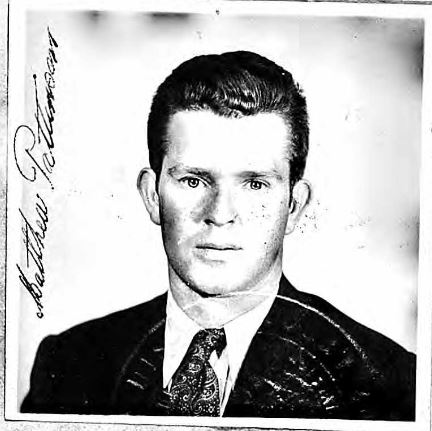
Of course, I had to run it through the new MyHeritage colorizing app, and it turned out really well!

He arrived at Ellis Island aboard the SS Laconia, pictured here:

He'd only been in the US for four years when he declared his intention to become a US citizen. He officially became a citizen of the US on 19 September 1938. I wonder if this event was more meaningful to him because of the family he then had - he'd married Kathryn Crellin in 1935, and by 1938 they had two boys, James and Joseph. I wonder if his wife and sons were there at the courthouse when he made his oath of allegiance. What a cool moment that would have been!
Like many others in Montana at the time, he found work in the mining industry, working for the Anaconda Copper Mining Company as a general miner. What really stood out to me, though, was the fact that he registered for the draft in October 1940, well over a year before the US entered WWII. I can imagine he followed the news of his native England's involvement in the growing war in Europe, but it impresses me that he would be willing, barely a decade after arriving here, to be called up to serve in the US military. I know we often speak of that generation as the "greatest generation," but seeing documents like this really bring it home just how great they were.
Looking into Matthew's past, I found he was one of at least six children of Isaac and Eleanor (Crellen) Pattinson, from Cumberland County, England. He had three older brothers, Joseph, John, and Tom, and two younger sisters, Sarah Ann and Eleanor. His father Isaac worked as a railway guard, which I thought was really cool as my family has a lot of history working in the railroad industry. Matthew's youngest sister, Eleanor, was only about 9 when Matthew left for the US. I went on my mission when my brother Jeff was 11, and in some ways, that's the image I still have of him, even though he's now a doctor, married, and raising two boys. I wonder if Matthew saw his parents or siblings after leaving England. I hope he at least had some correspondence with them.
 |
| Cumberlandshire, England. Courtesy of Wikipedia. |
I haven't found too much on Isaac's background yet. I know he was born in Cumberland, England, in 1871 to Matthew and Ann Pattinson, which shows Matthew was likely named after his paternal grandfather. He married Eleanor Crellen in Cumberland in 1897, and their oldest son Joseph was born two years later. Eleanor was the oldest child of Joseph and Ann Crellen, who were both born in Cumberland in the 1850s. Eleanor's youngest sister, Betsy, was only 9 years older than Eleanor's first child, so it's pretty fun to imagine them growing up knowing and playing with each other. Isaac was a widower by 1939, when he and his daughter were enumerated in the England register that year (kind of a census substitute taken as World War II ramped up). That would have been a scary time to live in England, even if you lived many miles away from London and the terror of the blitz. He lived through it though, and passed away in Cumberland in 1950.
Looking into the ancestry of my aunt's mother, Kathryn Rooney, I found she had English roots as well. Her parents James Rooney and Martha Barton, were both from Cumberland, England, and Kathryn's oldest brother William Rooney was born there as well. Interestingly, James immigrated to the US just a few weeks after William was born. I can't imagine leaving my wife and infant son like that, going so far away to establish a new home but not knowing when I'd see them again. He arrived in Boston, Massachusetts, in August 1906 aboard the SS Cymric, shown below.

I found James in the 1910 census in Montana, working as a copper miner. What's really cool is he actually lived with his brother Hughey, who was also a copper miner. If James was away from his wife and son, at least he had other family with him. Martha and William did eventually join him, arriving at Ellis Island in October 1910 aboard the SS Carmania, which you can see in the picture below.

James went through several occupational changes over the years. By 1920 he was a farmer, and worked on his own farm. Farming may not have been his thing, or perhaps it just didn't go well, because by 1930 he was back to copper mining, which he did through 1940. In 1942, he was a watchman for the Anaconda Copper Mining Company, but by 1948 he was again working as a miner. He died in 1949, though the cause of death was unclear - doctors felt it may have been tuberculosis, but it could also have been pulmonary fibrosis. Either way, even though he was 71 when he died, he apparently had been working right up until the end.
I don't have much info on James' parents yet, just that their names were Hugh Rooney and Anne McManus, and they were apparently from Ireland. It will be really interesting to see if I can find where exactly in Ireland they were from. Irish research has been really tough for me up until now, but these Irish ancestors are from the Republic of Ireland and lived several decades later than my almost impossible to find Gibsons and Stephensons in Northern Ireland. So hopefully I'll be able to find something.
Martha Barton, the wife of James Rooney, turned out to be the youngest of eight children of John Barton and Catherine Bouden, from Cumberland (lots of Cumberland ancestry!). John was a coal miner, and his sons worked in the mines too. In 1891, John and his sons Thomas (18), John (16), and William (14) all worked in coal mining, while the younger kids either went to school or stayed home. It blows my mind to think of a 14 year old boy working in a coal mine - my oldest is almost 14, and the thought of sending him down a mine shaft is beyond imagination. Things really were different then.
That's all I've got so far, but I think it's a good start! Lots of Cumberland ancestry with a dash of likely Irish. It'll be very interesting to see what other stories are waiting to be uncovered.
Sunday, September 8, 2019
Progress is progress right?
I haven’t had a lot of time lately to work on my own family history so I made a special effort to get some time in last night. I wanted to check at least one of my grandparents’ DNA tests and see if they had any new important matches (ideally one that would help me break through one of my brick walls). Since my paternal granoda’s Gibson and Cain lines remain my most stubborn brick walls, I checked his account at 23andMe.
His closest matches are descendants of his maternal uncle, Elmer Joseph. Then there are a few matches on his father's side, descendants of his aunt Annie Condon and uncle Thomas Gibson (one of which turned out to be an adoptee). Then there's a mix of maternal and paternal matches that are a little more distant - descendants of his maternal granduncle Gottlieb Joseph and paternal granduncle Anthony Cain. There's a whole group of descendants descended from his grandaunt Tina (Joseph) (Leistiko) Levick, seems that branch of my family got into DNA testing! There are a couple that I know which side of grandpa's ancestry they belong to, but I don't know exactly how yet (mostly because they haven't responded so I don't know anything about their ancestry).
As I worked through these matches, it struck me how much I've learned about my grandpa's ancestry since he did his first DNA test back in 2012. The fact that I can pinpoint where a lot of these matches fit in my grandpa's family tree is amazing to me. I didn't have as much luck with his matches at FamilyTreeDNA. Part of that is because his matches at FTDNA are much more distant, and their common ancestors are back further than I can go at this point. Because of that, I've spent most of my efforts on grandpa's matches at other websites, like 23andMe and Ancestry.
Ancestry has made some great improvements in their DNA offering, with the addition of color-coded groups and Thrulines to help see where you and your matches may be related (provided you have public and searchable trees attached and linked to your test). There are a lot of matches here related to Tina Levick, more than are at 23andMe, and quite a few Gibson and Cain matches too. I'm hopeful that I will eventually break through the brick wall on my Cain side and find where in Ireland Dennis Cain was from as told in Irish records. My biggest breakthrough so far thanks to Ancestry was help in identifying the maiden name of my grandpa's great-grandmother Pauline. We thought it was Rosen, based on the death certificate of grandpa's mother, Augusta (Joseph) (Staffen) Gibson, but it turned out to be Rosenke. That led me to find Pauline's parents in German records in Volhynia, which I still can't believe I found. I need to pursue that some more at some point. Along with about a billion other leads...
One exciting lead I followed just today was from a match at Ancestry, who turned out to be a Gibson match. She is a descendant of Sarah Gibson, a sister of my grandpa's grandfather John Gibson. Sarah Gibson married James Harris, a native of Nova Scotia who was 17 years older than she was, and they had six children that I know of. One of her grandchildren, George Aubrey Harris, left Canada in 1922 and sailed to Boston, where he married Gladys Moriarty and raised his family. As a fan of the classic Sherlock Holmes stories, I loved the fact that I now have Moriarty relatives. I even found an old postcard of the ship he sailed to Boston on, the SS Governor Dingley.

I wish I had more time to work on this, and I do get frustrated at these stubborn brick wall ancestors sometimes. But I'm grateful for all I've learned so far and I'm excited to see what else there is still to learn.
His closest matches are descendants of his maternal uncle, Elmer Joseph. Then there are a few matches on his father's side, descendants of his aunt Annie Condon and uncle Thomas Gibson (one of which turned out to be an adoptee). Then there's a mix of maternal and paternal matches that are a little more distant - descendants of his maternal granduncle Gottlieb Joseph and paternal granduncle Anthony Cain. There's a whole group of descendants descended from his grandaunt Tina (Joseph) (Leistiko) Levick, seems that branch of my family got into DNA testing! There are a couple that I know which side of grandpa's ancestry they belong to, but I don't know exactly how yet (mostly because they haven't responded so I don't know anything about their ancestry).
As I worked through these matches, it struck me how much I've learned about my grandpa's ancestry since he did his first DNA test back in 2012. The fact that I can pinpoint where a lot of these matches fit in my grandpa's family tree is amazing to me. I didn't have as much luck with his matches at FamilyTreeDNA. Part of that is because his matches at FTDNA are much more distant, and their common ancestors are back further than I can go at this point. Because of that, I've spent most of my efforts on grandpa's matches at other websites, like 23andMe and Ancestry.
Ancestry has made some great improvements in their DNA offering, with the addition of color-coded groups and Thrulines to help see where you and your matches may be related (provided you have public and searchable trees attached and linked to your test). There are a lot of matches here related to Tina Levick, more than are at 23andMe, and quite a few Gibson and Cain matches too. I'm hopeful that I will eventually break through the brick wall on my Cain side and find where in Ireland Dennis Cain was from as told in Irish records. My biggest breakthrough so far thanks to Ancestry was help in identifying the maiden name of my grandpa's great-grandmother Pauline. We thought it was Rosen, based on the death certificate of grandpa's mother, Augusta (Joseph) (Staffen) Gibson, but it turned out to be Rosenke. That led me to find Pauline's parents in German records in Volhynia, which I still can't believe I found. I need to pursue that some more at some point. Along with about a billion other leads...
One exciting lead I followed just today was from a match at Ancestry, who turned out to be a Gibson match. She is a descendant of Sarah Gibson, a sister of my grandpa's grandfather John Gibson. Sarah Gibson married James Harris, a native of Nova Scotia who was 17 years older than she was, and they had six children that I know of. One of her grandchildren, George Aubrey Harris, left Canada in 1922 and sailed to Boston, where he married Gladys Moriarty and raised his family. As a fan of the classic Sherlock Holmes stories, I loved the fact that I now have Moriarty relatives. I even found an old postcard of the ship he sailed to Boston on, the SS Governor Dingley.

I wish I had more time to work on this, and I do get frustrated at these stubborn brick wall ancestors sometimes. But I'm grateful for all I've learned so far and I'm excited to see what else there is still to learn.
Sunday, March 31, 2019
The short stories of two George Gibsons
Today I realized I haven't written a blog post since February, and it's the last day of March! This year is flying by much too quickly, so before the month expires, I wanted to share a story I've rediscovered this weekend - that of my second-great-granduncle, George Gibson

I only have a handful of records the record the major events of his life, but I'm grateful to even have this much information on him. As I wrote last year, for many years I had nothing but one record that showed they existed at all. George was born in New Brunswick, Canada, about 1862, and was the youngest known child of Henry and Ann (Stephenson) Gibson. He was quite young when his parents died, about 10 when Henry passed away and 15 when Ann died. He was found in the 1881 Canada census living with his older sister Sarah (Gibson) Harris and her family. Interestingly, Sarah named her oldest son George, perhaps after her younger brother.
By 1881, he had found work as a brick maker, the occupation he would stay with for the rest of his life. Ten years later, the 1891 census shows he was still single, living with the family of Hugh Hamilton, a carpenter. I don't know of any relationship to the Hamiltons, so he may have just been a boarder there. His religion at the time may have been Methodist (the handwriting is hard to read), which is interesting as he'd grown up in a family that belonged to the Church of Ireland.
Two households above George in that census was the family of Patrick McDonald. Patrick and his wife were Irish Catholics, and Patrick worked as a shoemaker. He and his wife had six children living with them, the oldest of which was their 25-year-old daughter Kate. Four years later, George and Kate were married in Fredericton, New Brunswick. George apparently made some life changes for Kate, as their marriage listed his religion as Catholic. The marriage record is actually what gave me the maiden name of George's mother, so I LOVE this record! Despite the fact that Kate was 28 years old at the time of her marriage to George, the marriage record notes that she had obtained the consent of her parents. Makes me wonder how much influence her parents had over the lives of their grown children.
The next census, the 1901 Canada census, showed George and Kate were doing pretty well. They had two children, a son named George and a daughter named Catherine, and had a 17-year-old live-in domestic named Margaret Buckley. George Jr. was 4 and Catherine was 1. George Sr. had steady work as a laborer at the brick works, working 12 months out of the year and bringing home $500 a year.
Everything changed the next year. On July 13th, 1902, George Sr. died of pneumonia. His death record doesn't say how long he had pneumonia before he died, no who his physician was, so it may have been too quick for a doctor to have been able to treat him. He was only 40 years old when he passed away - the same age I am now. I can't imagine the shock and pain and grief his wife went through, or how she had to explain to her little children, only 5 and 2, why their dad was gone. I have a 5-year-old now, so it really drives the situation home for me.
Kate seems to have carried on without George. She moved in with her aunt Mary (a widow like herself, though whether she was a widow at the time Kate and her kids moved in I don't know). Kate's brother, John McDonald, lived with them as well, but had no occupation listed in the 1911 census. Kate did not either, so Mary, who worked as a coat maker for a tailor shop, may have been the breadwinner for the whole family group. Still, George and Catherine were able to attend school that year, so the children were provided for at a level that allowed them to obtain an education.
Sadly, tragedy befell the family again. About 1916, George had a tubercular hip, which as I understand it was either tubercular arthritis in the hip. He suffered with this for two years, until it claimed his life on 16 February 1918. His occupation was listed on his death record as "school boy." He was only 21. I feel so badly for Kate, having to bury her husband, and then her son. Kate lived another 13 years after her son's passing. She died at the Fredericton Municipal Home on September 28th, 1931 of a cerebral hemorrhage. Her death record says she was 70, but based on census records, she may have been closer to 64. I don't know yet what became of Catherine (the informant for Kate's death certificate was the matron of the Municipal Home) but I hope she got to live a long and full life. Stories like that of my cousins George and George, and Kate and Catherine, really make me appreciate all that I have been blessed with - health, family, an occupation (two, actually) that I love, my church membership, and a life that has been blessed with relatively little loss. I know the pain of burying a child, but not parents or siblings or spouses. Really makes you grateful for the generations before us that endured so much so that we could have the life that we do.
I only have a handful of records the record the major events of his life, but I'm grateful to even have this much information on him. As I wrote last year, for many years I had nothing but one record that showed they existed at all. George was born in New Brunswick, Canada, about 1862, and was the youngest known child of Henry and Ann (Stephenson) Gibson. He was quite young when his parents died, about 10 when Henry passed away and 15 when Ann died. He was found in the 1881 Canada census living with his older sister Sarah (Gibson) Harris and her family. Interestingly, Sarah named her oldest son George, perhaps after her younger brother.
By 1881, he had found work as a brick maker, the occupation he would stay with for the rest of his life. Ten years later, the 1891 census shows he was still single, living with the family of Hugh Hamilton, a carpenter. I don't know of any relationship to the Hamiltons, so he may have just been a boarder there. His religion at the time may have been Methodist (the handwriting is hard to read), which is interesting as he'd grown up in a family that belonged to the Church of Ireland.
Two households above George in that census was the family of Patrick McDonald. Patrick and his wife were Irish Catholics, and Patrick worked as a shoemaker. He and his wife had six children living with them, the oldest of which was their 25-year-old daughter Kate. Four years later, George and Kate were married in Fredericton, New Brunswick. George apparently made some life changes for Kate, as their marriage listed his religion as Catholic. The marriage record is actually what gave me the maiden name of George's mother, so I LOVE this record! Despite the fact that Kate was 28 years old at the time of her marriage to George, the marriage record notes that she had obtained the consent of her parents. Makes me wonder how much influence her parents had over the lives of their grown children.
The next census, the 1901 Canada census, showed George and Kate were doing pretty well. They had two children, a son named George and a daughter named Catherine, and had a 17-year-old live-in domestic named Margaret Buckley. George Jr. was 4 and Catherine was 1. George Sr. had steady work as a laborer at the brick works, working 12 months out of the year and bringing home $500 a year.
Everything changed the next year. On July 13th, 1902, George Sr. died of pneumonia. His death record doesn't say how long he had pneumonia before he died, no who his physician was, so it may have been too quick for a doctor to have been able to treat him. He was only 40 years old when he passed away - the same age I am now. I can't imagine the shock and pain and grief his wife went through, or how she had to explain to her little children, only 5 and 2, why their dad was gone. I have a 5-year-old now, so it really drives the situation home for me.
Kate seems to have carried on without George. She moved in with her aunt Mary (a widow like herself, though whether she was a widow at the time Kate and her kids moved in I don't know). Kate's brother, John McDonald, lived with them as well, but had no occupation listed in the 1911 census. Kate did not either, so Mary, who worked as a coat maker for a tailor shop, may have been the breadwinner for the whole family group. Still, George and Catherine were able to attend school that year, so the children were provided for at a level that allowed them to obtain an education.
Sadly, tragedy befell the family again. About 1916, George had a tubercular hip, which as I understand it was either tubercular arthritis in the hip. He suffered with this for two years, until it claimed his life on 16 February 1918. His occupation was listed on his death record as "school boy." He was only 21. I feel so badly for Kate, having to bury her husband, and then her son. Kate lived another 13 years after her son's passing. She died at the Fredericton Municipal Home on September 28th, 1931 of a cerebral hemorrhage. Her death record says she was 70, but based on census records, she may have been closer to 64. I don't know yet what became of Catherine (the informant for Kate's death certificate was the matron of the Municipal Home) but I hope she got to live a long and full life. Stories like that of my cousins George and George, and Kate and Catherine, really make me appreciate all that I have been blessed with - health, family, an occupation (two, actually) that I love, my church membership, and a life that has been blessed with relatively little loss. I know the pain of burying a child, but not parents or siblings or spouses. Really makes you grateful for the generations before us that endured so much so that we could have the life that we do.
Subscribe to:
Posts (Atom)