Showing posts with label Sitzman. Show all posts

Monday, January 25, 2021

This is why you don't tease dogs

I've been doing professional research for a few years now, and it has been an amazing and fulfilling career so far. I love being able to help people find answers to their family history questions and mysteries, and in turn I've been able to make some great discoveries in my own family. One downside, however, is I sometimes end up treating those rare moments when I get to do my own family research a bit like a they're a research project - pick something to search for, frantically search for everything I can find as fast as I can find it, quickly document it, and move on. I don't often give my findings time to sink in and affect me. 

 I've been taking advice from a genealogist I follow named Heather Murphy, and slowing down a bit on my research. Starting with the intention of going slow is a few feeling, and I really like it. So today I set out to find some stories about my second-great-grandmother Maria Zitzmann aka Mary Hoffman. I'm super lucky to have a boatload of pictures of her and her family, but I still don't have too many stories about her and her life. I was hoping to find something about her marriage in 1919 to Christ Hoffman, but my searches at first turned up empty. Then a new idea hit me - find her address, and search for that. I went looking in city directories before her marriage, and found her in 1917, living at 1315 Cobban Street in Butte. Interestingly, the directory lists her as the widow of a man named Smith. That's really curious, as her daughters would later both state in their Social Security applications that their father was a man named Chris Schmidt, though DNA evidence points to them being half-sisters.


Now that I had her address, I searched through newspapers to see if anything came up, and I found a few really cool things! 

First I found a photo of my grandma Blossom's cousin Ellen Weyhe (listed as Ellen Whyte) taken when she was about a year old. It's a studio photo, with the name Dore Studio in the bottom right corner, with Ellen all dressed up in a cute little dress complete with baby shoes. 


Then I found two articles about something I'd never heard of, and my dad hadn't either when I asked him. Apparently soon after their marriage, Mary and Christ Hoffman owned a rather large dog and kept it in their yard. The first article said the dog had severely bitten the right hand of "the little Lohman boy," the son of Ed Lohman. A search of the 1920 census showed me this was Raymond Carrigg, the 13-year-old stepson of Edward Lohman, who also lived in Butte. The article went on to say the Assistant City Attorney filed a complaint against Mary and Christ's dog, saying he had appeared "to prove himself vicious" and notified them to not send the dog out of the city, as that might give "him an opportunity to bite some one else." The tenor of the article made it sound like the Hoffmans' dog was running loose in the city and just attacked the kid. The next few paragraphs talked about the dangers of the local dog population, and even suggested a law be made restricting the number of dogs citizens could own, based on their type of residence and the purpose of the dogs' being there. 


The next day, another article continued the story, but with significant changes to the story, starting with the headline - "Dog Is Acquitted Of Being Vicious Brute." Several of the Hoffmans' neighbors testified in court that the dog was kept in an enclosed yard. What's more, the pickets of their fence were too close together for the dog to be able to stick its head out between them, so that the only way for anyone's hand to be exposed to the dog would be to put their hand over the fence. Not only that, a number of boys (apparently including Raymond Carrigg) had actually attacked the dog by throwing sticks and stones at it. Mary Hoffman had been out at the time of the attack, and returned home to find her yard "littered with sticks, stones and other rubbish and that the coal scuttle was smashed, evidently by the boys who were pelting the dog." Needless to say, the case was then dismissed. 


I could almost see in my mind a group of youths having fun at the dog's expense, and then Raymond, goading him on by sticking his hand above the fence and thinking himself out of reach, gets bitten by the dog they'd been antagonizing. I kind of feel bad, but I feel he brought it on himself. It sounds like the dog was not injured in the attack, but I hope the Hoffmans at least got their coal scuttle replaced. I feel bad for the Hoffmans in finding their dog had been so cruelly treated, and grateful to the neighbors for sticking up for an innocent animal. 

PS - I looked up Raymond Carrigg's draft registration from 1942, which would mention any defining physical characteristics like scars, missing fingers, etc. Nothing was mentioned, so apparently he healed just fine from the dog bite. 

Monday, January 6, 2020

The lost history of Rosie Sitzman

Several years ago, DNA testing and a mailing list helped me bust through one of my most solid and unyielding brick walls - identifying the ancestry of my great-grandmother, Rose (Sitzman) (Wagner) Morris. It was an amazing breakthrough, and being able to finally identify her mother's place of birth and hundreds of years of her ancestors was and is one of best moments (or series of moments I guess) in my genealogical career. Best of all, I was able to share that info with my grandma Blossom, Rosie's daughter, just a few months before she unexpectedly passed away. Even with those discoveries, something always bugged me - who was Rosie's father? And could I find a birth record for her that might give me some clues?

According to my grandma Blossom, when Mary Sitzman came over from Europe, she told her girls they were making a clean break from Europe - no speaking German, no talking about where they were from, nothing. Rosie would have been a toddler or maybe a kindergartner at the time she entered the US, so I'm not sure what she could have revealed anyways. But she never said anything to my grandma about her origins, so grandma had no info to pass on. Since it seems Mary wanted a clean break from Europe, it makes sense that she might have changed some info for her daughters' births, either with or without their knowledge. And it seems she might have actually done so.

Rosie's Social Security Application

Rosie's Social Security application, filled out by Rosie herself, gave her date of birth as 20 August 1903 in Germany, and named her parents as Mary Sitzman and Chris Schmidt. Her sister Mary's card (dated the same day as Rosie's, it turns out) names the same parents. Obviously Rosie and Mary wouldn't have come up with this information themselves, so they probably got it from their mother. Their mother Mary's death certificate (with info provided by her granddaughter Ellen Richter) says she was born in Germany, which she may have told her family, or they may have inferred it from the fact she spoke German. Once I learned Mary (the mother) was not from Germany, but from a little town in what was then the Austrian Empire, and now sits in the Czech Republic, I thought maybe Rosie and her sister Mary had also been born there too. The birth records for that area were not publicly available for the years I needed, so I searched for an alternate way of searching them. The chance came up when a coworker of mine mentioned an onsite researcher he used for researching German ancestry in the western Czech Republic. I hired that researcher to look for the birth records of Rosie and her sister, and waited.

And waited.

And waited.

It turns out, onsite research in this area is SLOW. The government moves very slowly, the mail moves very slowly, and the process of obtaining records is measured in months, not weeks or business days. But eventually, I received a transcription and then an electronic copy of both birth records. And the information was worth the wait.

Rosie's birth reocrd

Rosie's birth name was Rosina Zitzmann, probably named after Mary Sitzman's sister Rosina (who was actually Rosie's godmother). She was born on 27 July 1902, more than a year earlier than Rosie's stated birthdate. She was born in Zirk, a tiny little village in Bohemia near the Austrian Empire's western border with Germany. Her birth record names her mother, Maria Zitzmann (her mother's original name), and her mother's parents, Johann Zitzmann and Theresia Dorfler, but unfortunately says nothing about the identity of her birth father.

Mary Sitzman's birth record

Mary's birth record was likewise illuminating. She was born on June 23 1899, over a year earlier than the 17 July 1900 date she put on her Social Security application. Like Rosie's birth record, Mary's birth record names her mother and maternal grandparents, but says nothing about who her father was. However, there was one tantalizing clue - her godmother. Mary's godmother was Maria Schmidt, daughter of Mattheus Schimdt from Brandhauser in Bavaria, Germany. Brandhauser was only 12-15 miles away from Zirk, just over the border into Germany. As Mary's reported father was Chris Schmidt, I am very interested to see if Mattheus had a son named Chris or something similar. There are no records for Brandhauser available online, so I'll probably have to rehire that onsite researcher to see what he could dig up on the Schmidts of Brandhauser. Identifying Mary's birth father won't directly help me identify Rosie's father, as DNA testing has revealed they had different fathers, but it would be great to solve at least one half of this outstanding family history mystery.

So it feels like I am getting closer and closer to unraveling my great-grandmother's story, perhaps even parts she may not have known completely. Thanks to my dad and his siblings all testing at Ancestry, I've some preliminary leads on genetic connections that may link to Rosie's father, which is fantastic because it looks like that's how this mystery is going to have to be solved. If the identity of her sister's father is any indication, I may have to cast the net a little wider than I originally imagined. But if I can identify Mary's father, it may give me some idea of who and where to look for Rosie's when I get to that point. It's been a bit of a challenge to get this far, but I am super happy with the progress I've made so far, and I am totally up for the challenge of figuring this guy out.

Wednesday, May 29, 2019

This just got more complicated

A few years ago, I found my great-grandmother Rosie Sitzman, her mom Mary, and her older sister Mary, attempted to enter the US. After a few days, they were deported due to Mary being a single mother with two little children and no likely means of support. That got me thinking - who was Rosie and Mary's father? Why wasn't he on the boat with them? Why did the girls have their mother's surname? I had no answer for these questions, so I went digging.

I ordered the Social Security applications for both Rosie and Mary, and both of them said their father's name was Chris Schmidt. There were definitely a lot of Germans in Rozvadov where they came from, and likely a lot of Schmidts. If that was their father's name, finding him would be like trying to find a John Smith in London. Not a pleasant thought for sure.

As I got more involved in DNA, and learned more about other lines of my family history, I started wondering in the back of my mind if Rosie and Mary did in fact have the same father. I have learned from experience both in my own family and through my work that it is not unusual for children in these situations to have different fathers. I realized that the only way to determine this would be to find a descendant of Mary and have them take a DNA test. Fortunately, in going through the Wagner family pictures with my Grandma Blossom a few years ago, I got to see loads of pictures of Mary, her daughter Ellen, and Ellen's children, so I knew who I needed to test.

I checked with a couple relatives, and got a phone number for one of Ellen's daughters. After a little phone tag, we talked for a while (super nice lady!!) and she agreed to do the test. Fast forward a few months, and the results came in. By this time, I had results for my dad, his brother, and two sisters, so I had a pretty good set of people to check this cousin against. I set the scenario up on DNAPainter.com, and ran it through their What Are The Odds? tool, once with Rosie and Mary being full sisters, and once with them being half-sisters. The full sisters scenario came out with a probability of zero - my dad and his sibs did not share enough DNA with their second cousin for Rosie and Mary to be full sisters. I ran it again, with Rosie and Mary being half-sisters, and the probability was one, meaning the relationships are possible. So that seems to pretty well confirm it - Rosie and Mary had different fathers.

This complicates things a bit. One of the reasons I had for getting my dad and his sibs tested was to try to identify Rosie and Mary's father. I had hoped that by testing one of Mary's descendants, she'd be kind of a triangulation point for Bohemian matches to help in this process. I can still do that, but only for relatives connected to Rosie and Mary's mother Mary. I think my plan now is to test the children of Blossom's brother, Howie Wagner. That will give me Wagner/Shute/Groff etc DNA, which I already have a ton of matches to. But those relatives are also the only other repository of Rosie's DNA out there, and hence the only other people who I know have the DNA of Rosie's father. Just one of them would give me about another 7% of mystery dad's DNA (I have about 23% of his DNA covered by testing 4 of my dad's generation, and adding one of Uncle Howie's kids into the mix would boost my coverage of Rosie's DNA, and hence my coverage of her dad's DNA). I've already got one of those kids, Chuck, tested. He passed away a couple years ago, so he's not available to test at Ancestry. Hopefully one or more of his siblings will be cooperative and help me in this research.

So yeah, like I said, it's more complicated now, but still doable. Wish me luck!

Wednesday, May 16, 2018

Mothers in my family tree - Grandma Rosie

 With last Sunday being Mother's Day here in the US, I wanted to post a little tribute to the mothers in my family tree. I come from many remarkable and amazing women. I wish I had the time to pay adequate tribute to them all, but for now, I'll start with one - my great-grandmother, Rosie (Sitzman) (Wagner) Morris. She was an immigrant from what is now the Czech Republic, where her mother's family had lived for centuries. I still don't know for sure who her father was, as birth records aren't publicly available yet for the year she was born. She grew up in Montana, where she attended Catholic school as a little girl. She married my great-grandfather, Charles Wagner, and moved to Washington state, where they raised their family. After Charles' death, she later remarried to Clarence "Unc" Morris, and moved back to Montana, where she passed away in 1983.

The following two pictures best sum up my impression of her, based on the research I've done, the pictures I've reviewed, and the stories I've heard from family (she passed away when I was a little kid, so I only have one clear memory of her). The first picture is of Rosie and her family visiting the grave of her son, Charles. He died when he was 10 of tuberculosis. Having buried a child myself, I can imagine somewhat the pain and sadness she felt. Her expression, and that of her husband, to me epitomize the grief you feel when you bury a child. There just aren't words for it.


But I equally love this picture (which I think I've shared before on this blog). It was taken many years later, and shows that while she did experience great sorrow and grief at times, she also didn't let those emotions rule her life. She continued to look for joy and happiness. The sheer number of pictures she took (numbering in the thousands!) of her children, and especially her grandchildren, shows me that she found that joy in her family. 


Her daughter, my grandma Blossom, was the same way - family was everything. That love of family carried down to my dad, who has a closeness with his siblings and cousins that I envy. My dad and mom both did their best to instill that love of family in me and my siblings, and I hope I'm doing my best to pass it to my kids as well. Like Gordon B. Hinckley once said, don't let yourself be the weak link in the chain of the generations. Grandma Rosie was, and in many ways still is, a powerful influence in my family. I hope that I can continue to weld links in our family chain with the same strength and love she did.

Update: I tried colorizing the pictures, and the effect is amazing. The picture of Charles's grave is really different when you realize it was a beautiful sunny day. The black and white version captures the feeling better, but the colorized kind of helps me put that emotion in a larger context. The colorized version of the sledding picture almost looks like a still shot from a home movie. I love technology!


Wednesday, January 20, 2016

My favorite family history documents

I recently saw a Tweet from FamilySearch asking people what their favorite family history document was. That was a really interesting question to think about, and the more I thought about it, the more favorites I came up with. It was impossible to narrow down to just one document, so here are my top five favorites, in no particular order.


1. The marriage certificate for Christ Hoffman and Mary Sitzman (Maria Zitzmann)
When I got started in family history, I was dismayed to find out my great-great-grandmother Mary Sitzman had left this world with sealed lips as to where she and her family came from. Her daughter Rosie said nothing, and her granddaughter, my grandma Blossom, knew nothing. Years of searching based on the few clues I did have yielded nothing. This marriage record proved the key to blowing that brick wall to smithereens. Mary gave her birth town as Rosshaupt, a tiny village in western Bohemia (now called Rozvadov and part of the Czech Republic), and that one clue led to many, many, many discoveries. I've now got information on Mary's ancestors going back to 1700s and even 1600s on some lines. All from one little marriage record! It taught me that seemingly insurmountable brick walls can be overcome, even with one simple document.


2. 1910 US-Canadian border crossing of Samuel and Helena Joseph
For years, all we knew about my great-grandmother Augusta (Joseph) Gibson's family was that they came from "Germany". They were Germans, spoke German, and came to Canada before moving to Montana. Records pointed to Berlin and "Toran", Germany, but those leads proved to be dead ends. Then a few years ago, at a Family History Fair up in Bellevue, I was going over my recent discovery of this border crossing Augusta's father Samuel Joseph and sister Helena made in 1910 (Sam and Helena are listed on lines 17-18). It lists a lot of great information - relatives in the country they are leaving, name of person and address they are going to, when they first came to Canada, name of the ship, and (best of all) birthplace. Sam's birthplace was listed as "Gitomar, Russia", and Helena's as "Ulanowka, Russia". I went to the display table for the SGGEE and asked their representative to help me figure out what these places were. She figured out Gitomar was actually Zhitomir, a pretty big city in the Volhynia region of what's now Ukraine. Ulanowka is a smaller village a few miles west of Zhitomir. Boy was I excited! That piece of info led me to other discoveries, allowing me to trace Sam's family back to his grandparents in Poland. This was the first time I'd ever traced a line of my family back to their point of origin in the old world, and it felt great! This was my first real breakthrough, and I still feel the deepest genealogical connection to my Joseph ancestors, largely in part to this discovery.

 
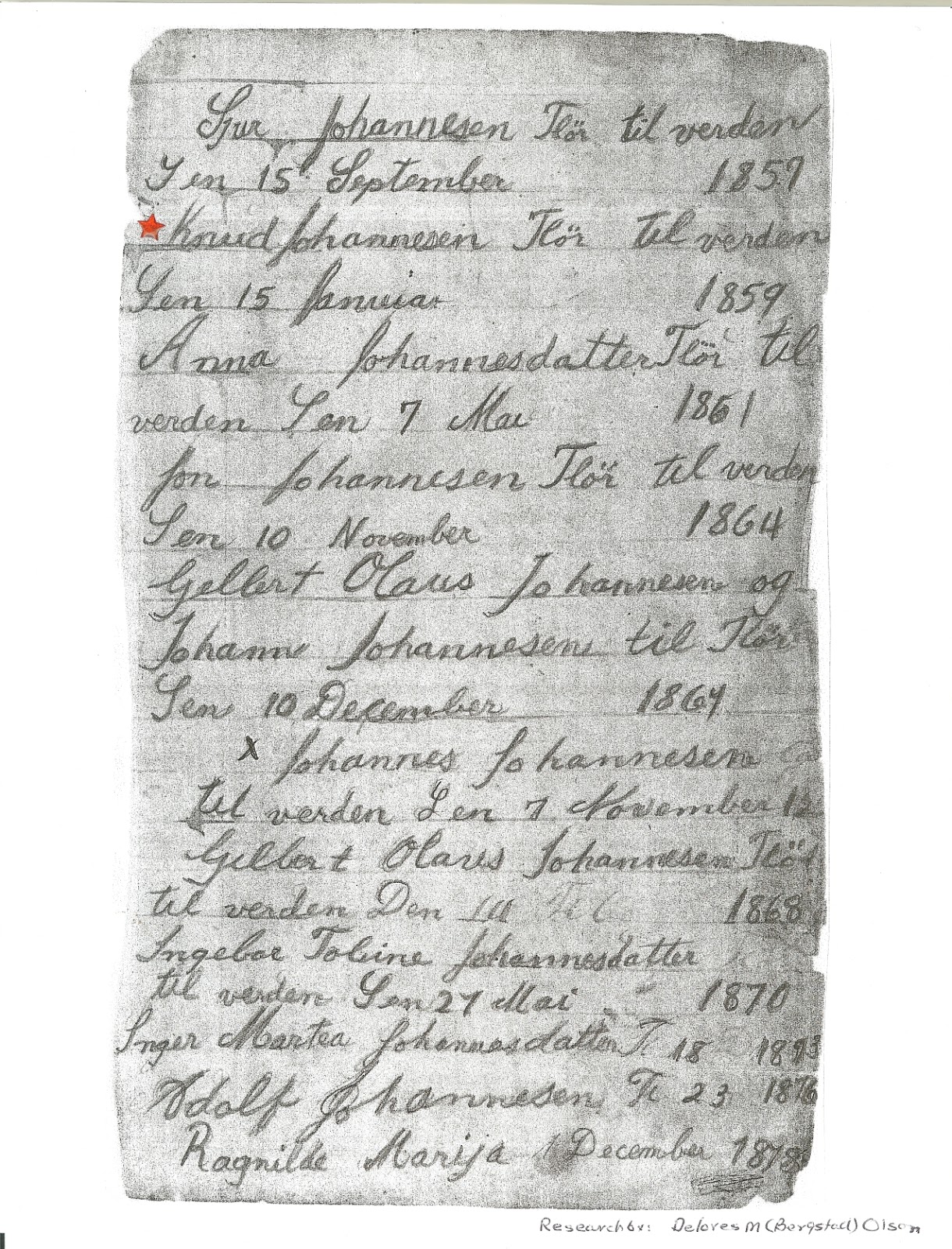
3. Bergstad family Bible page
Several years ago, I got a phone call from someone who said they were related to me. They'd gotten my cell number from an old genealogy website I'd put up, and wanted to send me some info on my/our Bergstad ancestors. I was really excited, but didn't want to get my hopes up too much, because she wouldn't say exactly what she was sending. The package arrived, and the contents knocked my socks off! Picture after picture after picture of my ancestors and their families, with people identified clearly; typewritten histories of various people; and this - a scan of a page from the Bergstad family Bible! This was the first time I'd ever heard of there being a family Bible on any of my ancestral lines. This page covers one generation, and I don't know whose handwriting it is, but it's all in Norwegian, and doesn't even mention the Bergstad name (which first appears as their surname in 1880). It was fascinating to see them listed in the old Norwegian patronymic style. It just drove it home in my mind that these were new Americans, still living their old culture in their new home.

 
 4. Harris family photos
When I was 19, I was serving a mission for my church in Japan, when I got a letter from my Grandma Sally Crawford. In it, she sent me a pedigree chart she put together of her ancestors, the first of any genealogy-related document I'd ever seen for my family. Attached to the unfamiliar names were actual photos, including the two above (Thomas W. Harris on the left, Frank and Charlotte (Scribner) Harris on the right). I'd never heard of these people or seen these pictures, and I had a sudden, intense desire to know more about them. I had to wait a couple years until my mission was finished, but when I got home, I delved right into researching my family tree, even making a presentation on the subject in college just a couple months later. It was fascinating stuff, and I'm even more captivated by it 17 years later.


5. John Gibson family - 1881 New Brunswick census
If I absolutely had to pick one favorite document, this would be it. This was my very first discovery in family history research. My mom told me my paternal great-great-grandparents, John and Catherine (Cain) Gibson came from Saint John, New Brunswick, Canada, and that my great-grandfather John Frederick Gibson was born there about 1884. I somehow found there were records for the area for the 1881 census. I pulled out the microfilm for Saint John, sat down at a microfilm reader and started cranking. Within just a few minutes, I found them! I thought to myself "this genealogy stuff is easy!" If I only knew... I am glad that first discovery came so readily, because it encouraged me to start really researching my family history.

So there you have it, my top five favorite family history documents. Let me know what your favorites are and why.

Sunday, February 22, 2015

My grandparents' DNA trails, Part III - "Wagner" mtDNA

The next DNA trail I'm tracing is the path of my paternal grandmother, Blossom (Wagner) Gibson's mtDNA. I've traced this DNA back to Anna Kreutzer, my 6th-great-grandmother, who married my 6th-great-grandfather Georg Adam Salfer in Rosshaupt in the Bohemia region of the Austrian Empire in 1756. My grandma inherited it from her mother, Rosie Sitzman [Zitzmann], who married Charles Frederick Wagner.


Blossom had three daughters, one from her first marriage and two from her second. I know mtDNA is also passed on to male children, but as they can't pass it on to their kids, they are left out of this analysis. Her first daughter had three kids, one girl and two boys. The daughter, my cousin, had two children but both are boys, so they can't pass on the mtDNA. As it looks like they aren't having any more kids, the mtDNA on that branch ends with my cousin.


Blossom's second daughter had two kids, both daughters. The older daughter has three kids, one daughter and two boys. The younger daughter has one child, a daughter. So both of my cousins on that branch each have a daughter that can pass the mtDNA from my grandma on down to another generation.


Blossom's youngest daughter had three kids, one girl and two boys (noticing a pattern here?). The daughter, my cousin, has two kids, a boy and a girl, with a third on the way (so far gender is unknown). But my cousin's daughter gives us another candidate for passing on grandma's mtDNA to a new generation.


So between my two aunts that have girl grandchildren, there are three girls of the latest generation that could pass on grandma's mtDNA. Given that there are currently 18 kids of that generation, I'd say that having a full 1/6 of them be girls in the direct maternal line is pretty good. Hopefully they'll be able to keep Anna Kreutzer's DNA going to a new generation of descendants.

Wednesday, March 19, 2014

Wordless Wednesday - Obsolete German villages in Bohemia


I recently learned of something terrible that happened in Bohemia, the homeland of my great-grandmother Rosie (Sitzman/Zitzmann) Wagner. After World War II had ended, the Sudeten Germans, the German-speaking inhabitants of the Bohemian part of Czechoslovakia (now the Czech Republic), were brutally attacked, killed, and driven from their homes. According to one source, 3.2 million people were forcibly relocated to Germany, with no say in the matter, and only with those possessions they could carry with them. I've spoken recently to a survivor of this tragedy, who provided me with the above map. Each red dot represents one settlement where German-speaking residents, some of whose family had lived in the area for centuries, were beaten, killed, or forcibly driven from their homes and country. Most of these settlements were left uninhabited, and are now gone.

This really struck home, as my great-grandmother and her family lived on the western border of Bohemia, in the Tachau region, which is on the far western edge of the region. Her family had lived in the villages of Rosshaupt, Neuhasl, Ströbl, Zirk, and others since at least the late 1700s. To think that her relatives were treated in such a brutal way is unthinkable, yet it happened. Maybe that was one reason she forbade her daughters to speak of where they were from.

To learn more about these events, and to read English translations of first-hand accounts, please visit http://www.wintersonnenwende.com/scriptorium/english/archives/whitebook/desg00.html.