Showing posts with label Bohemia. Show all posts

Monday, January 6, 2020

The lost history of Rosie Sitzman

Several years ago, DNA testing and a mailing list helped me bust through one of my most solid and unyielding brick walls - identifying the ancestry of my great-grandmother, Rose (Sitzman) (Wagner) Morris. It was an amazing breakthrough, and being able to finally identify her mother's place of birth and hundreds of years of her ancestors was and is one of best moments (or series of moments I guess) in my genealogical career. Best of all, I was able to share that info with my grandma Blossom, Rosie's daughter, just a few months before she unexpectedly passed away. Even with those discoveries, something always bugged me - who was Rosie's father? And could I find a birth record for her that might give me some clues?

According to my grandma Blossom, when Mary Sitzman came over from Europe, she told her girls they were making a clean break from Europe - no speaking German, no talking about where they were from, nothing. Rosie would have been a toddler or maybe a kindergartner at the time she entered the US, so I'm not sure what she could have revealed anyways. But she never said anything to my grandma about her origins, so grandma had no info to pass on. Since it seems Mary wanted a clean break from Europe, it makes sense that she might have changed some info for her daughters' births, either with or without their knowledge. And it seems she might have actually done so.

Rosie's Social Security Application

Rosie's Social Security application, filled out by Rosie herself, gave her date of birth as 20 August 1903 in Germany, and named her parents as Mary Sitzman and Chris Schmidt. Her sister Mary's card (dated the same day as Rosie's, it turns out) names the same parents. Obviously Rosie and Mary wouldn't have come up with this information themselves, so they probably got it from their mother. Their mother Mary's death certificate (with info provided by her granddaughter Ellen Richter) says she was born in Germany, which she may have told her family, or they may have inferred it from the fact she spoke German. Once I learned Mary (the mother) was not from Germany, but from a little town in what was then the Austrian Empire, and now sits in the Czech Republic, I thought maybe Rosie and her sister Mary had also been born there too. The birth records for that area were not publicly available for the years I needed, so I searched for an alternate way of searching them. The chance came up when a coworker of mine mentioned an onsite researcher he used for researching German ancestry in the western Czech Republic. I hired that researcher to look for the birth records of Rosie and her sister, and waited.

And waited.

And waited.

It turns out, onsite research in this area is SLOW. The government moves very slowly, the mail moves very slowly, and the process of obtaining records is measured in months, not weeks or business days. But eventually, I received a transcription and then an electronic copy of both birth records. And the information was worth the wait.

Rosie's birth reocrd

Rosie's birth name was Rosina Zitzmann, probably named after Mary Sitzman's sister Rosina (who was actually Rosie's godmother). She was born on 27 July 1902, more than a year earlier than Rosie's stated birthdate. She was born in Zirk, a tiny little village in Bohemia near the Austrian Empire's western border with Germany. Her birth record names her mother, Maria Zitzmann (her mother's original name), and her mother's parents, Johann Zitzmann and Theresia Dorfler, but unfortunately says nothing about the identity of her birth father.

Mary Sitzman's birth record

Mary's birth record was likewise illuminating. She was born on June 23 1899, over a year earlier than the 17 July 1900 date she put on her Social Security application. Like Rosie's birth record, Mary's birth record names her mother and maternal grandparents, but says nothing about who her father was. However, there was one tantalizing clue - her godmother. Mary's godmother was Maria Schmidt, daughter of Mattheus Schimdt from Brandhauser in Bavaria, Germany. Brandhauser was only 12-15 miles away from Zirk, just over the border into Germany. As Mary's reported father was Chris Schmidt, I am very interested to see if Mattheus had a son named Chris or something similar. There are no records for Brandhauser available online, so I'll probably have to rehire that onsite researcher to see what he could dig up on the Schmidts of Brandhauser. Identifying Mary's birth father won't directly help me identify Rosie's father, as DNA testing has revealed they had different fathers, but it would be great to solve at least one half of this outstanding family history mystery.

So it feels like I am getting closer and closer to unraveling my great-grandmother's story, perhaps even parts she may not have known completely. Thanks to my dad and his siblings all testing at Ancestry, I've some preliminary leads on genetic connections that may link to Rosie's father, which is fantastic because it looks like that's how this mystery is going to have to be solved. If the identity of her sister's father is any indication, I may have to cast the net a little wider than I originally imagined. But if I can identify Mary's father, it may give me some idea of who and where to look for Rosie's when I get to that point. It's been a bit of a challenge to get this far, but I am super happy with the progress I've made so far, and I am totally up for the challenge of figuring this guy out.

Sunday, August 11, 2019

And I thought it was complicated before...

I wrote not long ago about discovering that my great-grandmother Rosie Sitzman and her sister Mary Sitzman had different fathers. I had a little time this week, and started going through the DNA tests for my dad and his siblings and looking for matches that had ancestry from Bohemia or Czechoslovakia, that didn't have their second cousin in the shared match list. That way, the odds were more likely that they were related through Rosie's mystery father. I was able to find at least five or six leads, so I sent off emails to them, hoping at least someone would write back.

This weekend, I got an email back! One of the matches identified a few other matches as her first cousin and father, which gave me a little family group to work from. That was really helpful, because her cousin had a family tree that gave me enough data to identify some of their ancestors in census records in Wisconsin. With that info, I traced them back to their immigrant ancestor - John Miller, born 3 March 1883 in Kathrina, Bohemia/Czechoslovakia.

I found John's birthdate and birth place in his WWI and WWII draft registrations, where the info came directly from him, which made the info more reliable. Knowing that, I went looking in the Bohemian archives at the Porta fontium website (www.portafontium.eu) and found the most likely candidate for the village of Kathrina - Sankt Katharina, a little village that's actually part of my great-great-grandmother's hometown of Rosshaupt! The right family in the right place at the right time! I couldn't believe my luck.

I went looking through the birth records for Sankt Katharina and Rosshaupt, and with some help from the German-Bohemian mailing list I'm on, I soon had most of three generations of John Miller's ancestry identified, and even a few ancestors from the fourth generation. His family name was, as I suspected, originally Müller (I wish I could take a German class so I could pronounce these names correctly). He also has the surnames Dobner, Radl, and Heger in his tree, none of which appear in my Zitzmann line. So this is all really good news, it's additional evidence that I really am on the track of my elusive great-great-grandfather. But as I began researching this family, I ran into some roadblocks.

For starters, John's mother Anna Radl was born to a single mother. Anna's birth record lists her mother (also named Anna Radl) and maternal grandparents, but the father's section is totally blank. That leaves a big chuck of John's family tree empty. Then, to complicate things even further, John's paternal grandfather, Michael Müller, was also born to a single mother (also named Anna, as it turned out). Thus John's pedigree has two big holes in it that local records probably won't help with (if the parents later married, they would sometimes add the father's info in later, but they didn't here).

It's still early into my research on this family, so I'm not giving up by any means. Many years ago, when I first learned my great-grandma was born to a single mom, I thought "well, that's one blank I'll never be able to fill," but that was before the advent of DNA and genetic genealogy. Now, I've got at least a partial family tree for someone that I am reasonably sure is related to me through that mystery great-great-grandfather. I have names, exact dates, and specific places for vital events of his relatives! That is huge!!  It looks like he, or at least his extended family, was from the same area that Rosie and her mom and sister were from, which makes sense. It's also a bit comforting to know that too, that my ancestor wasn't some vagabond who vanished into the ether. Even though his name isn't on the records, his DNA is, which links him to his family. I really hope someday I'll be able to find his name, as he's the only second-great-grandparent I haven't identified in my tree. And I don't like having white space in my family tree. :)

One other thing this research has taught me - there's a reason we keep saying test all the relatives you can afford. If I had tested just myself, I wouldn't have had enough DNA to match some of these matches. I tested my dad and three of his siblings, all of whom show these matches as related, but they all share different amounts of DNA with them - my uncle shares the most (over 200 cM with with father of that family group I mentioned earlier), one aunt shares less than half of that (barely 90 cM) and my dad and another aunt are about halfway between the two. Thus I now know to use my uncles test when dealing with these matches, as he shares the most DNA from that line, and is most likely to be the test that picks up matches the best. It's like having four fishing poles in the same pond with different bait - you don't know which will work best or what you'll catch, but the more lines you have out there, the better the odds that something will bite. (and yes, for any of you that really understand fishing, I clearly don't. But it's the best I could come up with late on a Sunday night.)

Saturday, June 1, 2019

Sitting on a goldmine

A few years ago, my grandma Blossom's DNA test at 23andMe led to one of the hugest genealogical discoveries since I started my research back in 2000. Her grandmother, Maria (Zitzmann) Hoffman, had said nothing about her background, where they were from, or who her ancestors were. Grandma's test helped me find a match who lives in Germany, who was intimately familiar with our common ancestors in Bohemia, and helped me find literally hundreds of years of my family history in that area. Being able to share that with my grandma before she passed away still stands as one of the genealogical accomplishments I am most satisfied with and happy about.

One of the challenges with all those records, though, is getting all the info out of all of them. I have somewhere between 50 and 60 individual records - baptisms, marriages, burials - that tell me about these ancestors, all written in German. I don't speak or read German much at all, though I have come to learn a few words, like baptism, day laborer, born, died, etc. so I can get the gist of who the record is about. But anything beyond that is beyond my level to get into, without a lot of time spent to read the handwriting (I did take a German genealogy course or two through BYU, but a few months' exposure isn't enough to make me proficient at the level I need to be to read these records). So, for the most part, they've been sitting in my hard drive, untranslated, waiting for the day when I have the time or funds to get them translated.

I decided to reach out to a genealogist I'm acquainted with, and asked her to translate one of the records for me - the marriage record of Lenhard Zitzmann and Maria Elizabeth Hüttl in 1810. This one is important to me, as it's the earliest record of the earliest Zitzmann ancestor that I know of. Lenhard was likely born sometime around 1785, and Maria was born in 1788. I really want to know the origins of the Zitzmann surname in my family, where it originally came from, so if any record could help me go back further than 1810, this one could. What she found startled me.

Marriage record of Lenhard Zitzmann and Maria Elizabeth Hüttl.
She said that Lenhard's info (the section on the left in the image above) said his mother's name was Katharina Weiman, the daughter of a herder, who lived in Hagendorf in the Palatinate. I'd heard of Palatine Germans, but only in the context of those who immigrated to Pennsylvania in the late 1700s. Suddenly I found I was also a descendant of Palatine Germans, but who went east instead of west. What's really interesting is that Hagendorf is almost right on the border between Bavaria and Bohemia (now in the Czech Republic), and really isn't far from Rosshaupt, where the Zitzmanns lived for many years. But that short little trip is across a border, which helps explain why Lenhard just appears in the records at this time. This means I could try reaching out to churches and archives in and near Hagendorf and might be able to learn more about the Zitzmanns and Katharina Weiman. The prospect of learning about more of my ancestors is just thrilling, and the key to that all has been sitting in my own computer for years!!

Hagendorf, Bavaria. Image from Wikipedia. 
This means that I might be sitting on a veritable gold mine of information about my family, and I don't even know it. I'd like to dig in a little more, see if I can get some more of these records translated. I might need to reach out to other professionals for some help with the handwriting, but I think it's worth it. Who knows what other gold nuggets are just waiting to be discovered?

Wednesday, February 10, 2016

Nearly Wordless Wednesday - My ancestral hometowns


After blogging about my Gibson ancestors' hometown, I thought it'd be fun to browse Google Earth and mark the locations of other ancestral hometowns I've discovered in my research. Here they are!
 
 
Gross-Bieberau, Germany - My 3rd-great-grandfather Jacob Beilstein was born here in 1851.

 
Evanger, Norway - My 3rd-great-grandfather Johannes Sjursen Bergstad was born here in 1832.

 
Paris, France - My 9th-great-grandmother, Claude Demise, was born here in 1650. Other ancestors were born here as well.

Kepa Kikolska, Poland - My 3rd-great-grandfather Ludwig Heinrich Joseph was born here in 1836.
Reischewo, Poland - My 3rd-great-grandmother Justine Witt (Ludwig's wife) was born here in 1842.
 

Rosshaupt, Bohemia (now Rozvadov, Czech Republic) - My 2nd-great-grandmother Maria Zitzmann was born here in 1876
  
Uljanowka, Ukraine - My great-grandmother Augusta Joseph was born here in 1892. Her grandparents, Ludwig and Justine Joseph, moved here around 1865 from their native Poland.

Wednesday, January 20, 2016

My favorite family history documents

I recently saw a Tweet from FamilySearch asking people what their favorite family history document was. That was a really interesting question to think about, and the more I thought about it, the more favorites I came up with. It was impossible to narrow down to just one document, so here are my top five favorites, in no particular order.


1. The marriage certificate for Christ Hoffman and Mary Sitzman (Maria Zitzmann)
When I got started in family history, I was dismayed to find out my great-great-grandmother Mary Sitzman had left this world with sealed lips as to where she and her family came from. Her daughter Rosie said nothing, and her granddaughter, my grandma Blossom, knew nothing. Years of searching based on the few clues I did have yielded nothing. This marriage record proved the key to blowing that brick wall to smithereens. Mary gave her birth town as Rosshaupt, a tiny village in western Bohemia (now called Rozvadov and part of the Czech Republic), and that one clue led to many, many, many discoveries. I've now got information on Mary's ancestors going back to 1700s and even 1600s on some lines. All from one little marriage record! It taught me that seemingly insurmountable brick walls can be overcome, even with one simple document.


2. 1910 US-Canadian border crossing of Samuel and Helena Joseph
For years, all we knew about my great-grandmother Augusta (Joseph) Gibson's family was that they came from "Germany". They were Germans, spoke German, and came to Canada before moving to Montana. Records pointed to Berlin and "Toran", Germany, but those leads proved to be dead ends. Then a few years ago, at a Family History Fair up in Bellevue, I was going over my recent discovery of this border crossing Augusta's father Samuel Joseph and sister Helena made in 1910 (Sam and Helena are listed on lines 17-18). It lists a lot of great information - relatives in the country they are leaving, name of person and address they are going to, when they first came to Canada, name of the ship, and (best of all) birthplace. Sam's birthplace was listed as "Gitomar, Russia", and Helena's as "Ulanowka, Russia". I went to the display table for the SGGEE and asked their representative to help me figure out what these places were. She figured out Gitomar was actually Zhitomir, a pretty big city in the Volhynia region of what's now Ukraine. Ulanowka is a smaller village a few miles west of Zhitomir. Boy was I excited! That piece of info led me to other discoveries, allowing me to trace Sam's family back to his grandparents in Poland. This was the first time I'd ever traced a line of my family back to their point of origin in the old world, and it felt great! This was my first real breakthrough, and I still feel the deepest genealogical connection to my Joseph ancestors, largely in part to this discovery.

 
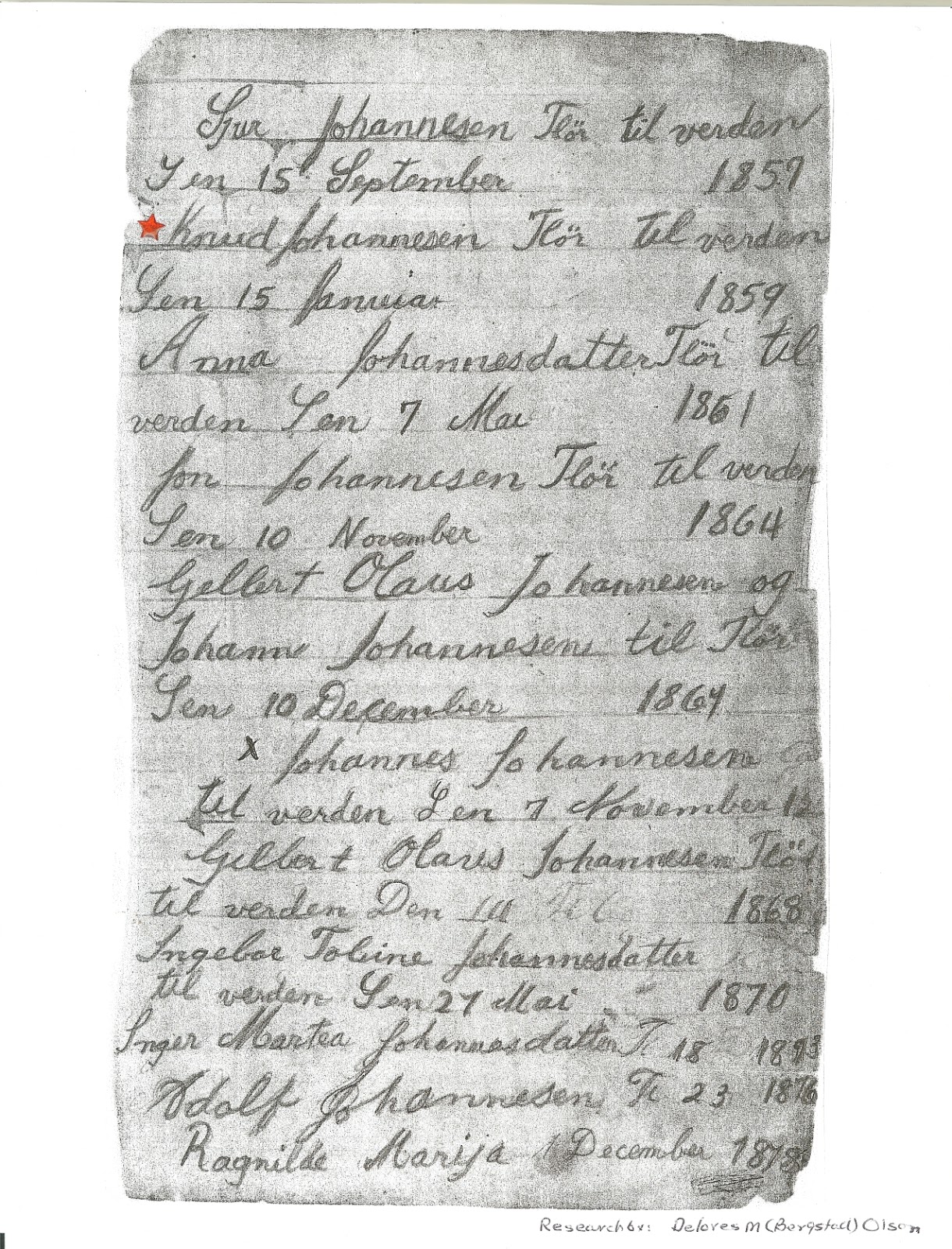
3. Bergstad family Bible page
Several years ago, I got a phone call from someone who said they were related to me. They'd gotten my cell number from an old genealogy website I'd put up, and wanted to send me some info on my/our Bergstad ancestors. I was really excited, but didn't want to get my hopes up too much, because she wouldn't say exactly what she was sending. The package arrived, and the contents knocked my socks off! Picture after picture after picture of my ancestors and their families, with people identified clearly; typewritten histories of various people; and this - a scan of a page from the Bergstad family Bible! This was the first time I'd ever heard of there being a family Bible on any of my ancestral lines. This page covers one generation, and I don't know whose handwriting it is, but it's all in Norwegian, and doesn't even mention the Bergstad name (which first appears as their surname in 1880). It was fascinating to see them listed in the old Norwegian patronymic style. It just drove it home in my mind that these were new Americans, still living their old culture in their new home.

 
 4. Harris family photos
When I was 19, I was serving a mission for my church in Japan, when I got a letter from my Grandma Sally Crawford. In it, she sent me a pedigree chart she put together of her ancestors, the first of any genealogy-related document I'd ever seen for my family. Attached to the unfamiliar names were actual photos, including the two above (Thomas W. Harris on the left, Frank and Charlotte (Scribner) Harris on the right). I'd never heard of these people or seen these pictures, and I had a sudden, intense desire to know more about them. I had to wait a couple years until my mission was finished, but when I got home, I delved right into researching my family tree, even making a presentation on the subject in college just a couple months later. It was fascinating stuff, and I'm even more captivated by it 17 years later.


5. John Gibson family - 1881 New Brunswick census
If I absolutely had to pick one favorite document, this would be it. This was my very first discovery in family history research. My mom told me my paternal great-great-grandparents, John and Catherine (Cain) Gibson came from Saint John, New Brunswick, Canada, and that my great-grandfather John Frederick Gibson was born there about 1884. I somehow found there were records for the area for the 1881 census. I pulled out the microfilm for Saint John, sat down at a microfilm reader and started cranking. Within just a few minutes, I found them! I thought to myself "this genealogy stuff is easy!" If I only knew... I am glad that first discovery came so readily, because it encouraged me to start really researching my family history.

So there you have it, my top five favorite family history documents. Let me know what your favorites are and why.

Sunday, February 22, 2015

My grandparents' DNA trails, Part III - "Wagner" mtDNA

The next DNA trail I'm tracing is the path of my paternal grandmother, Blossom (Wagner) Gibson's mtDNA. I've traced this DNA back to Anna Kreutzer, my 6th-great-grandmother, who married my 6th-great-grandfather Georg Adam Salfer in Rosshaupt in the Bohemia region of the Austrian Empire in 1756. My grandma inherited it from her mother, Rosie Sitzman [Zitzmann], who married Charles Frederick Wagner.


Blossom had three daughters, one from her first marriage and two from her second. I know mtDNA is also passed on to male children, but as they can't pass it on to their kids, they are left out of this analysis. Her first daughter had three kids, one girl and two boys. The daughter, my cousin, had two children but both are boys, so they can't pass on the mtDNA. As it looks like they aren't having any more kids, the mtDNA on that branch ends with my cousin.


Blossom's second daughter had two kids, both daughters. The older daughter has three kids, one daughter and two boys. The younger daughter has one child, a daughter. So both of my cousins on that branch each have a daughter that can pass the mtDNA from my grandma on down to another generation.


Blossom's youngest daughter had three kids, one girl and two boys (noticing a pattern here?). The daughter, my cousin, has two kids, a boy and a girl, with a third on the way (so far gender is unknown). But my cousin's daughter gives us another candidate for passing on grandma's mtDNA to a new generation.


So between my two aunts that have girl grandchildren, there are three girls of the latest generation that could pass on grandma's mtDNA. Given that there are currently 18 kids of that generation, I'd say that having a full 1/6 of them be girls in the direct maternal line is pretty good. Hopefully they'll be able to keep Anna Kreutzer's DNA going to a new generation of descendants.

Wednesday, March 19, 2014

Wordless Wednesday - Obsolete German villages in Bohemia


I recently learned of something terrible that happened in Bohemia, the homeland of my great-grandmother Rosie (Sitzman/Zitzmann) Wagner. After World War II had ended, the Sudeten Germans, the German-speaking inhabitants of the Bohemian part of Czechoslovakia (now the Czech Republic), were brutally attacked, killed, and driven from their homes. According to one source, 3.2 million people were forcibly relocated to Germany, with no say in the matter, and only with those possessions they could carry with them. I've spoken recently to a survivor of this tragedy, who provided me with the above map. Each red dot represents one settlement where German-speaking residents, some of whose family had lived in the area for centuries, were beaten, killed, or forcibly driven from their homes and country. Most of these settlements were left uninhabited, and are now gone.

This really struck home, as my great-grandmother and her family lived on the western border of Bohemia, in the Tachau region, which is on the far western edge of the region. Her family had lived in the villages of Rosshaupt, Neuhasl, Ströbl, Zirk, and others since at least the late 1700s. To think that her relatives were treated in such a brutal way is unthinkable, yet it happened. Maybe that was one reason she forbade her daughters to speak of where they were from.

To learn more about these events, and to read English translations of first-hand accounts, please visit http://www.wintersonnenwende.com/scriptorium/english/archives/whitebook/desg00.html.