Showing posts with label England. Show all posts

Sunday, March 15, 2020

My aunt's ancestors - the Pattinson and Rooney families

A few weeks ago, a whole big group of my dad's family gathered to celebrate my grandpa Fred Gibson's 94th birthday. It was so much fun seeing so many relatives together, all gathered to celebrate the life of my amazing grandpa. While we were there, my aunt Sandy (uncle Randy's wife) came up to me, and asked me if I would be willing to do some research on her ancestry. She said her dad was from England, as were her mom's parents, and she knew little to nothing about her ancestry beyond them. That sounded super interesting to me, so I said sure, give me a couple hours and I'll see what I can find. Of course I'd brought my laptop with me, just in case someone wanted to talk family history. So I went to work.

I found she had some really cool stories in her background! Her dad, Matthew Pattinson, was born in Netherton, Cumberland, England, and came to the U.S. in 1930 at the age of 25. As far as I can tell, he came alone - no parents, no siblings, just him embarking on a new life in the U.S. I was lucky enough to find a picture of him:
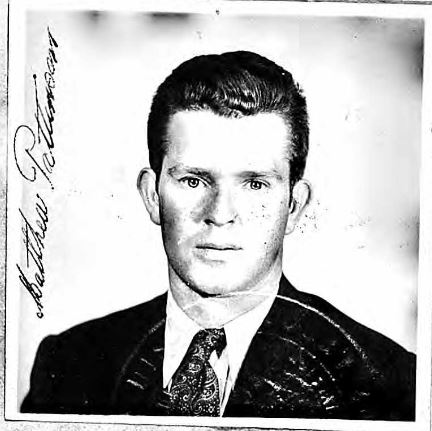

 Of course, I had to run it through the new MyHeritage colorizing app, and it turned out really well!


He arrived at Ellis Island aboard the SS Laconia, pictured here:

He'd only been in the US for four years when he declared his intention to become a US citizen. He officially became a citizen of the US on 19 September 1938. I wonder if this event was more meaningful to him because of the family he then had - he'd married Kathryn Crellin in 1935, and by 1938 they had two boys, James and Joseph. I wonder if his wife and sons were there at the courthouse when he made his oath of allegiance. What a cool moment that would have been! 

Like many others in Montana at the time, he found work in the mining industry, working for the Anaconda Copper Mining Company as a general miner. What really stood out to me, though, was the fact that he registered for the draft in October 1940, well over a year before the US entered WWII. I can imagine he followed the news of his native England's involvement in the growing war in Europe, but it impresses me that he would be willing, barely a decade after arriving here, to be called up to serve in the US military. I know we often speak of that generation as the "greatest generation," but seeing documents like this really bring it home just how great they were. 

Looking into Matthew's past, I found he was one of at least six children of Isaac and Eleanor (Crellen) Pattinson, from Cumberland County, England. He had three older brothers, Joseph, John, and Tom, and two younger sisters, Sarah Ann and Eleanor. His father Isaac worked as a railway guard, which I thought was really cool as my family has a lot of history working in the railroad industry. Matthew's youngest sister, Eleanor, was only about 9 when Matthew left for the US. I went on my mission when my brother Jeff was 11, and in some ways, that's the image I still have of him, even though he's now a doctor, married, and raising two boys. I wonder if Matthew saw his parents or siblings after leaving England. I hope he at least had some correspondence with them.

Cumberlandshire, England. Courtesy of Wikipedia.

I haven't found too much on Isaac's background yet. I know he was born in Cumberland, England, in 1871 to Matthew and Ann Pattinson, which shows Matthew was likely named after his paternal grandfather. He married Eleanor Crellen in Cumberland in 1897, and their oldest son Joseph was born two years later. Eleanor was the oldest child of Joseph and Ann Crellen, who were both born in Cumberland in the 1850s. Eleanor's youngest sister, Betsy, was only 9 years older than Eleanor's first child, so it's pretty fun to imagine them growing up knowing and playing with each other. Isaac was a widower by 1939, when he and his daughter were enumerated in the England register that year (kind of a census substitute taken as World War II ramped up). That would have been a scary time to live in England, even if you lived many miles away from London and the terror of the blitz. He lived through it though, and passed away in Cumberland in 1950.

Looking into the ancestry of my aunt's mother, Kathryn Rooney, I found she had English roots as well. Her parents James Rooney and Martha Barton, were both from Cumberland, England, and Kathryn's oldest brother William Rooney was born there as well. Interestingly, James immigrated to the US  just a few weeks after William was born. I can't imagine leaving my wife and infant son like that, going so far away to establish a new home but not knowing when I'd see them again. He arrived in Boston, Massachusetts, in August 1906 aboard the SS Cymric, shown below.


I found James in the 1910 census in Montana, working as a copper miner. What's really cool is he actually lived with his brother Hughey, who was also a copper miner. If James was away from his wife and son, at least he had other family with him. Martha and William did eventually join him, arriving at Ellis Island in October 1910 aboard the SS Carmania, which you can see in the picture below.


James went through several occupational changes over the years. By 1920 he was a farmer, and worked on his own farm. Farming may not have been his thing, or perhaps it just didn't go well, because by 1930 he was back to copper mining, which he did through 1940. In 1942, he was a watchman for the Anaconda Copper Mining Company, but by 1948 he was again working as a miner. He died in 1949, though the cause of death was unclear - doctors felt it may have been tuberculosis, but it could also have been pulmonary fibrosis. Either way, even though he was 71 when he died, he apparently had been working right up until the end.

I don't have much info on James' parents yet, just that their names were Hugh Rooney and Anne McManus, and they were apparently from Ireland. It will be really interesting to see if I can find where exactly in Ireland they were from. Irish research has been really tough for me up until now, but these Irish ancestors are from the Republic of Ireland and lived several decades later than my almost impossible to find Gibsons and Stephensons in Northern Ireland. So hopefully I'll be able to find something.

Martha Barton, the wife of James Rooney, turned out to be the youngest of eight children of John Barton and Catherine Bouden, from Cumberland (lots of Cumberland ancestry!). John was a coal miner, and his sons worked in the mines too. In 1891, John and his sons Thomas (18), John (16), and William (14) all worked in coal mining, while the younger kids either went to school or stayed home. It blows my mind to think of a 14 year old boy working in a coal mine - my oldest is almost 14, and the thought of sending him down a mine shaft is beyond imagination. Things really were different then.

That's all I've got so far, but I think it's a good start! Lots of Cumberland ancestry with a dash of likely Irish. It'll be very interesting to see what other stories are waiting to be uncovered.

Saturday, October 19, 2019

Good things do occasionally come to those who wait

The last couple weeks have been such a roller coaster ride. I took a short trip to Utah for the annual company retreat, which was amazing; turned in some projects for work where we were able to find quite a bit of info for a few clients; spent some time as a family doing service for others; and biggest of all, today was the third birthday of my son Levi, who left us two months after he was born. I can't begin to describe the range of emotion that goes along with all of those activities, but it honestly was a little exhausting. So to have some time to just sit back and explore my own family history for a bit is, for me, the ultimate in relaxation.


And I've got some great discoveries to share! At the retreat last week, we had some free time on Friday morning, and management asked us what we'd like to do. Some folks said they wanted to collaborate on a work project, as those are fun to do - you really get to see your coworkers in action, watch brainstorms happen on the spot. Someone said they wanted to do their own family history, which I totally agreed with - seems I have so little time for it anymore, between trying to fit in two jobs, two church callings, family responsibilities, and everything else. But then I thought - what if we did both? What if we collaborated on each other's family history brick walls? The idea of having these awesome minds I work with helping me tackle my family history problems was exciting, so I suggested it, and the response was really positive, so we did just that. Three other coworkers and me brought genealogy problems to be solved, and the company split into four teams. The problem my team and I tackled was the origins of my fourth-great-grandparents, George Donald McDonald and Jane Dobson. Both were born in England, though they apparently immigrated separately (Jane around 1830 as a five-year-old, George I don't know when) and raised their family in Ontario. I had no siblings, no parents, no extended family for either of them, and with a name like McDonald, I hadn't ever tried to find them amongst all the other McDonalds out there.

My awesome team helped me in several ways - scoured church records for evidence of them (didn't find anything), traced the lines of my ancestors' other kids and tracked down living McDonalds who could be invited to do a Y-DNA test; and helped me identify genetic matches on my Dobson side with some big clues as to Jane's parents, siblings, and point of origin in England!! Needless to say, I was over the moon about all of this! I still need to go in and verify the paper trail for my apparent Dobson relatives to make sure everything checks out on their end, but if it does, then I can finally link that side of my tree to its Old World origins. That was on my bucket list of genealogy problems to solve, so I am super stoked on that.

The other breakthrough came just today. A little over 2 1/2 years ago, I upgraded my paternal grandfather's mitochondrial DNA test to a full sequence test - I really wanted to see what it said about grandpa's mother's mother's mother's line. FTDNA had trouble processing it, and at one point they even asked for another DNA sample (which we provided). They tried and tried again and again, but for some reason they said it just wasn't working. Eventually, after months and months of unsuccessful tests, they said they had one last option - a last ditch, all or nothing final effort. There was no guarantee of success, and if it failed to read his DNA, there would be no refund, and no timeline for when or if it would succeed. On the other hand, I could take the refund, but get no results, and I would not be able to resubmit another test (because they said they'd already lost money on this one from having re-run it so much). I weighed the options, and figured I had nothing to lose by trying the rescue program, as they called it, because it was the only option that offered me what I wanted most - the full haplogroup of my grandfather's mtDNA, and the opportunity to find matches on that line. So I opted for the rescue.

I checked in on the progress every six months or so, but the answer was always the same - we don't know if it will work, and we don't know when we'll know the results. Then today a little before dinner, I got a few emails from FTDNA - the results were in!!! I now know that my great-grandma's mtDNA haplogroup is U5b2a1a1. The cool thing is, he has seven perfect matches that show their mtDNA line's origins - one is in the US, one in Poland, and four in Germany. That fits perfectly for where his mother's line is from - they were Germans living in what is now Ukraine. Grandpa's mom was Augusta Joseph, who was born Uljanowka. Her mom was Pauline Rosenke, born in Zhitomir, in the Volhynia region of what is now Ukraine. Pauline's mom was Marie Siebert, though that's all I know about her. So whatever connection my grandpa has to these matches is through Marie. But even just knowing her line was apparently German for at least a ways back is really cool - drives home just how German his mom's side really was. That's information that was worth waiting 2 1/2 years for.

Pauline Rosenke's birth record

So now I've got some new answers to old problems, new tools to work with, and more answers to find. Which is exactly why I love genealogy - you get the satisfaction of solving difficult puzzles, only to realize you just expanded the size of the original puzzle, and there's still work to do. It never ends, and that's a great thing!

Sunday, October 15, 2017

Family History Month - post 11

This census record is from the 1851 Canadian census. It's the earliest record I have so far of my 4th-great-grandfather, George D. McDonald. He's the one who died on December 23rd, that I wrote about a couple months ago. I've always thought it interesting that his surname is McDonald, yet he was apparently from England. I would love to track down a male-line descendant and have them take a Y-DNA test.


He and his wife Jane (nee Dobson) were both from England, but I think they married in Ontario, Canada. Need to find a marriage record to prove it though.

Friday, August 18, 2017

Genes Day Friday - My LivingDNA results are in!

When last I wrote about LivingDNA, I had just gotten the email saying testing had begun. At the time, they gave me an estimated completion date of September 13. Imagine my surprise when I checked my email this morning and saw that my results were ready! They have seriously overdelivered at every step of the process so far, so I've got high expectations for these results now.

So I logged in to see what they had to say. The Ancestry section has three options - Family Ancestry, Fatherline, and Motherline. Each section gives you a little tour of the info provided (though Fatherline tour said "motherline" instead of "fatherline" on each section, probably just a typo). The infographics were cool, easy to follow, and gave you the option to explore more. What I liked best is that both Fatherline and Motherline lead with the information you really want - your haplogroup (and subclade for Y-DNA). My mtDNA haplogroup is H, no surprise there. FTDNA's full sequence test listed the haplogroup as H3v-T16093C, so I wonder if LivingDNA did a full sequence test, or just lots of SNPs. FTDNA gave me a list of differences from both RSRS and rCRS values, and the list from LivingDNA only has one value in common with rCRS. So I'm guessing they did a SNP test rather than a full sequence, which is fine. They got the haplogroup right, so I'm not doubting their data, just wondering what their list of differences means in comparison with my FTDNA values. I'll have to look into this.

Looking at the Y-DNA info, once again they lead with the info you want first - haplogroup and subclade. They put me in haplogroup R-U106, subclade R-Z159. Back when I did my paternal grandfather's Y-DNA test at FTDNA in 2012, I had to purchase the Z159 SNP test, so to see that this SNP is included at LivingDNA is awesome. The coverage map for the Y-DNA is interesting, because it shows where in the world your haplogroup is predominantly from. For my haplogroup, the top country of origin is England. That matches what I've seen at FTDNA, where most of my grandpa's 12 marker matches are from England. Interestingly, Ireland isn't even on the list of countries my haplogroup is from. I'm sure there are U106 descendants in Ireland, but maybe the haplogroup shows up in less than 7% of the male population? That adds to my suspicion that my Gibsons were pretty recent transplants to Ireland and originally came from England or Scotland (Scotland shows up in the list at 15%, by the way).

Then there's the autosomal results, or Family Ancestry as they call it here. This part works kind of like 23andMe, where they have Complete, Standard, and Cautious levels Complete means they've assigned every percent of your DNA to areas where it's most similar to. Standard is their "best guess" level of assignment, with some areas still labeled "unassigned". Cautious is the level where they have the most certainty. The Great Britain and Ireland section of my Complete view down to the sub-regional level looks like this:


Most of these are areas I know very little about. I know Aberdeenshire is in Scotland, but for some reason, when I click on it, it highlights Ireland as well. But between these areas, I have ancestry from all of Ireland, most of England, and chunks of Scotland and Wales. Pretty awesome! I realize that this is the speculatory level, and not all of these areas may actually be in my family tree. So I took a look at the cautious level as well, and this is what I saw:


This is a lot more conservative in terms of pinpointing the areas of Great Britain my ancestors came from. But I still have most of England, all of Ireland, and chunks of Scotland and Wales highlighted. I'm very much excited by this! I took a class on English and Welsh family history at BYU, as well as one on Irish and Scottish family history. The history of all these countries is fascinating, and it looks like I might have ties to them all!

Some other interesting points from the ethnicity breakdowns:

On the cautious level, only my ancestry in Great Britain is identified by place - everything else is labeled European. When I first logged in, there was a notice or disclaimer that said basically "You're one of the first to take this test, and your results will be refined as we add more tests to our database." So hopefully as their database grows, the cautious level will become more certain for non-UK areas. Even though I took this test specifically with the intention of gaining more insight into my UK roots, I do hope that Europeans from other areas, especially France and Scandinavia, will test as well. I just like seeing the information get better in all areas basically.

Also, all three levels showed me as having 1.7% "Chuvashian-related ancestry." I have never heard of Chuvashia or Chuvashian before, so I had to look it up. According to Wikipedia, Chuvashia, or the Chuvash Republic, is part of Russia and home to the Chuvash people, a Turkic ethnic group. Apparently their history goes back to at least the 7th and 8th centuries AD. I'm thinking that my Joseph ancestors, who lived in Poland and Ukraine (or where those countries are now, anyways) are where my Chuvashian ancestors came into my family tree. None of my other branches were anywhere near there in the last couple hundred years.

One thing that really stands out - no French ancestry. I should have somewhere around 13% French ancestry, as my maternal grandmother is 1/2 French-Canadian. I don't know if they are lumping French and German together, but the standard level shows me as having 2.8% German ancestry, and 39.5% Scandinavian. Mathematically, I should have about 16% Scandinavian ancestry, and a LOT more German than 3%. I have German ancestry from all four grandparents - my paternal grandfather is half German, my paternal grandmother is somewhere between half and 3/4 German, my maternal grandmother was 1/4 German, and my maternal grandfather was 1/8 German. I know that gets watered down a little bit before it gets to me, but not to the extent of 3%. I'm curious to see how these numbers will adjust in the future as the database grows.

So that's my first glace at my LivingDNA test results. LOTS of information!! So much to take in. I really want to look more closely at the English ancestry, and go through my family tree and see where my likely English and Welsh ancestors are. Also, I thought there was going to be matching to cousins, but I don't see that option yet. Maybe that will be opened up later on. When they open that up, I hope they include a chromosome browser. I would love to see one that mixes both ethnicity and common segments, so I can see the DNA I share with someone AND what the projected ethnicity of that segment is. Wouldn't that be awesome?

All in all, I am totally satisfied that I took this test. $99 was a huge deal, and even the current discount price of $119 is more than reasonable for all this data. For a relatively new DNA testing company, these guys have really hit the ground running. Can't wait to see what refinements and improvements are in store.