Showing posts with label Bergstad. Show all posts

Sunday, September 1, 2019

Genealogy remembers them all - Ivar Bergstad


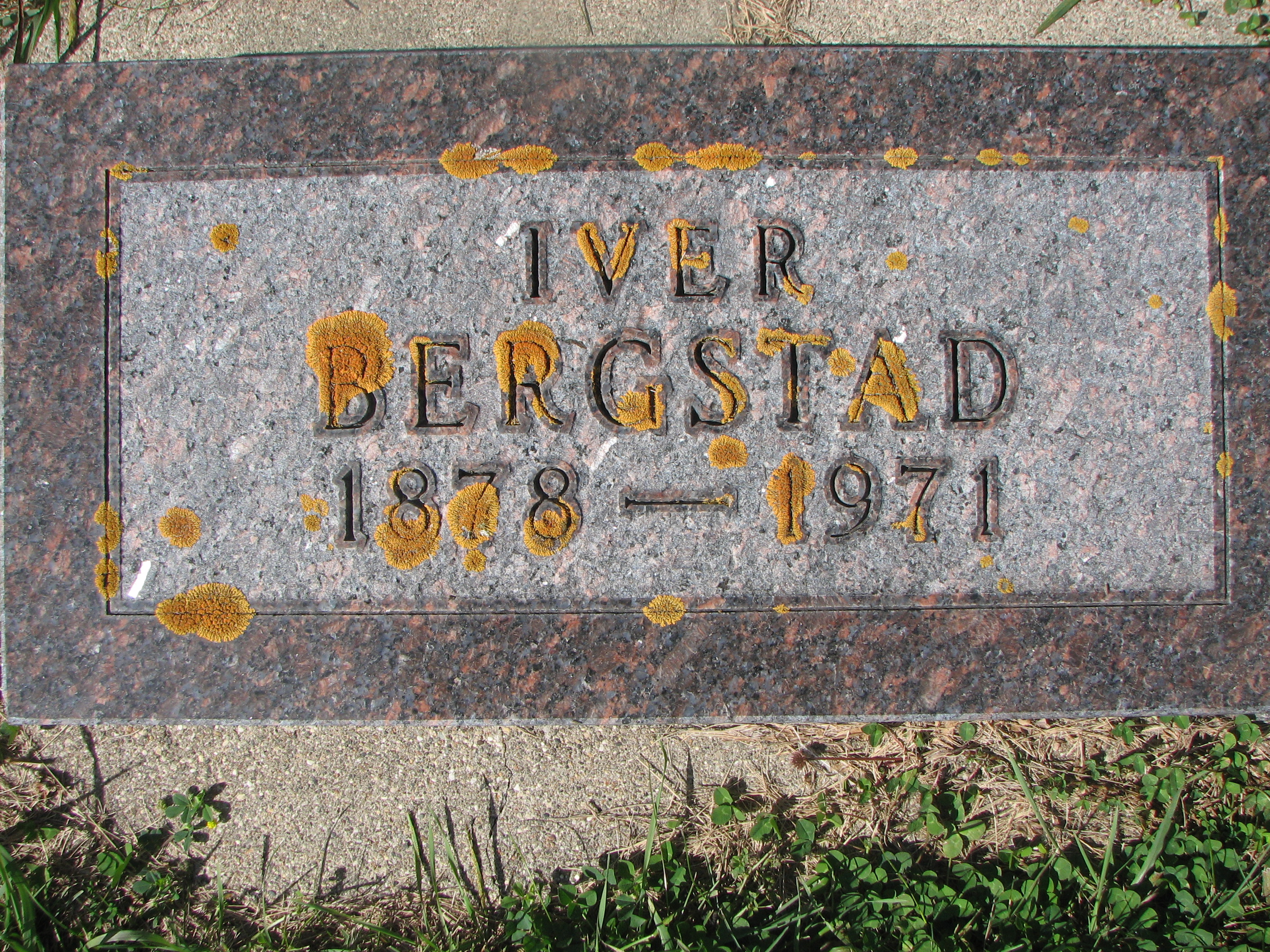
I had some time tonight to dig into my own family history (yay!) and found myself drawn to the records of a relative I haven't really researched much before - Iver Bergstad, son of Ole Sjursen Bergstad and Karen Johannesdatter, born in Fertile, Worth County, Iowa, on 8 April 1878. Ivar's father Ole was born in Norway, and was the brother of my ancestor Johannes Sjursen Bergstad.

The earliest record I have of Ivar is his baptism into the Fertile Lutheran Church on 12 May 1878, just a few weeks after his birth. His godparents were Johannes Sjursen (likely his uncle and my ancestor), Knud Sjursen (another uncle) Thorbjor Knudsen and Anna (can't read her last name). Two years later, he's in the 1880 census with his large extended family - parents Ole and Karen (aka Caroline), older siblings Carl and Shur, uncle Knudt Bergstad and aunt Caren, and cousins Albert and Anne. He seems to have lived with and near family for much of his life:

1885 - Ivar lived with his parents and older brothers, as well as younger brothers John and Nils.
1895 - Ivar lived with his parents and all the previously listed siblings, as well as additional siblings Sophia and Osker.
1905 - Ivar was still living with his parents and all his siblings, none of whom had apparently yet married.
1915 - Iowa decided the best way to record the census was to make individual cards for each person. That makes it unclear who lived with who, since home addresses weren't recorded. 
1917 - He listed Ole Bergstad (maybe his father) as someone who would always know his address.
1920 - Ivar lived with his parents and brother Osker (also known as Clarence).
1925 - Ivar's father had passed away, but his mother and brother Osker still lived with him.
1930 - Osker had married a woman named Ida, and they had two children, Otto and Betty Ann. They lived with Karen, Ivar and Osker's mother, in Ivar's home.
1940 - Ivar's household included his mother, his nephew Otto, and his brother Nils.

He was physically pretty fit too - his WWI draft registration said he was 6 feet tall, 175 pounds, blonde hair and blue eyes. He worked as a farmer in every census, and in every census of his adult life, Ivar was the head of the household, even when his parents lived with him. Though he apparently never married or had kids, he took care of his family well in to his 50s and maybe longer. He seems to have been one of those men who just did what needed to be done to take care of those he loved. He passed away in North Dakota in 1971.


Sunday, October 15, 2017

Family History Month - post 10

For this post, I wanted to throw it back a few centuries. This is the baptism record of my 7th-great-grandfather, Johannes Andersen Flantzaas. He was baptized on 14 November 1728 in Evanger, Voss parish, Hordaland, Norway. Flantzaas was the name of the farm they lived on, which was also spelled Flantsaas and Flansås.


The family moved to the Berstad farm, where Johannes' mother Marita was from, and his family stayed on that farm for the next four generations. His great-grandson, Sjur Johanneson Bergstad, moved his family to the US, and after 20-30 years, the family took on the name of the family farm as their surname - Bergstad.

Monday, June 19, 2017

Why I'm a bad genealogist - Ingeborg Fadness family edition

Have you ever set out to document one side of your family that you didn't know much about, and make some amazing discoveries (which you sourced carefully in your files), but didn't write down right away what you did or how you did it? Unfortunately, I did exactly that with the family of my 3rd-great-grandmother, Ingeborg (Fadness) Olson. I'm going to try to reconstruct what I did, based on the information I put in my file, and the timestamps on the documents I found.

I do remember that I had documentation on Ingeborg (aka Ingebor, Ingebjor, etc), going back to 1880, when she'd have been about 24 years old. At that point, she had 4 kids, ages 8, 5, 3, and 8 months. Which means she must have started having kids when she was 15 or 16! Wow, times were different back then. I also knew from later censuses that she started going by (or was at least referred to as) Emma rather than Ingeborg. I didn't have anything that directly stated she was the daughter of Gullick Knudsen Fadness and Martha Helgesdatter Kjenes, as I'd found somewhere years ago (online? distant cousin? no idea now...). So I wanted to prove it. I found online that I could order her death certificate for only $9, which I did. The problem was, they only sent them out by snail mail, so I'd have to wait a week or two to get it. I couldn't wait that long to start digging into the problem, so I launched into Ancestry to see what I could find.

First off, I found a marriage record for Ingeborg's older brother Helge Fadness to Hanna Johannsdatter Bergstad. (These families intermarried a lot - Hanna was a sister of my ancestor Knute Bergstad, and Knute and Hanna were first cousins to Helge and Ingeborg, plus Knute married Ingeborg's daughter...like I said, lots of intermarriages). Helge's marriage record said he was born in "Vos" in Norway. I thought that could be Voss parish, Hordaland county, Norway, the same parish my Bergstad ancestors are from. So I went looking in the Voss parish emigration records on the Digitalarkivet website.

/
 
And that's exactly where I found them. I found that Gullick, his wife Martha Helgesdatter, and their sons Knud and Helge (named after Gullick and Martha's respective fathers) immigrated to America in April 1854. This fit perfectly with what I had in my files for Ingeborg's family, as she was born in Wisconsin in January 1855. I also found another immigration record for this family from 6 years earlier, in 1848 (minus Helge, as he wasn't born yet). It seems the family intended to immigrate then, but changed their minds and stayed in Norway a few more years, and then left. It's really interesting to think that they had made up their minds to move to another country, and then for whatever reason, had to stick it out a few more years before leaving. I wonder what those years were like - were they anxious to move? Were they putting off a difficult decision because of cold feet? The answer is unknowable, but the fact that they vacillated on the decision makes them seem more human to me. It wasn't just a "pack up and go!" option for them - it was a tough choice, with consequences that would likely be permanent for all involved.
 
I kept looking for more info, and soon found Ingeborg's baptism record in the Lutheran church records in the US (though still written in Norwegian), confirming that she was born and baptized on 21 January 1855 in Wisconsin. Now that I had her exact birthdate, I just needed one thing to clinch the theory that this Ingeborg Fadness was the same as my Ingeborg Fadness - the death certificate of Ingeborg/Emma Olson.
 
Once the death certificate arrived, I compared it to what I had pieced together, and found what I needed. Ingeborg/Emma's birthdate was 21 January! The year was off (1851), but I've seen enough records where ages vary by more than that to know that this wasn't a deal breaker. Also, her father's name was listed as Gilbert Fadnes, easily an Anglicized version of Gullick Fadness.
 
Now I can finally say I have documented evidence that my Ingeborg Fadness was indeed the daughter of Gullick Knudsen Fadness and Martha Helgesdatter Kjenes. Now I can look them up in Norwegian records in Voss parish, and push the line back even further. And hopefully - I'll document it this time!

Friday, February 10, 2017

Genes Day Friday - DNA Circles at last!!

One of the cool things about DNA testing at Ancestry is their use of DNA Circles. The circle is basically a group of people who share autosomal DNA with at least 3 other people in the circle and have a common ancestor in their family trees. This means that Ancestry figures, because of the comination of DNA and family tree matches, your shared DNA probably comes from that common ancestor. Because autosomal DNA inheritance is random, you won't match everyone in the circle, even though you have the same ancestor. Ancestry looks back as far as 9 generations in your tree, so you could potentially be matched with some pretty distant cousins.

When I first got my DNA results, I didn't have a tree uploaded to my account. I've kind of been holding out for Ancestry and Rootsmagic to get their sync issues worked out, so I postponed putting up my tree for a while. But when I saw their recent blog post about how the tree sync feature is delayed (as any complex software could be) I decided to post my tree. Because I had no tree, I wasn't put in any DNA circles, so I figured my circles would show up soon after uploading the tree. I was pretty disappointed when, after a couple weeks, I still had no circles. So I did what I always do when I have to wait for something - I distracted myself with other projects, and came back later. And voila - it worked!!


All I've really had time to do so far is check out which ancestors the circles are centered around. The variety is really interesting. I have 12 circles so far, and 8 of them are for Norwegian ancestors! The closest to me in generations are Betsy Martha Olson and Knute J. Bergstad, my 2nd-great-grandparents (and spouses to each other interestingly). Four more of the circles are dedicated to each of Betsy and Knute's parents - Betsy's parents were Andreas Olson and Ingeborg Fadness, and Knute's were Johannes Sjursen Bergstad and Torbjorg Knutsdatter Fadness. The other two Norwegians in the lot are Knute Gulleikson Fadness and Ingeborg Olsdatter Rongen, who turn out to be Torbjorg Fadness's parents. That means half of my circles come from one ancestral couple and their parents or grandparents. Either these ancestors have a LOT of descendants, or my Norwegian DNA is strongly biased towards them. Or both.
 
All of these Norwegian ancestors are from my maternal grandfather's paternal side, the Bergstads. There aren't any DNA circles for his maternal Norwegians, the Hammers. I wonder if I'll see any of those pop up later?
 
My remaining four circles cluster around another family group. Adoniram Shute is my 3rd-great-grandfather on my paternal grandmother's father's side. His wife was Mary Groff, and her parents were Paul Groff and Susanna Garlinghouse. So that group of circles basically covers the ancestors of my great-great-grandmother Eldora Shute (Adoniram and Mary's daughter).
 
Of my four grandparents, my paternal grandmother and maternal grandfather have ancestors represented in these circles. That means I have no circles as of yet for any of my paternal grandfather or maternal grandmother's lines. My grandpa's lack of circles, I can understand - relatively small families and recent immigrants to the Americas (1840s-1900s). My maternal grandmother's side though, I'm surprised. Colonial English, plus German immigrants with large families, plus French-Canadians with HUGE families. And no circles for any of them? Maybe they'll pop up later. I wonder how often Ancestry updates their circle roll call.
 
All in all, very interesting to see who my circles center around, and what ancestors pop up in my DNA. I'm very much looking forward to delving deeper into this!


Sunday, January 8, 2017

A Tale of Two Wills - The sons of William and the daughters of Jessie

I had some free time the other night, and jumped into my own family tree for an hour or two. I was looking through my lines, trying to decide which one to research, when my Bergstad line caught my eye. I started sifting through them, and came upon Turby Bergstad, the oldest child of my 2nd-great-grandparents Knute Bergstad and Betsy Olson. As I was looking at her husband, William Clyde Cornell, and their children (among whom was Andy Cornell, my grandpa Tom Bergstad's cousin and close friend), I saw that I didn't have really any info on William - no parents, siblings, or anything. I went digging, and pretty soon found his family in census records in Wisconsin, where he was from. I found his parents were William H. Cornell and Jessie Butterfield. William the dad was from Vermont, while Jessie was from Wisconsin. William's parents were Stephen Cornell and Almira Wolridge, while Jessie's parents were Thaddeus Butterfield and Jessie Webb. I have always liked the name Thaddeus, ever since I saw Disney's Atlantis, and now I'm (distantly) related to one!

I wanted to see what happened to William and Jessie, so I poked around Ancestry for a while, and found that they both left wills. Bonus! I found Jessie's first, but as I read through it, I found something I have never seen in a will - she deliberately left her sons out of her will, and said so. She even said why she was doing it - because they would be provided for in her husband's will. The exact language is:

I do not devise or bequeath to my sons any of my property, for I expect they will be taken care of in the will of my husband. 

She left everything to her daughters, and described how everything was to be divvied up between the three of them. The will was dated 4 December 1917, but I haven't found Jessie's death info yet, so I don't know how much time passed between when her will was written and when it was probated. Unless Jessie's husband was near death though, she was leaving her sons' inheritance to be settled potentially decades in the future.

So how long was it between the two wills? About ten years, as William's will was recorded on 4 October 1927. And just like Jessie's will, William's specifically leaves out his daughters with these words:
I do not make any bequests or devises to my daughters, Jessie Bredesen and Grace Browning, for the reason that I have helped them some what in the past and because they have been provided for by the will of my deceased wife, she having made certain provisions for them in her will.

So obviously this was planned out intentionally by Jessie and William (and it looks like one of the daughters died between the making of the two wills). I have to wonder what made them decide to do this. There doesn't seem to be any ill will for the sons or daughters by either parent, or bad feeling for either parent for each other. Maybe they thought that was how you do it - men for men and women for women. Would they have still done this if they had had fewer children? I wonder what their children thought of the deal, and whether either group thought they were being dealt with unfairly. There's no way to know for sure, of course, but I do wonder.

It just goes to show you, every ancestor, every document, is an individual case, and you really could find anything in it.

Wednesday, February 10, 2016

Nearly Wordless Wednesday - My ancestral hometowns


After blogging about my Gibson ancestors' hometown, I thought it'd be fun to browse Google Earth and mark the locations of other ancestral hometowns I've discovered in my research. Here they are!
 
 
Gross-Bieberau, Germany - My 3rd-great-grandfather Jacob Beilstein was born here in 1851.

 
Evanger, Norway - My 3rd-great-grandfather Johannes Sjursen Bergstad was born here in 1832.

 
Paris, France - My 9th-great-grandmother, Claude Demise, was born here in 1650. Other ancestors were born here as well.

Kepa Kikolska, Poland - My 3rd-great-grandfather Ludwig Heinrich Joseph was born here in 1836.
Reischewo, Poland - My 3rd-great-grandmother Justine Witt (Ludwig's wife) was born here in 1842.
 

Rosshaupt, Bohemia (now Rozvadov, Czech Republic) - My 2nd-great-grandmother Maria Zitzmann was born here in 1876
  
Uljanowka, Ukraine - My great-grandmother Augusta Joseph was born here in 1892. Her grandparents, Ludwig and Justine Joseph, moved here around 1865 from their native Poland.

Wednesday, January 20, 2016

My favorite family history documents

I recently saw a Tweet from FamilySearch asking people what their favorite family history document was. That was a really interesting question to think about, and the more I thought about it, the more favorites I came up with. It was impossible to narrow down to just one document, so here are my top five favorites, in no particular order.


1. The marriage certificate for Christ Hoffman and Mary Sitzman (Maria Zitzmann)
When I got started in family history, I was dismayed to find out my great-great-grandmother Mary Sitzman had left this world with sealed lips as to where she and her family came from. Her daughter Rosie said nothing, and her granddaughter, my grandma Blossom, knew nothing. Years of searching based on the few clues I did have yielded nothing. This marriage record proved the key to blowing that brick wall to smithereens. Mary gave her birth town as Rosshaupt, a tiny village in western Bohemia (now called Rozvadov and part of the Czech Republic), and that one clue led to many, many, many discoveries. I've now got information on Mary's ancestors going back to 1700s and even 1600s on some lines. All from one little marriage record! It taught me that seemingly insurmountable brick walls can be overcome, even with one simple document.


2. 1910 US-Canadian border crossing of Samuel and Helena Joseph
For years, all we knew about my great-grandmother Augusta (Joseph) Gibson's family was that they came from "Germany". They were Germans, spoke German, and came to Canada before moving to Montana. Records pointed to Berlin and "Toran", Germany, but those leads proved to be dead ends. Then a few years ago, at a Family History Fair up in Bellevue, I was going over my recent discovery of this border crossing Augusta's father Samuel Joseph and sister Helena made in 1910 (Sam and Helena are listed on lines 17-18). It lists a lot of great information - relatives in the country they are leaving, name of person and address they are going to, when they first came to Canada, name of the ship, and (best of all) birthplace. Sam's birthplace was listed as "Gitomar, Russia", and Helena's as "Ulanowka, Russia". I went to the display table for the SGGEE and asked their representative to help me figure out what these places were. She figured out Gitomar was actually Zhitomir, a pretty big city in the Volhynia region of what's now Ukraine. Ulanowka is a smaller village a few miles west of Zhitomir. Boy was I excited! That piece of info led me to other discoveries, allowing me to trace Sam's family back to his grandparents in Poland. This was the first time I'd ever traced a line of my family back to their point of origin in the old world, and it felt great! This was my first real breakthrough, and I still feel the deepest genealogical connection to my Joseph ancestors, largely in part to this discovery.

 
3. Bergstad family Bible page
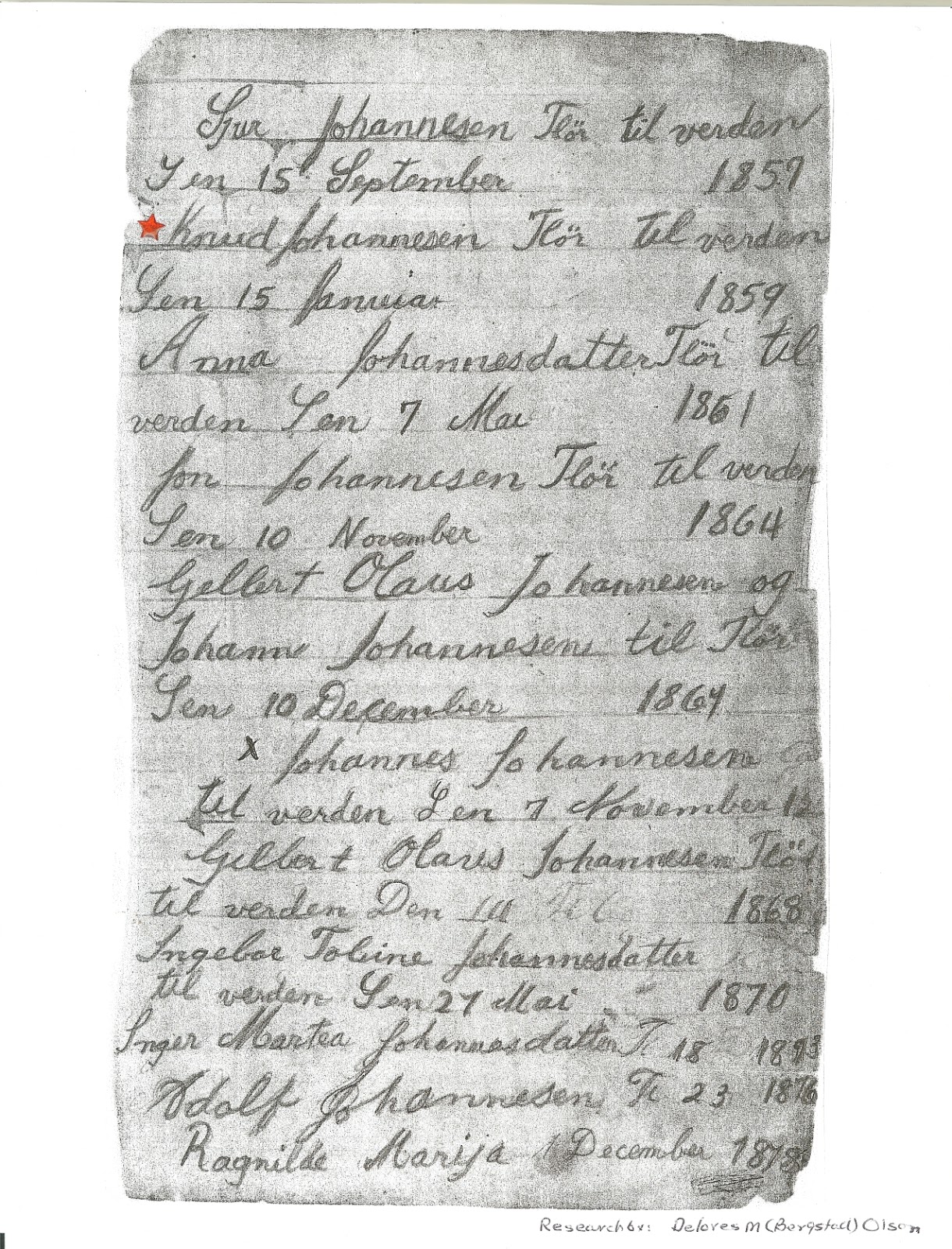
Several years ago, I got a phone call from someone who said they were related to me. They'd gotten my cell number from an old genealogy website I'd put up, and wanted to send me some info on my/our Bergstad ancestors. I was really excited, but didn't want to get my hopes up too much, because she wouldn't say exactly what she was sending. The package arrived, and the contents knocked my socks off! Picture after picture after picture of my ancestors and their families, with people identified clearly; typewritten histories of various people; and this - a scan of a page from the Bergstad family Bible! This was the first time I'd ever heard of there being a family Bible on any of my ancestral lines. This page covers one generation, and I don't know whose handwriting it is, but it's all in Norwegian, and doesn't even mention the Bergstad name (which first appears as their surname in 1880). It was fascinating to see them listed in the old Norwegian patronymic style. It just drove it home in my mind that these were new Americans, still living their old culture in their new home.

 
 4. Harris family photos
When I was 19, I was serving a mission for my church in Japan, when I got a letter from my Grandma Sally Crawford. In it, she sent me a pedigree chart she put together of her ancestors, the first of any genealogy-related document I'd ever seen for my family. Attached to the unfamiliar names were actual photos, including the two above (Thomas W. Harris on the left, Frank and Charlotte (Scribner) Harris on the right). I'd never heard of these people or seen these pictures, and I had a sudden, intense desire to know more about them. I had to wait a couple years until my mission was finished, but when I got home, I delved right into researching my family tree, even making a presentation on the subject in college just a couple months later. It was fascinating stuff, and I'm even more captivated by it 17 years later.


5. John Gibson family - 1881 New Brunswick census
If I absolutely had to pick one favorite document, this would be it. This was my very first discovery in family history research. My mom told me my paternal great-great-grandparents, John and Catherine (Cain) Gibson came from Saint John, New Brunswick, Canada, and that my great-grandfather John Frederick Gibson was born there about 1884. I somehow found there were records for the area for the 1881 census. I pulled out the microfilm for Saint John, sat down at a microfilm reader and started cranking. Within just a few minutes, I found them! I thought to myself "this genealogy stuff is easy!" If I only knew... I am glad that first discovery came so readily, because it encouraged me to start really researching my family history.

So there you have it, my top five favorite family history documents. Let me know what your favorites are and why.
Sunday, September 6, 2015

An unexpected treasure trove - Probate Case Files

Earlier this week, Ancestry.com announced the release of a huge group of digitized, indexed records - U.S. Wills and Probate Records for all 50 states. I've only dealt with wills a little in my genealogy research, so this was an exciting prospect for me, and I hoped to find records of my ancestors in these files. I went through and quickly searched for the more unusual names in my tree - Bergstad, Craddock, Vadnais, Waechter, Beilstein, Groff, and a couple others. I found one hit in Groff, with the probate case file for Cynthia P. (McMullins) Groff, wife of my 3rd-great-granduncle, George Groff. I still need to look through that one (it's 38 pages!) but what I did see in my cursory scan through it has me very excited - married names for all her children (both those with George and those from her first marriage to Milton Smith)! But I wanted to find something for a direct ancestor if possible, maybe even something to break through a brick wall. So I kept searching, and soon found something - a probate case file for J.E. Craddock of Montana!

I scanned through it and found that J.E. Craddock's probate case was being handled by four of his children - G. A. Craddock, J. B. Craddock, W. L. Craddock, and E. L. Craddock. That fit nicely with what I knew of my James E. Craddock's children - George, Jessie, William, and Ernest. I knew that in addition to those four, he had three additional children - Moses, Otis, and Edna. I kept looking and found mention of them as well. This was my guy! And the file was 64 pages!!

I downloaded all 64 pages of the file, and began going through them. After the initial mention of the four sons requesting letters of administration, the bulk of the file was taken up with paperwork that didn't tell me much (letters to and from court the trying to name the administrator mostly). Then came some more interesting details. E. C. Kurtz was eventually named administrator of the estate, and there were notices posted in the paper for several weeks inviting creditors to come forward and claim any money owed them by James. The funeral home that took care of the funeral was paid $15 for furnishing the hearse (this was in 1917; I wonder what that would cost today). James' daughter Edna Morton was paid $101.70 for funeral expenses and for caring for James through his final illness. Mr. Kurtz was paid $75 for his role as administrator.

I also learned that James had two lots in Victor, Ravalli county, Montana that were, according to the case file, split so each child received an "undivided one seventh of all the real property." It doesn't go into any more detail than that. I'd have to look up the original plat of the survey to see where exactly the property was, since there is no map attached. The remaining cash in James' account was also split evenly, so each child received $69.87 as their part of the inheritance.

Reverse side of Ernest Craddock's voucher

But the most interesting part of the whole file wasn't any of the forms or receipts. It was a note written (presumably) by my 2nd-great-grandfather, Ernest Craddock, on the back of the voucher he received for his $69.87. His was the only one with this information, and since he was the 3rd youngest of the children, it's interesting that the information came from him. On his voucher, Ernest wrote the following (spelling and grammar are original): "We don't know where Otis, is he is in the Army somewhere that all we know about him he never writes. Yours truly E L Craddock". That short little note brought a whole different aspect to this file. At first I'd imagined all the kids coming together to deal with the loss of their father, and to divvy up his property evenly. But now, according to that note, there had been some estrangement between Otis (the youngest of James' children) and his older siblings, to the point where there was no written communication and no one knew where he was, at least for a time. I know they eventually found him, as his voucher is in the file and signed by him. But it made me sad to think that the family went through a loss like this without one of their own to help deal with the situation, to talk to, and comfort and be comforted by. I hope they overcame the estrangement and stayed in communication as time went on. But it just goes to show that you really never know what you'll find when you research your family history, or where you'll find it. Sometimes the most powerful little nuggets are tucked away in the margin or on the back of what looks to be something boring and inconsequential.

Tuesday, August 18, 2015

Tombstone Tuesday - Another Brennan family tragedy

As I was wrapping up my post about Frances Alvira Brennan yesterday, I went looking for a little more information on Frances' parents and siblings. I found that her father, David D. Brennan, was a World War I veteran, having served as a medical officer in France from 1918-1919. I also found that he and his wife Clara Bergstad had several more children besides Ellen, Betty, and Frances. There were also Thelma, Violet Mae, Daniel, and Ida. Crazy that out of seven total children, only one was a boy.


Violet Mae Brennan memorial, Findagrave.com

David died in 1968, and was buried in Belfield Lutheran Cemetery in Belfield, North Dakota. I searched Findagrave.com to see if any other Brennans were buried there, and found David's wife Clara and daughter Violet. Violet's record stuck out because she was only 20 at the time of her death in 1954. I thought there had to be a story there, so I went looking. I soon found her death record, but from an unusual place - Washington state. How did she die in Washington when the rest of her family was in North Dakota?

I figured the best way to find out the rest of the story (if it could be found) would be in digitized newspapers, so I hit up Newspaper Archive (which I have a free subscription to thanks to my local library). I soon found what I was looking for: a death announcement from November 9, 1954.


The article said Violet (who was apparently living in Washington state at the time) fell out of a vehicle being driven by a Glenn Lamb, and that Lamb was subsequently charged with negligent homicide. That phrase really jumped out - negligent homicide. Glenn wasn't charged with outright murder, but it wasn't manslaughter either. The car was moving at 30-40 miles an hour when she "fell out". I thought there had to have been more going on, so I kept searching. Soon I found another article from a Spokane newspaper dated November 8, the day Violet died. It gave a little more information.
 
Spokane Daily Chronicle article about Violet's death
The additional information in this article was this - that Glenn Lamb and Violet Brennan had (according to an eyewitness) been having an argument and Violet had fallen out of the car during the argument. I don't know anyone who was sitting on the front porch of a café (like the eyewitness was) and watching cars go by (which he must have been) could have known there was an argument between two people in a car going 30-40 miles an hour, unless there was something very obvious about that argument. And for Violet to "fall out" of the car during an argument suggests that, unless something really unusual was going on, she fell out because of something the driver did - maybe a punch, slap, push, or wild swerve? At any rate, it seems that things got out of control, and as a result, Violet lost her life. 
 
It was really heartbreaking to discover a second tragedy to hit David and Clara's family (third if you count the house fire and Frances' death as separate). I wonder how they coped with the losses. I'm also curious to find out what happened to Glenn Lamb, and see whether he was convicted on the charges of negligent homicide. Maybe on my next trip out to Spokane I'll head up to the Pend Oreille county courthouse and see if I can find out. I'd kind of like to know what happened to the rest of the Brennan kids, just to see if any of them had a happy ending. I sure hope they did.


Saturday, August 15, 2015

Church record bonanza - Lutheran church records in US Midwest

Earlier this month I received a text message alert from Twitter, notifying me of a new tweet from FamilySearch. The tweet mentioned several record sets that had been posted or updated by Ancestry.com, one of which was the Evangelical Lutheran Church of America, Records, 1875-1940. I was really intrigued by this, because my Norwegian ancestors were staunchly Lutheran, and lived in Wisconsin, Iowa, Minnesota, and North Dakota after immigrating to the US. I thought this would be a perfect opportunity to find more information about them, and maybe even fill in a few gaps.

Little did I know how right I was. Just searching for the surname Bergstad generated 219 hits! Many of these turned out to be for people not connected to me (not that I know of, at least). But I did find 70 records of my family - baptisms, confirmations, marriages, and a few burials. Most of the records were in Norwegian, right up until around the early 1900s-1910s, though the books used Norwegian titles and column headings up into the 1920s and beyond. I knew there were areas in the US where German immigrants clung onto their identity and language for many years after coming to the US (my Waechter and Beilstein ancestors were prime examples of this), but I had no idea that Norwegians had clung just as tenaciously to theirs. It was fascinating to see generation after generation of my family documented in these books, with the entries continuing in Norwegian decades after they came to this country.

Of all the records I found, three records really stood out:

Baptism records of the four oldest Bergstad children
 

First is the baptism record of four of my grandfather Tom Bergstad's siblings. Virgil and Clayton were children of John Knute Bergstad and his first wife, Mamie Wells, while Katherine and Lorraine were children of his second wife, Katherine Hammer. These were all of the children living at the time, and they were all baptized on the same day in 1928. Maybe they had lapsed in church attendance, or maybe something about Lorraine's birth (sixth months before the baptisms) spurred them to get everyone baptized. Whatever the case, I was really interested to see that they had all four of their children baptized on the same day.

Baptism record of Roland John Thomas Bergstad

Next up is the baptism record of my grandfather, Tom Bergstad. I wasn't expecting to find a record for someone so closely related to me, so this was a pleasant surprise. For some reason I'd always thought that he was named Roland John Bergstad, and that Thomas was a nickname or added into his name later. This pretty well proves that Thomas was part of his name from the beginning. It's interesting that, after four older siblings were all baptized together, that Tom's baptism didn't happen until he was over a year old. His older sister Helen, born in 1929, was baptized at seven months, so it just seems odd that they'd wait until Tom was twice that age almost. But then, I'm not Lutheran and I don't know their customs that well, so maybe this wasn't unusual.


The record that impacted me the most, though, was this one. This is the baptism record of Frances Alvira Brennan, a first cousin twice removed (our common ancestors were Knute Bergstad and Betsy Olson, my second-great-grandparents). Before finding her baptism record, I had no previous records of her existence. I tried searching Google, Ancestry, FamilySearch, MyHeritage, Newspaper Archive, and Findagrave.com, and can find no other records of her anywhere. So far as I can find online, this is the only record of her out there, which makes it all the more important. What gets me about this record isn't that it's a baptism; it's the little note at the far right. Next to the names of the witnesses (Mr. and Mrs. Knute Bergstad, Frances' maternal grandparents) is a note that says "Burned in fire that destroyed home in Bad Lands, died next day." It doesn't give a death date, and I don't know where the home in "Bad Lands" was. But that's a horrible way to die at any age. Her baptism occurred a little after her 3rd birthday, so I know she lived to be that old at least. I don't see her in the 1930 census, so I'm inclined to say her death occurred between Nov 1928 (the baptism) and April 1930 (the census). If that's true, she would have died at 4 1/2 at the oldest. What a tragedy for that family.

In short, I am once again blown away by the wealth of information contained in church records. I now have exact birth dates for several dozen more relatives, and a greater sense of the role religion played in the Bergstad side of my family. The records also led me to the short story of one little cousin, and even if I'd found nothing else, I'd be glad she can now be remembered.

Thursday, June 11, 2015

Treasure Chest Thursday - DNA update and an apology

This has been a remarkable week in terms of family history discoveries. My uncle Bill's DNA results are almost complete (I can compare him to matches I've already connected with, and see his ancestry composition, but not his full list of matches yet). While I haven't delved too deeply into his data yet, I did see that his mtDNA haplogroup is listed as H3 (which is good, because that's what his mother's is), and his Y-DNA haplogroup is I1. This is great, because according to 23andMe, this haplogroup "reaches its highest levels in Denmark and the southern parts of Sweden and Norway." My Bergstad ancestors hailed from southern Norway, so this exactly matches what I've found in my genealogy research. Awesome!

23andMe's map of I1 frequency
 

In addition to my uncle's results coming in, my mother-in-law Peggy McFarland has agreed to take the test my wife so kindly bought for me recently. As she is 1/4 Osage, that will give me a lot of Native American DNA to work with. My wife's earliest known Native American ancestor is Wy-e-gla-in-kah, or Redcorn. That will pretty well cover my wife's side in terms of DNA testing, at least in terms of getting people tested. I'll eventually need to order Y-DNA results for her father and mtDNA results on both her parents, but that will have to wait until I can afford them. At least the atDNA tests are more affordable, so I can get their DNA samples to FTDNA for storage and later testing.

Once her test is in, that just leaves two more people I want to test - a male Wagner descendant (to get the Wagner Y-DNA, and a little atDNA too) and a maternal cousin of my maternal grandmother (to try and filter cousins on my grandmother's maternal side into maternal and paternal matches). After that, I'll just have some mtDNA tests to upgrade (both my dad and paternal grandfather's) and I should have a very robust DNA database to play with for years!

Next up, an apology. A few days ago, I wrote a post about the servicemen in my family, and how lucky I was to not have lost any direct ancestors in war. I neglected to mention a few men in my family who did make the ultimate sacrifice in wartime. First, Tom Nelson, the first husband of my paternal grandmother Blossom and the father of my aunt Eileen, who joined the Army Air Force during World War II. He was the bombardier of a flight crew that flew bombing missions over Germany. He survived being shot down in July 1943, when his plane went down in the North Sea (they did lose one crew member in that crash, but everyone else survived with minor injuries). He was not so fortunate three months later when his plane went down in a combat mission on October 8, 1943. He and the other nine crew members all perished. His only child, my aunt Eileen, was born five months later. He really gave up everything in defense of his country, including the chance to meet and raise his daughter.

Tom Nelson (right) and Air Force buddy


Another relative who gave his life in a time of war was Stephen Norton Johnson, the first husband of my 3rd-great-grandmother Mariah Janette Beardsley, who I've written about before. He enlisted just six months after the outbreak of the Civil War and was assigned to the company band. He got sick while practicing and marching in inclement weather, and died just two months after joining up. Like Tom Nelson, Norton (as he went by) left behind a pregnant wife when he went to war, but unlike Tom, he also left four older children, ages 12, 10, 9, and 3. His last child, a son named Norton after him, was born five months after he died. Five years later Mariah married my ancestor, Zachariah Scribner, with whom she had four more children, including Charlotte Scribner, my 2nd-great-grandmother.

I didn't meant to downplay or ignore the sacrifices these men made in the defense of this country, its freedoms, and its people. I was so focused on my direct line and living relatives that they simply slipped my mind. I am grateful for the sacrifice of those who gave their lives, as well as those who were willing to do the same, so that I can live the nice, cushy, easy life that I do today.

Monday, May 25, 2015

Military Monday - Honoring the servicemen in my family

With today being Memorial Day, people everywhere are honoring the members of our military who gave their lives protecting and defending our country. I am lucky enough to not have lost any family members or direct ancestors (that I know of so far) while in the service of my country, but I do want to take a moment to pay tribute to those in my family who have served in the armed forces. The military is what it is because of the men and women who serve in it, and these men pictured below are all fine examples of what makes America's military the best in the world.


Alexander B. Shute - Army, Civil War


Paul Groff - Army, Mexican War 


Fred Gibson - Marines, WWII

Douglas Redcord - Warrant Officer, WWII


Jim Harris Sr. - Navy, WWII

Jim Crawford - Navy, Korean War

Jim Harris Jr. - Army, Korean War

Tom Bergstad - Navy, Korean War
David Gibson - Navy, Vietnam War


Randy Gibson - Navy, Vietnam War

Richard McFarland - Air Force, Cold War


Travis Smith - Army, Iraq War

Sunday, April 19, 2015

Why my genealogy is so awesomely hard to trace - part 2

Picking up where I left off, here's a summary of where I'm at with my maternal ancestral lines, and what I want to do from here.

1. Bergstad - Thanks to a Bergstad cousin and the awesome online archives of the Norwegian government, I've got original records taking my Bergstad line back to the 1700s. I could try to push back further, but what I'd really like to do is get copies of the records about the farms they lived on, because that seems to be how things were organized in Norway back then. There are books in the FHL, I know which ones I need, I just need someone to get the copies for me.

2. Fadness - I've got some of the records for my Fadness lines that I have for my Bergstads, but not as many or as complete. I intended to go get them, just got sidetracked and never got back to them. I need to flesh out my record collection from the Norwegian archives for the Fadnesses I know about before going any further back on them. Plus I need to do a little more study on how the Norwegian naming system actually worked. I don't know enough about how the farm name worked, if it was considered part of the person's name or not. In both the Bergstad and Fadness families, they eventually adopted the farm name as their surnames, and there has to be a reason for that.

3. Olson - Another Norwegian line, in about the same situation as the Fadnesses - need to flesh out the documentation, but both in the US and Norway. This is one case where the surname came from a direct ancestor, not a farm.

4. Hammer - My last Norwegian line, slightly better documented in Norway than the Olsons and Fadnesses, but not by much. I do have some really cool homestead documents for the immigrant on this line, Philip Wilhelm Oleson Hammer for his settlement in North Dakota. I think this is another family that took the farm name as the surname. I want to document them better in Norway, and see what I can pull up on the farm records.

5. Krüger - One of my German lines in my mom's ancestry, and one where I have a lot of names and dates and places but no supporting documentation. I really want to research these guys and trace them back to the old country, but haven't because I've thought it would be too tough. Maybe I should test this and see what I can find out?

6. McDonald - My one and only Scottish line. Well, sorta - one line of McDonalds was apparently English, while the other was probably Scottish. The problem is, I'm stuck in Ontario in the mid 1800s, where there were approximately 50,000 George McDonalds/MacDonalds. It's like looking for a single strand (blade? string?) of hay in a field of haystacks. If I could track down a modern descendant and get them to take a DNA test, I might stand a chance of tracing them back to Scotland.

7. Harris - I've got some pretty good documentation on them going back to the late 1700s in America, and then it stops. Although I've always thought I need more solid info on my 4th-great-grandfather, Lewis Harris, tying him to his parents Nathaniel Harris and Mary Howard. That and colonial Virginia research is way beyond me at this point, so I'd really have to bone up before trying to tackle this line.

8. Berry - Lewis Harris married Lucinda Berry, so the time and location for the Berry's is pretty close to that of the Harrises. I've got some good info on Lucinda and her folks, but not much beyond those two generations. Again, this is colonial Virginia and perhaps Maryland, so I haven't really tried to push beyond what I already know about them.

9. Scribner - This is another early American family, where the data I have goes back to England, but I haven't verified it yet. I'm sure there's a lot of good info out there to corroborate it, I just haven't taken time to learn about how to winnow it out of the records yet.

10. Craddock - This is a probable English connection, but I only feel comfortable with my documentation on them going back to about 1830 (and even that's pushing it a bit). It's southern research, so you're dealing with missing/destroyed records much moreso than any other of my lines. I'd like to shore up what I have going back to 1850, and see where I can go from there.

11. Beilstein - I've written pretty extensively about Philena "Lena" Beilstein, probably more than any other single ancestor in my whole tree. Her story is just so fascinating and so tragic. I was recently able to find a little more info about her parents, and the man who married them. I have a lot more info on her ancestry, but not a lot of documentation to support it. I'd like to confirm it if I can and explore the Hessian connection.

Well, that about sums it up. Any recommendations on which line I should research first?

Friday, February 13, 2015

My grandparents' DNA trails, Part II - Bergstad Y-DNA

Next up on my DNA trails is the Y-DNA of my maternal grandfather, Roland John "Tom" Bergstad. He was the one grandparent I never got to meet, having died two years before I was born. He was the sixth of nine children of Jack Bergstad and Katherine Jane (Hammer) Bergstad (though Jack's first two children were from his first marriage to Mamie Wells). I haven't had much contact with the Bergstads, and online sources for North Dakota (where my Bergstads lived for a long time) are far and few between, so I don't know all the descendants of my grandfather's siblings. Thus I can't say for sure how many Bergstad men are out there from those lines. But I do know my grandfather's descendants pretty well.

Tom and Sally Bergstad had three children, two girls and a boy. They later divorced and remarried, but never had kids with any of their subsequent spouses, so that limits the Y-DNA carriers in my grandpa's line to his only son, my uncle.

My uncle has lived a very eventful life (at least what I know of it seems eventful). He is married with four kids, three sons and a daughter. None of  his sons have married and had kids yet, so at this point, that's where things stand. With three sons, I'd say there stands a pretty good chance of the Bergstad Y-DNA carrying forward to future generations.

Just out of curiosity, I looked my grandfather's siblings, to see what I do know of their male descendants. Again, my knowledge is spotty at best on some of these lines, so if anyone out there reading this knows these folks, by all means speak up! Here are the results, as I have them:

Clayton Bergstad - one son, who had one or two sons
Virgil Bergstad - two sons, one of which had a son
James Bergstad - no known descendants

So even if my uncle's boys for some reason didn't have any sons, there would be some second and third cousins out there who could carry the name forward. The Bergstads have been in this country since 1847, and it looks like they'll be here a while longer yet.

Sunday, June 29, 2014

Sentimental Sunday - An only child with four siblings

My seventh-great-grandfather Johannes Andersen of the Berstad/Bergstad farm married Dorethe (or Dordei) Larsdatter from Hiornevigen farm on 22 June 1751 in Evanger sogn, Voss parish, Hordaland County, Norway. It still boggles my mind that I have digital copies of the church records from when they were married.
Marriage record - Johannes Andersen Berstad and Dorethe Larsdatter Hiornevigen
A little over a year later, their daughter Marite Johannesdatter was baptized. Marite had at least four siblings that I have found records for - sister Barbru born in 1753, sister Anna born in 1756, brother Anders born in 1759, and another sister named Barbru born in 1761.

However, Marite and her parents suffered a tragedy in 1758 when the older Barbru died at just 4 years and 19 weeks old (she never even got to see the youngest two siblings). Another tragedy struck when little Anders died in 1760, just 16 weeks after he was born. They remained a family of five - Johannes, Dorethe, Marite, Anna, and the younger Barbru - for the next 12 years. Then something, perhaps illness, claimed the lives of both Anna and Barbru, who were buried the same day, 22 March 1772. Not yet 20 years old, Marite had witnessed her family lay four of their five children to rest. I can't imagine what that kind of frequent encounter with loss and grief would do to a young girl.

Then, nearly two years later, something wonderful happened - Marite married Sjur Nielsen from Horvei farm, also in Voss parish. Part of me wonders what she thought about that day - did she remember the siblings who should have been there? Did she grieve for her parents, who would only get to see one of their five children live to be married? Or was she happy that she was able to give them that day of joy, to give them the chance to see their only surviving child find a husband and have a family of her own? It was probably a mixture of all of that, and more.

It's sad that Marite ended up being an only child, but I'm grateful that she survived. The loss of her siblings may have helped her cope with the losses she suffered as a parent - she also lost four children in infancy. Her parents lived long enough witness the first of those losses, a son named Niels Siursen who died at 8 months, and I'd like to think that they helped her and her husband get through it. But Marite also had two children, Johannes (my ancestor) and Niels, that her parents lived long enough to see. Hopefully they were able to spend time with their grandchildren before they passed away. It wouldn't have made up for all the losses they experienced, but it might have made things a little easier knowing that some of their posterity would survive.

Thursday, June 12, 2014

Two brothers, one name

In doing genealogy research, I've come across habits and traditions of people in different places that sometimes leave me scratching my head. I've written before about some American traditions of this nature, but in my research into Norwegian records I've come across a new one.

My Norwegian ancestors had a habit that is, from my perspective, very unusual. If the family had a child that died young, they would sometimes name a subsequent child (of the same gender) with the same name. I'm not sure if it was just a determination to have the name in the family, or the desire to see a descendant carry on a family name into future generations, or what ever else may have inspired the tradition. But I've seen it happen in multiple generations of that side of my family. For example, my second-great-grandparents Knute and Betsy (Olson) Bergstad had a daughter named Olga, born in 7 January 1900, who died before she was a year old. Knute and Betsy's next child, another daughter, was born 12 Feb 1901, and they named her Olga as well, but added the middle name Sophia. 

Knute's great-grandparents Johannes Sjursen and Brytteva Johannesdatter did something similar a hundred years earlier. Johannes's third child and second son, Johannes Johannesen, was born about September 1807, but died just 15 months later in February 1809. Later that year, Brytteva gave birth to a baby boy, whom they named Johannes Johannesen, just the same as his older brother. The name Johannes is pretty dominant in this family, so maybe they were just determined to have a surviving son carry the name forward. But it still seems a little morbid to me to give a child the same name as an older sibling who passed away. 

However, just recently, I found a new spin on this tradition in the family of Johannes Sjursen's parents, Sjur Nielsen and Marite Johannesdatter. Sjur and Marite's firstborn son, Niels Sjursen, was born in February 1775. 
Baptism record of Niels Sjursen b.1775
I knew from previous research that he died in 1779, and that a younger son, also named Niels, was born in 1779, so I assumed it followed the traditional pattern. But then I found that this wasn't the case. 

Burial record of Niels Sjursen, b.1775, d.1779
By going to the original records, I found that the older Niels was buried on 24 October 1779, but that the younger Niels was baptized on 3 October 1779, three weeks earlier. This took me by surprise; why would the family name one son Niels, and then a second son also Niels while the first Niels was presumably still alive? If the older Niels had died before the younger Niels was born, why did they wait at least 3 weeks to bury him? I am admittedly completely ignorant of Norwegian burial customs, but I doubt the family would have waited a month to bury their son after his passing. So what happened? 

Baptism record of Niels Sjursen, b.1779
After thinking about it for a while, I came upon a possible solution that made me very sad. What could have happened is this - perhaps the older Niels had taken ill or been injured at some point, but not fatally, or at least not immediately so. By the time the younger sibling was born, it was apparent that the older Niels wasn't going to make it, and they named the younger sibling Niels to preserve the name. Then sometime in the next three weeks, the older Niels passed away and was buried, leaving only one Niels in the family. I can't imagine losing one of my kids at any point in their lives. But to lose one so close to the time that another one is about to be (or has just been) born, and to know ahead of time that he was going to die, and so name your newborn son after him, is especially heartbreaking. 

If naming the younger child after the older was a form of paying tribute to the lost child, then the older Niels must have made quite the impression on his mom and dad in the short four years and eight months he was with them. And now, 235 years later and thousands of miles away, little Niels is remembered again. 

Thursday, May 15, 2014

Treasure Chest Thursday - My first foray into Norway

I was lucky enough a couple years ago to attend a class for Norwegian genealogy research at the local Family History Expo taught by Jan Sjavik, a Norwegian native who teaches Norwegian at the University of Washington. The class was awesome, full of real examples of how to use the records, and great explanations of how to use the Norwegian digital archives website. I've been a total Johnny-come-lately in getting around to making my first real attempt at original Norwegian research, but a week or so ago, I thought I'd give it a shot and see what I could find.

I've written before about getting some help in searching these archives, so I kind of knew how to go through them, I'd just never made the attempt on my own before. But I knew from Prof. Sjavik's class that the best and most reliable records for Norwegian research are the parish registers, and that all available registers have been digitized and made available online for free by the Norwegian national archives (pretty sweet deal, huh?). However, there aren't indexes for these records yet, so you have to know what parish your people came from, and then search the registers manually. Some of them are broken down by year and event type (baptism, burial, banns, etc), and some of them are just everything together in one book. Based on my previous research, I knew that my Bergstad ancestors came from Voss parish in Evanger, Hordaland county. So I decided to take a family I had some info on that I'd found in Ancestral File years and years ago when I was first starting out, but hadn't confirmed with actual records yet, and went in search of information to confirm or refute that info.

I started with the family of Johannes Sjursen Bergstad, my fourth-great-grandfather, who was supposedly born in 1777. He and his wife Brytteva Johannesdatter Horvei were the parents of 10 children:
Marita, Sjur (my ancestor), Johannes (who died as an baby), Johannes (they reused the name), Niels, Anna, Olav, Anders, Ivar, and Dordei. According to my info, Marita was born in 1803 and Dordei was born in 1820, so they had kids in pretty rapid-fire succession. Much moreso than me, I must say, with only 3 kids to show for 9 years of marriage. I figured I'd start with the patriarch, Johannes Sjursen, and see what I could find for him. I pulled up the Voss parish register book for 1777, went to the births, and started going through the entries one by one. I don't read or speak Norwegian, but I can recognize names, and I hoped that would be enough. Turns out, it was!


With some help from the Norway Genealogy Research group on Facebook, I confirmed that this was indeed my ancestor, who was baptized on the 21st Sunday after Trinity, or October 19, 1777. No actual birth date was given, but it does give his parents' names as Siur Nielsen and Mairtta Johannesdatter Bergstad, which was exactly what I have in my files. The names of the witnesses were interesting too - Knud Biørge, Knud Andersen Herveij, Niels Siursen Wasenden, Anna Biørge and Brita Andersdatter Bergstadnæs. I'm still not sure if or how Bergstadnæs is related to my Bergstad family, but I would tend to think so. That's something I still need to research. But boy was I excited by all this info! I had actually done original research, and found what I was looking for! I thought, if I could find him, why not look for all his children as well? So I did. 


I learned a couple things right away from finding all these records. First, the research I found on Ancestral file was very, very accurate. The only details that were wrong were Olav's name was actually Ole, Dordei was Durdei, and the first son Johannes died in February 1809 and not 1808. But everything else was spot on. That made finding these records a lot easier, and my confidence in the data grew with each record found. 

Another thing that stood out to me was the names of the witnesses for these baptisms. Some of the witnesses were from families whose surnames I recognized - Bergstad obviously, but Flantzaas (spelled Flansas in my files) and Horvei are both families that married into the Bergstads. There were many I didn't recognize, but kept seeing over and over again, especially Biørge. I wonder if there isn't a family connection there, maybe cousins or in-laws or something. 

I was also interested in how rare the name Johannes was, comparatively speaking. I thought it would be tough finding my Johannes, given how common the name John is in English speaking countries, but it actually turned out to be pretty rare. It made finding the birth records a lot easier, as the records all start with the name of the father, and I learned to skim the page for the father's name and just search for Johannes. 

All in all, I was pleasantly surprised at how easily the search for Johannes' family was concluded, and how I was able to put the family together so quickly. I now have baptism dates for all of his kids, and exact birth dates for a few of them. Plus there's just something magical about seeing a two hundred-year old record in a foreign language, with the name of your ancestor in it, and you're one of only a few family members to see that record since it was written. I am really looking forward to finding more of my relatives in these records, and maybe (hopefully) learning how to read more than just the names.