Showing posts with label Scribner. Show all posts

Saturday, June 18, 2016

Genealogy Blog Party - Edna Ascends the Iron Throne

Time for another round of Genealogy Blog Party!

Elizabeth O'Neal's Blog Party logo, used with permission

For this month's genealogy blog party, we are talking about an ancestor who epitomizes the word "strong," or in Game of Thrones* terminology, is worthy to sit on the Iron Throne - a throne made of 1000 swords and knives and was known to cause injury (or worse) to those that sat on it. Strength could be defined as military achievement, passing through hardships, or surviving an event or situation that others didn't. While I have many ancestors that I look up to as examples of strength, I chose to focus on my great-grandmother, Edna Mae (Craddock) (Harris) Moore. Edna was the oldest child of Ernest Leonard Craddock and Philena Emily "Lena" Beilstein. She was born on August 11, 1911 in Philipsburg, Montana and died December 25, 1996 in Sequim, Washington.

Edna as a baby with her mother Lena (Beilstein) Craddock
Edna went through a lot of trials in her early years, many connected with her family's poverty. Edna's daughter Sally told me the home Edna lived in at one point when she was young was a one room cabin with dirt floors. Edna's mom apparently broke down in tears when she saw it (and I don't think they were tears of joy). I can't imagine the impact of moving into a home so...rustic, if you want to put it that way, and then seeing your own mother crying because of the living conditions there. Later on, Edna's mom made a birthday cake for one of the girls (Edna had 3 sisters) and when it was done she covered it with a towel. When time came to eat it, she took the towel off, only to discover a large rat eating the cake! On another day, her father went shopping for supplies and came home with shoes for the girls, and Edna got two shoes for the same foot. With no other options (apparently returning the shoes wasn't an option), she wore them, though she later said this contributed to feet problems she had later in life.

Some time later the family moved back into a home in Philipsburg, Montana, and Edna joined the school basketball team. One day Edna complained of pain in her stomach. Her mother didn't believe her, and just assumed she didn't want to go to school. The pain was real however, and that night she had an emergency appendectomy. (This reminds me all too well of a similar story in my paternal grandmother Blossom (Wagner) Gibson's family, where her younger brother Charles Wagner complained of pain days after getting hit by a baseball while playing with friends. His parents didn't believe him, also feeling he wanted to skip school. Tragically, he was actually ill and died of tuberculosis).

Edna's parents separated sometime before she was 17, and her mom remarried to Jack White (among others; see my earlier posts on Lena Beilstein for details). Ernest was left with all four girls, and not having enough money to support them, he put them in the Montana State Orphans' Home for several years. Going into the orphanage must have interfered with her education, as the 1940 census reports that Edna only made it to 8th grade in school. Sally said this was because the orphanage put her to work doing laundry, and didn't give her time for school. Her younger sisters fared a little better, Hazel getting one year of high school and Grace two. Else was the only daughter in the family to actually complete high school.

In 1930, Edna married James Harris, son of Frank Harris and Charlotte Scribner. While I don't know too many details of their marriage, I do know that things were pretty rocky for them while they were together. Edna had dental problems in the late 1930s that caused her to have all her teeth pulled. She and Jim got some money together, ostensibly to buy her a set of false teeth. However, one night Jim came home and announced "your teeth are in the driveway." Edna went outside and saw a new car, purchased with the money that would have bought her teeth.

Jim and Edna divorced in the 1940s, Edna was then briefly married to a man named Ed Cole, then Isaac Hays, and then Bill Moore. She and Bill remained married for almost 25 years until Bill's death in 1975. She remained Edna Moore for the rest of her life (that is the name I remember seeing on her mail when we'd come to visit when I was young, and I always wondered why her last name didn't match my grandmother or mother's surnames. If I'd only asked!).

Edna in 1989
Edna had many health and other challenges in her later years. She was diagnosed with cancer in 1967, but radiation therapy sent the cancer into remission. She fell and broke her wrist in her 70s, but the wrist wasn't set properly and didn't heal correctly. She outlived her parents and all three of her sisters, her last surviving sister passing away in 1992. The next year she was diagnosed with another form of cancer, which eventually claimed her life on Christmas Day, 1996.

As with any person's life, you can't really go into all the challenges and struggles they faced in life in just a few paragraphs. Even in this brief overview of her life, I am struck with how many struggles and challenges and setbacks she was dealt. Yet the thing that strikes me the most was that every time I saw her, even in her later years when she could barely move, she was never anything but kind, cheerful, and happy. As a child and teenager, I had no clue about the hard life she had lived, and she showed no evidence of it in the way she acted around me and my siblings. She always greeted me with a hug and a smile, and would tell me to pull up my "britches" if they slouched too low. She really was the strong, silent type - silent in terms of not complaining about or bemoaning her circumstances. She took what she was given and did all she could with it. If there's anyone worthy to be called strong in my family, it's her. That's why I chose great-grandma Edna to sit on the Iron Throne.

*Disclaimer: I've never seen Game of Thrones, and had to Google search the Iron Throne to see what it was. Honestly though, after reviewing my great-grandma Edna's life, I think she'd take that throne, throw a few decorations on it and take a nap in it without blinking.

Wednesday, January 20, 2016

My favorite family history documents

I recently saw a Tweet from FamilySearch asking people what their favorite family history document was. That was a really interesting question to think about, and the more I thought about it, the more favorites I came up with. It was impossible to narrow down to just one document, so here are my top five favorites, in no particular order.


1. The marriage certificate for Christ Hoffman and Mary Sitzman (Maria Zitzmann)
When I got started in family history, I was dismayed to find out my great-great-grandmother Mary Sitzman had left this world with sealed lips as to where she and her family came from. Her daughter Rosie said nothing, and her granddaughter, my grandma Blossom, knew nothing. Years of searching based on the few clues I did have yielded nothing. This marriage record proved the key to blowing that brick wall to smithereens. Mary gave her birth town as Rosshaupt, a tiny village in western Bohemia (now called Rozvadov and part of the Czech Republic), and that one clue led to many, many, many discoveries. I've now got information on Mary's ancestors going back to 1700s and even 1600s on some lines. All from one little marriage record! It taught me that seemingly insurmountable brick walls can be overcome, even with one simple document.


2. 1910 US-Canadian border crossing of Samuel and Helena Joseph
For years, all we knew about my great-grandmother Augusta (Joseph) Gibson's family was that they came from "Germany". They were Germans, spoke German, and came to Canada before moving to Montana. Records pointed to Berlin and "Toran", Germany, but those leads proved to be dead ends. Then a few years ago, at a Family History Fair up in Bellevue, I was going over my recent discovery of this border crossing Augusta's father Samuel Joseph and sister Helena made in 1910 (Sam and Helena are listed on lines 17-18). It lists a lot of great information - relatives in the country they are leaving, name of person and address they are going to, when they first came to Canada, name of the ship, and (best of all) birthplace. Sam's birthplace was listed as "Gitomar, Russia", and Helena's as "Ulanowka, Russia". I went to the display table for the SGGEE and asked their representative to help me figure out what these places were. She figured out Gitomar was actually Zhitomir, a pretty big city in the Volhynia region of what's now Ukraine. Ulanowka is a smaller village a few miles west of Zhitomir. Boy was I excited! That piece of info led me to other discoveries, allowing me to trace Sam's family back to his grandparents in Poland. This was the first time I'd ever traced a line of my family back to their point of origin in the old world, and it felt great! This was my first real breakthrough, and I still feel the deepest genealogical connection to my Joseph ancestors, largely in part to this discovery.

 
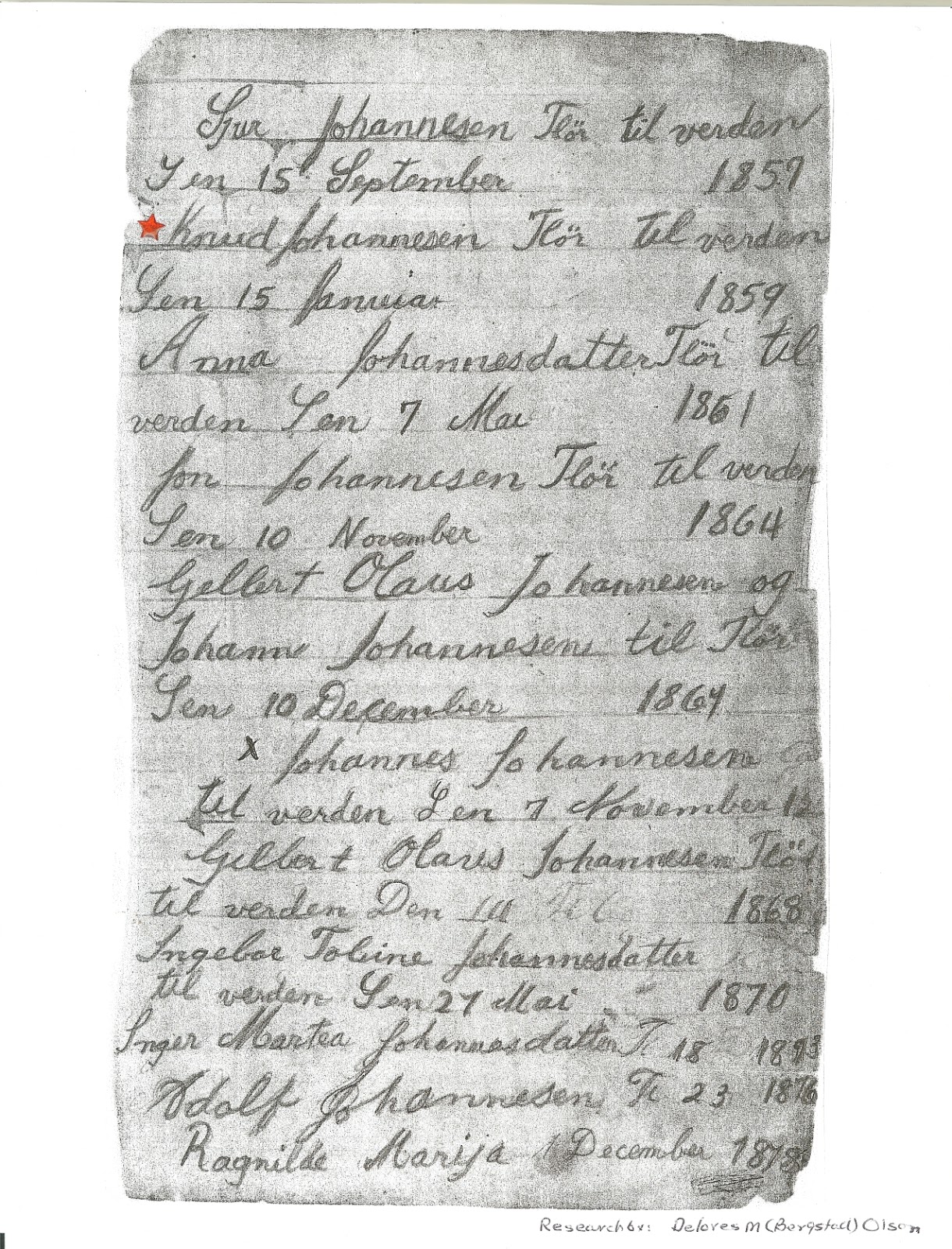
3. Bergstad family Bible page
Several years ago, I got a phone call from someone who said they were related to me. They'd gotten my cell number from an old genealogy website I'd put up, and wanted to send me some info on my/our Bergstad ancestors. I was really excited, but didn't want to get my hopes up too much, because she wouldn't say exactly what she was sending. The package arrived, and the contents knocked my socks off! Picture after picture after picture of my ancestors and their families, with people identified clearly; typewritten histories of various people; and this - a scan of a page from the Bergstad family Bible! This was the first time I'd ever heard of there being a family Bible on any of my ancestral lines. This page covers one generation, and I don't know whose handwriting it is, but it's all in Norwegian, and doesn't even mention the Bergstad name (which first appears as their surname in 1880). It was fascinating to see them listed in the old Norwegian patronymic style. It just drove it home in my mind that these were new Americans, still living their old culture in their new home.

 
 4. Harris family photos
When I was 19, I was serving a mission for my church in Japan, when I got a letter from my Grandma Sally Crawford. In it, she sent me a pedigree chart she put together of her ancestors, the first of any genealogy-related document I'd ever seen for my family. Attached to the unfamiliar names were actual photos, including the two above (Thomas W. Harris on the left, Frank and Charlotte (Scribner) Harris on the right). I'd never heard of these people or seen these pictures, and I had a sudden, intense desire to know more about them. I had to wait a couple years until my mission was finished, but when I got home, I delved right into researching my family tree, even making a presentation on the subject in college just a couple months later. It was fascinating stuff, and I'm even more captivated by it 17 years later.


5. John Gibson family - 1881 New Brunswick census
If I absolutely had to pick one favorite document, this would be it. This was my very first discovery in family history research. My mom told me my paternal great-great-grandparents, John and Catherine (Cain) Gibson came from Saint John, New Brunswick, Canada, and that my great-grandfather John Frederick Gibson was born there about 1884. I somehow found there were records for the area for the 1881 census. I pulled out the microfilm for Saint John, sat down at a microfilm reader and started cranking. Within just a few minutes, I found them! I thought to myself "this genealogy stuff is easy!" If I only knew... I am glad that first discovery came so readily, because it encouraged me to start really researching my family history.

So there you have it, my top five favorite family history documents. Let me know what your favorites are and why.

Thursday, June 11, 2015

Treasure Chest Thursday - DNA update and an apology

This has been a remarkable week in terms of family history discoveries. My uncle Bill's DNA results are almost complete (I can compare him to matches I've already connected with, and see his ancestry composition, but not his full list of matches yet). While I haven't delved too deeply into his data yet, I did see that his mtDNA haplogroup is listed as H3 (which is good, because that's what his mother's is), and his Y-DNA haplogroup is I1. This is great, because according to 23andMe, this haplogroup "reaches its highest levels in Denmark and the southern parts of Sweden and Norway." My Bergstad ancestors hailed from southern Norway, so this exactly matches what I've found in my genealogy research. Awesome!

23andMe's map of I1 frequency
 

In addition to my uncle's results coming in, my mother-in-law Peggy McFarland has agreed to take the test my wife so kindly bought for me recently. As she is 1/4 Osage, that will give me a lot of Native American DNA to work with. My wife's earliest known Native American ancestor is Wy-e-gla-in-kah, or Redcorn. That will pretty well cover my wife's side in terms of DNA testing, at least in terms of getting people tested. I'll eventually need to order Y-DNA results for her father and mtDNA results on both her parents, but that will have to wait until I can afford them. At least the atDNA tests are more affordable, so I can get their DNA samples to FTDNA for storage and later testing.

Once her test is in, that just leaves two more people I want to test - a male Wagner descendant (to get the Wagner Y-DNA, and a little atDNA too) and a maternal cousin of my maternal grandmother (to try and filter cousins on my grandmother's maternal side into maternal and paternal matches). After that, I'll just have some mtDNA tests to upgrade (both my dad and paternal grandfather's) and I should have a very robust DNA database to play with for years!

Next up, an apology. A few days ago, I wrote a post about the servicemen in my family, and how lucky I was to not have lost any direct ancestors in war. I neglected to mention a few men in my family who did make the ultimate sacrifice in wartime. First, Tom Nelson, the first husband of my paternal grandmother Blossom and the father of my aunt Eileen, who joined the Army Air Force during World War II. He was the bombardier of a flight crew that flew bombing missions over Germany. He survived being shot down in July 1943, when his plane went down in the North Sea (they did lose one crew member in that crash, but everyone else survived with minor injuries). He was not so fortunate three months later when his plane went down in a combat mission on October 8, 1943. He and the other nine crew members all perished. His only child, my aunt Eileen, was born five months later. He really gave up everything in defense of his country, including the chance to meet and raise his daughter.

Tom Nelson (right) and Air Force buddy


Another relative who gave his life in a time of war was Stephen Norton Johnson, the first husband of my 3rd-great-grandmother Mariah Janette Beardsley, who I've written about before. He enlisted just six months after the outbreak of the Civil War and was assigned to the company band. He got sick while practicing and marching in inclement weather, and died just two months after joining up. Like Tom Nelson, Norton (as he went by) left behind a pregnant wife when he went to war, but unlike Tom, he also left four older children, ages 12, 10, 9, and 3. His last child, a son named Norton after him, was born five months after he died. Five years later Mariah married my ancestor, Zachariah Scribner, with whom she had four more children, including Charlotte Scribner, my 2nd-great-grandmother.

I didn't meant to downplay or ignore the sacrifices these men made in the defense of this country, its freedoms, and its people. I was so focused on my direct line and living relatives that they simply slipped my mind. I am grateful for the sacrifice of those who gave their lives, as well as those who were willing to do the same, so that I can live the nice, cushy, easy life that I do today.

Sunday, April 19, 2015

Why my genealogy is so awesomely hard to trace - part 2

Picking up where I left off, here's a summary of where I'm at with my maternal ancestral lines, and what I want to do from here.

1. Bergstad - Thanks to a Bergstad cousin and the awesome online archives of the Norwegian government, I've got original records taking my Bergstad line back to the 1700s. I could try to push back further, but what I'd really like to do is get copies of the records about the farms they lived on, because that seems to be how things were organized in Norway back then. There are books in the FHL, I know which ones I need, I just need someone to get the copies for me.

2. Fadness - I've got some of the records for my Fadness lines that I have for my Bergstads, but not as many or as complete. I intended to go get them, just got sidetracked and never got back to them. I need to flesh out my record collection from the Norwegian archives for the Fadnesses I know about before going any further back on them. Plus I need to do a little more study on how the Norwegian naming system actually worked. I don't know enough about how the farm name worked, if it was considered part of the person's name or not. In both the Bergstad and Fadness families, they eventually adopted the farm name as their surnames, and there has to be a reason for that.

3. Olson - Another Norwegian line, in about the same situation as the Fadnesses - need to flesh out the documentation, but both in the US and Norway. This is one case where the surname came from a direct ancestor, not a farm.

4. Hammer - My last Norwegian line, slightly better documented in Norway than the Olsons and Fadnesses, but not by much. I do have some really cool homestead documents for the immigrant on this line, Philip Wilhelm Oleson Hammer for his settlement in North Dakota. I think this is another family that took the farm name as the surname. I want to document them better in Norway, and see what I can pull up on the farm records.

5. Krüger - One of my German lines in my mom's ancestry, and one where I have a lot of names and dates and places but no supporting documentation. I really want to research these guys and trace them back to the old country, but haven't because I've thought it would be too tough. Maybe I should test this and see what I can find out?

6. McDonald - My one and only Scottish line. Well, sorta - one line of McDonalds was apparently English, while the other was probably Scottish. The problem is, I'm stuck in Ontario in the mid 1800s, where there were approximately 50,000 George McDonalds/MacDonalds. It's like looking for a single strand (blade? string?) of hay in a field of haystacks. If I could track down a modern descendant and get them to take a DNA test, I might stand a chance of tracing them back to Scotland.

7. Harris - I've got some pretty good documentation on them going back to the late 1700s in America, and then it stops. Although I've always thought I need more solid info on my 4th-great-grandfather, Lewis Harris, tying him to his parents Nathaniel Harris and Mary Howard. That and colonial Virginia research is way beyond me at this point, so I'd really have to bone up before trying to tackle this line.

8. Berry - Lewis Harris married Lucinda Berry, so the time and location for the Berry's is pretty close to that of the Harrises. I've got some good info on Lucinda and her folks, but not much beyond those two generations. Again, this is colonial Virginia and perhaps Maryland, so I haven't really tried to push beyond what I already know about them.

9. Scribner - This is another early American family, where the data I have goes back to England, but I haven't verified it yet. I'm sure there's a lot of good info out there to corroborate it, I just haven't taken time to learn about how to winnow it out of the records yet.

10. Craddock - This is a probable English connection, but I only feel comfortable with my documentation on them going back to about 1830 (and even that's pushing it a bit). It's southern research, so you're dealing with missing/destroyed records much moreso than any other of my lines. I'd like to shore up what I have going back to 1850, and see where I can go from there.

11. Beilstein - I've written pretty extensively about Philena "Lena" Beilstein, probably more than any other single ancestor in my whole tree. Her story is just so fascinating and so tragic. I was recently able to find a little more info about her parents, and the man who married them. I have a lot more info on her ancestry, but not a lot of documentation to support it. I'd like to confirm it if I can and explore the Hessian connection.

Well, that about sums it up. Any recommendations on which line I should research first?