Sunday, September 3, 2023

A possible answer to the never answered question: Why?

We took a mini vacation to Montana recently drove up Friday morning and came home Saturday afternoon. Since we moved to Idaho two years ago, I've been really looking forward to taking my kids to Butte, showing them some of the sights that are familiar to me, like the Berkeley Pit, the home of my grandpa Unc (Clarence Morris, my great-grandma Rosie's second husband), and others. While we were there, my dad showed us some of the sites related to mining, the industry that basically brought Butte into existence and provided labor for many of its residents, including some of my ancestors. That got me wondering if I could get some details on my ancestors' work in the mines there, maybe even identifying which mine they worked in. 

Fortunately, Butte city directories helped me find exactly that! The 1939 and 1942 directories included the names of the mines that miners worked in. My maternal great-grandfather Jim Harris is listed in both directories as a miner in the Belmont Mine. 

Belmon Mine, Butte, Montana in 1927, from StoryOfButte.org.

While going through the directories, I found that Jim and Edna Harris, my great-grandparents, lived for a few years at 610 1/2 S Montana, but around 1942, they moved to 609 Silver Bow Homes. I've never heard of Silver Bow Homes, and thought it might be a housing development or maybe an apartment complex or something. I went to Newspapers.com, and found something very interesting! 


There was an article from September 1942 about how Silver Bow Homes, apparently an outfit that rented homes to customers, approved a rent schedule with a reduced rent payment for men working in industries related to the war effort. The rent included light, heat, water, cooking fuel, and electrical refrigeration. Since mining definitely qualified as war-related, this may have been what induced him and his family to move there. I've documented dozens of moves in my family history, but this is the first time I've come close to identifying a specific "why" for someone in my family tree that I never got to meet in person. I tell my clients all the time that we may never really understand the why behind what they did, so this was a fun little gold nugget to find, and a great reminder that sometimes we do get at least a possible answer to the one question that almost never gets answered. 


In Memoriam: Randall Frederick "Hoot" Gibson

 A few months ago, on March 27, 2023, my uncle Randy "Hoot" Gibson passed away. He hadn't been sick very long, only a few months, when he was diagnosed with cancer. He fought it hard, and after only a few short months, he passed away. 


In the last decade or so, my dad's family has been dealt some pretty heavy losses - my cousin Jimmy Pushard in 2011, grandma Blossom in 2013, Para Fred in 2021, and now uncle Randy. In all cases, we didn't have a funeral, though we did have a family get together of some kind, and in the case of my grandparents, we had a big family memorial over the summer last year. I get that for the Gibsons, funerals just aren't their thing, but in a way I really wish they were. They really give a chance for closure, and just that sense of everyone getting to say goodbye together. But that's just my wish. 


I have too many memories of times with uncle Randy to pick one or even a few to start with. He and his family were the only relatives we had who lived in Washington for most of my growing up years, us in Federal Way and them down in Vancouver. One of my earliest memories is celebrating Christmas at their home when I was like 5. It was fun having everyone together like that. He served in the Navy during the Vietnam War, and worked/served in Navy for quite some time afterward. I remember going to his retirement from the Navy years ago, can't remember exactly when. But it was really something to hear all these people get up and talk about how much they admired uncle Randy and enjoyed working with him. 


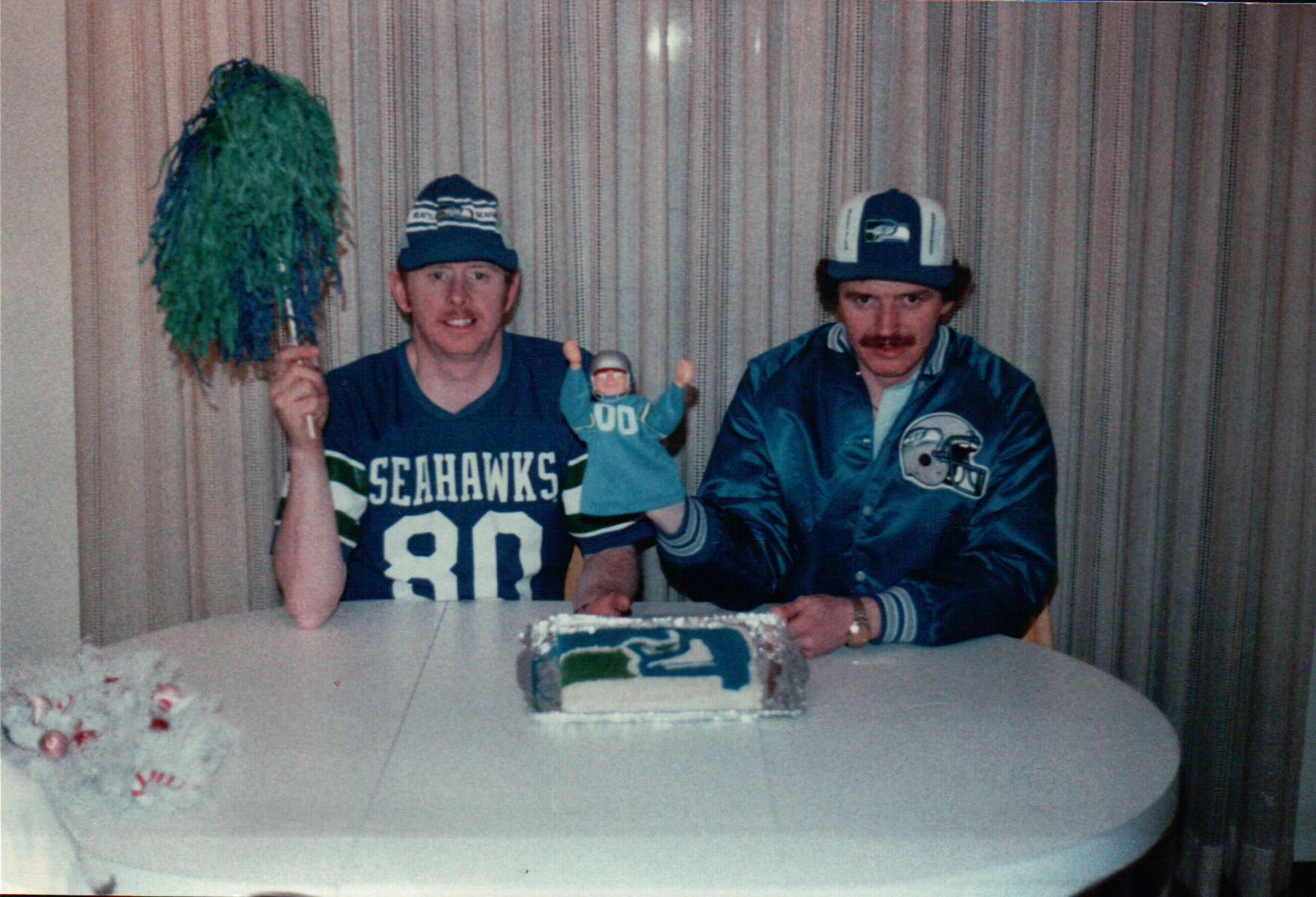
He and my dad were avid Seahawks fans for years, and would take trips from Montana out to Washington to go watch Seahawks games, probably at the Kingdome (the best football stadium ever, in my opinion, though that doesn't mean much coming from someone who only watched sports like three times a year). 


He was one of the most genuinely happy guys I've ever met. Every family get together I would look forward to his loud, infectious laugh, his big happy grin, and a "Hey BJ!" from him. He, my dad, and Papa Fred went on a fishing trip together every summer, and I always thought that was a wonderful thing for them to do (not that I'm super into fishing or anything, but that they found a great way to just get away and spend time together). 


He and my aunt Sandy were devout Catholics, the only ones in our family. That came in handy when I found some Catholics in our famliy tree, and needed help understanding some of the religious experiences and events in their lives. One of the things I've always admired about my dad's siblings is that, even though they were all different religions, there was nothing but love between them when they got together. Don't get me wrong, there were bumpy times and hard times, but through it all, they stuck together and worked things out in a very admirable way. 

It's still hard to think he's actually gone, since I never got a chance to see him even sick or anything. But at least I know there will come a day when I'll get to see Uncle Hoot again, and hear that familiar laugh and give him a big, back-pounding hug. Goodbye for now uncle Randy, till we meet again. 

Sunday, February 19, 2023

In Memoriam: William Andrew "Bill" Berstad

Two weeks ago, my mom's only brother, William "Bill" Bergstad passed away after courageously fighting stomach cancer for the last five years. I won't say he lost his fight with cancer, because he didn't. He fought with everything he had, he never lost his faith in God despite the pain and difficulty, and we saw miracle after miracle as he kept defying expectations and assumptions. 


Uncle Bill's funeral was this past Friday, and it was really touching to see how many people came. Of course we had a lot of family there, but there were many other people that he knew from the church he led, Set Free Ministries, people he worked with, and just dozens of others he had interacted or connected with in some way. 


Most of my early memories of him are of either visiting him in Spokane, riding one of the horses he owned (it was so huge, I was terrified, but Uncle Bill was so calm and patient), him coming to my baptism when I was 8, playing with his pet chihuahua Suzie, or marveling at his physical strength. When I was about 12, my parents added on an extra car space to our garage, and had bags of cement and other materials in our driveway. I was asked to bring one bag into the garagge, and could barely move it. Uncle Bill was visiting at the time, and saw me struggling. He came over, said something like "It's ok, I've got this" and picked it up with one arm, slung it over his shoulder like it was nothing, and brought it inside. 


The times I saw him over the years, he was always nice, always smiling, laughing with people, or making them laugh. He was just an easygoing guy, kinda loud sometimes, but not in a bad way. He was just letting you know he enjoyed his life. I could tell from the pictures he shared on Facebook how much he loved his kids and grandkids. It was so weird at the celebration of his life, I kept expecting to see him walk in, throw his arm around someone and start telling a joke. It was hard seeing Aunt Carol, my mom, my grandma, my aunt, and everyone missing him so much. But I could also picture him seeing so many of our family that are already on the other side of the veil - Levi, Grandma Edna, Grandpa Tom, Grandpa Jim, not to mention all of our ancestors going back through the generations. I hope he had a good welcoming party. 

God be with you (and with us) until we meet again, Uncle Bill. 

Sunday, December 18, 2022

Surnames: Wibbly wobbly, namey-wamey stuff

For those that don't know, the title of this post is taken from Doctor Who, when he explains to someone that time isn't this linear thing that always behaves properly; instead it's made of "wibbly, wobbly, timey-wimey stuff." As a genealogist, I've come to realize that surnames are never as set in stone as we'd like to believe. Variations in spelling are so commonplace, that the idea that one's family name was "always" a certain way is almost laughable. Still, I have sometimes gotten in the habit of thinking that, within certain boundaries, I'd figured out most of my family surnames and their histories, at least in recent years. I should have known better. 

When my Bergstad ancestors emigrated from Norway in 1847, the name "Bergstad," the name of the farm they lived on at the time they emigrated to the US, was a part of their emigration record, as you can see below in the entry for Sjur Johannesen Bergstad, which starts on the first line but continues on the second line.

 
 Then on the passenger list coming into the US, the image cuts off part of the name, but you can still see Bergstad there after Sjur Johannesen. 


For a long time, the next record I had of Sjur's family was the 1860 US Census, which lists them as Johnson (the Anglicized version of Johannesen), with no mention of Bergstad.

Then Sjur's son Johannes Sjursen was listed in the 1870 US Census as John Shurson, again with no mention of the Bergstad name. 

This led me to think that they dropped the Bergstad name after arriving in the US until sometime between 1870 and 1880, as Johannes Sjursen shows up in the 1880 census as John S. Bergstad. 


From that point on, they were Bergstads. Or that's how I thought it went, until last week. I went looking for birth or baptism records for Johannes Sjursen Bergstad's oldest children, and I actually found them! First was Sjur Johannesson, born in 1857 in Wisconsin. One of the fun things about Norwegians is the fact that they formed communities here in the US and created their own records in Norwegian - church records, newspapers, all in Norwegian. Sjur's baptism record listed his parents as Johannes Sjursen and Thorbjor Knutsdr. 
 
 
Just what I expected to find - the patronymic Sjursen surname, and no Bergstad. But then Johannes's second son Knud was born. 


In Knud's baptism record, his parents are listed as Johannes Bergstad and Thorbjor Knudsdr. No Sjursen, just Bergstad. This predates the 1860 census record, and shows the family considered and used Bergstad as a surname about a decade after getting to the US, and a couple decades before it became a permanent thing for them. It makes me wonder what they really considered their surname to be - was it the patronymic they would have used in Norway? Was it the Bergstad farm name? Or did it change depending on some internal decision or outside influence? I'll probably never know for sure, but it does serve to remind me that we really need to be open minded when looking for records of our ancestors - we really  never know what they were thinking when they did things.

Wednesday, August 25, 2021

In Memory of Frederick Joseph Gibson 1926-2021

My grandpa, Fred Gibson, was born in Butte, Montana, on 20 February 1926. He was the only child of Frederick John Gibson and Augusta (Joseph) (Staffan) Gibson. His dad was 42 when Fred was born, and his mom was about 35. Fred was the first Gibson in our line born in the U.S., as his dad was born in Canada and his mother was German but born in Ukraine. He remembered learning German from his mother as a little boy, and could still count and remember some words many decades later. Augusta died just a few weeks before Fred turned 5. He lived with his maternal aunt and uncle Pat and Jack Walsh for a while after his mother's death, but when they invited him to join their Catholic church and he declined, the relationship soured. 


Fred at age 1

Fred's dad remarried a couple years later to Emma Kitzel, and brought with her Fred's only sibling, his step-sister Vera. She was 13 years older than Fred, so they didn't live together long, though they had occasional contact over the years until her death in the 1990s. 


Fred Sr., Emma, Vera, and Fred.

Fred, Charlie Wagner, and Howie Wagner

One of Fred's earliest memories was receiving a Flexible Flyer sled for Christmas when he was 7. He said that present made him as happy as he could be. He never had a bicycle until he was 14. When Fred was young, his family lived near his maternal grandfather, Samuel Joseph, as well as the Richters, relatives of his future wife Blossom Wagner. Blossom would come and visit her relatives sometimes, and Fred would come to see her. She was "too old for him" then, as she was 17 and he was 14. 


Fred on a train

Fred started working for the railroad when he was 14. He worked in various capacities, including brakeman, conductor, and switchman at Butte and Rocker. He didn't always work for the railroad; he once told me there was a time he worked trying to sell cemetery plots door to door, but that wasn't a very lucrative job. He worked for a while at the Wagner Bros. lumber mill with Blossom's father and uncles. But most of his professional life was spent working for the Northern Pacific Railroad, which he started in 1947. 


First page of Fred's train schedule from 1947

The U.S. entered World War II in 1941, and two years later was still heavily involved in the conflict. Two days after turning 17, Fred went to enlist and serve his country, originally intending to enlist in the Navy. A Marines recruiter saw him and yelled "Hey you big guy, come here." He must have been very persuasive, as Fred ended up enlisting with the Marines. During WWII, Fred certified as a rifle marksman, and also qualified to operate 90mm anti-aircraft machine guns and light trucks. He served in the Hawaiian Islands and Midway between 25 April 1943 and 22 April 1945. He was discharged at San Diego on 15 November 1945. 


Fred in 1943 at Kaneoh Bay

After returning home from the war, he again met Blossom, then widowed (her husband Tom Nelson was killed flying over Germany) and raising a daughter. They began dating, and decided to get married. Fred proposed to Blossom while he was flying them around in a small airplane. Blossom said "yes, if you can land this thing!" They were married on 19 November 1947 in Butte. 


Fred and Blossom on Carolina St. in Butte. 

Fred and Blossom went on to add four more children to their family. Their home was the cool home in the neighborhood, the one all the kids wanted to come and stay at. Their sons Dave and Randy both followed Fred's example and served in the military during the Vietnam War (both in the Navy). Their kids grew and added grandkids to their family, and Fred and Blossom made time for everyone. As their kids began moving away from Montana, Fred and Blossom took trips to visit them, as well as to take vacations around the world including Germany and Australia. Whenever they went on trips they always sent postcards and letters to their kids and grandkids. They remembered birthdays and sent cards and usually a few dollars to each of us. They knew how to make us feel remembered and special. 


Fred and his younger descendants in 2016

When the husband of one of Fred's cousins died in the 1980s, he left a sizable inheritance to Fred and his cousins. Fred and Blossom used the money to purchase a motorhome, which is how I remember them coming to visit my family when I was young. I remember one day when they came to visit, I was up in my room reading when suddenly there was a huge BOOM and the house shook! I ran outside to see what had happend, and it turned out grandpa had accidentally backed the motorhome into the house! We all had a good laugh, and still do when we tell the story. 

Fred and Blossom eventually sold the motorhome and bought a small home in Marysville, Washington, where they lived together for several years. They still called on birthdays and took trips to visit family, and family took trips to visit them. We had big reunions every now and then, in Idaho, in Montana, or just and their house. We loved seeing them, and they were always so cute together. Blossom called him "Freddie" and he called her "mother." They held hands when they walked together, and at my wedding, they were the couple who had been married the longest and were rightly honored as such. They teased each other sometimes too though. Once when I was telling grandma about her connection to European royalty, grandpa tried to interrupt with something, but grandma said "be quiet Freddie, I'm a princess!" 


Fred and Blossom in 1966

Fred was also very musical. He could play a lot of songs on the piano, some of which he taught to me and my sister, and he seemed to have a song for every occasion. Something always reminded him of a song, and he'd start singing it in that loud, boistrous voice of his. 

Blossom passed away very unexpectedly in January 2013. Fred talked often about how much he missed her, and it was hard to see him so sad. He kept right on living in their home, still driving himself where he needed to go, and still taking time to visit family. He still called on my birthday, and he remembered my kids' birthdays too. He had the sharpest memory of anyone I've ever met. Once when I was trying to help him make a purchase over the phone, I asked him for his card, and instead he just rattled off the entire number, expiration date, and code on the back! He remembered places, dates, and people with exactness decades after the events and people were long gone. 


Fred and Blossom's 50th anniversary

I loved talking about family history with my grandpa. He had stories of his family, mostly his mom's side. When I got into genealogy and started learning about our more distant relatives, he was always interested in the stories I found. Family meant everyting to him, past or present. 


Four generations of Gibsons - Me, Dave, Fred, and 3 of my kids

It's so surreal to think he's on the other side of the veil now. Just a couple weeks ago, we were at my parents' house the day before heading out for Idaho, and he came down with several of his kids for a big dinner. He was talking and having a great time with all of us. That's how I will always remember him - just sitting in a comfy chair, talking and laughing, or dozing off for a bit, but just a great guy to be around. It will be hard to wait to see him again, but I know grandma is happy to be with him, along with his mom and dad, Levi, Jimmy, and all the other family that I'm sure were there to greet him. 


Fred in Hawaii in 2003

God be with you till we meet again, grandpa. We love you. 

Monday, January 25, 2021

This is why you don't tease dogs

I've been doing professional research for a few years now, and it has been an amazing and fulfilling career so far. I love being able to help people find answers to their family history questions and mysteries, and in turn I've been able to make some great discoveries in my own family. One downside, however, is I sometimes end up treating those rare moments when I get to do my own family research a bit like a they're a research project - pick something to search for, frantically search for everything I can find as fast as I can find it, quickly document it, and move on. I don't often give my findings time to sink in and affect me. 

 I've been taking advice from a genealogist I follow named Heather Murphy, and slowing down a bit on my research. Starting with the intention of going slow is a few feeling, and I really like it. So today I set out to find some stories about my second-great-grandmother Maria Zitzmann aka Mary Hoffman. I'm super lucky to have a boatload of pictures of her and her family, but I still don't have too many stories about her and her life. I was hoping to find something about her marriage in 1919 to Christ Hoffman, but my searches at first turned up empty. Then a new idea hit me - find her address, and search for that. I went looking in city directories before her marriage, and found her in 1917, living at 1315 Cobban Street in Butte. Interestingly, the directory lists her as the widow of a man named Smith. That's really curious, as her daughters would later both state in their Social Security applications that their father was a man named Chris Schmidt, though DNA evidence points to them being half-sisters.


Now that I had her address, I searched through newspapers to see if anything came up, and I found a few really cool things! 

First I found a photo of my grandma Blossom's cousin Ellen Weyhe (listed as Ellen Whyte) taken when she was about a year old. It's a studio photo, with the name Dore Studio in the bottom right corner, with Ellen all dressed up in a cute little dress complete with baby shoes. 


Then I found two articles about something I'd never heard of, and my dad hadn't either when I asked him. Apparently soon after their marriage, Mary and Christ Hoffman owned a rather large dog and kept it in their yard. The first article said the dog had severely bitten the right hand of "the little Lohman boy," the son of Ed Lohman. A search of the 1920 census showed me this was Raymond Carrigg, the 13-year-old stepson of Edward Lohman, who also lived in Butte. The article went on to say the Assistant City Attorney filed a complaint against Mary and Christ's dog, saying he had appeared "to prove himself vicious" and notified them to not send the dog out of the city, as that might give "him an opportunity to bite some one else." The tenor of the article made it sound like the Hoffmans' dog was running loose in the city and just attacked the kid. The next few paragraphs talked about the dangers of the local dog population, and even suggested a law be made restricting the number of dogs citizens could own, based on their type of residence and the purpose of the dogs' being there. 


The next day, another article continued the story, but with significant changes to the story, starting with the headline - "Dog Is Acquitted Of Being Vicious Brute." Several of the Hoffmans' neighbors testified in court that the dog was kept in an enclosed yard. What's more, the pickets of their fence were too close together for the dog to be able to stick its head out between them, so that the only way for anyone's hand to be exposed to the dog would be to put their hand over the fence. Not only that, a number of boys (apparently including Raymond Carrigg) had actually attacked the dog by throwing sticks and stones at it. Mary Hoffman had been out at the time of the attack, and returned home to find her yard "littered with sticks, stones and other rubbish and that the coal scuttle was smashed, evidently by the boys who were pelting the dog." Needless to say, the case was then dismissed. 


I could almost see in my mind a group of youths having fun at the dog's expense, and then Raymond, goading him on by sticking his hand above the fence and thinking himself out of reach, gets bitten by the dog they'd been antagonizing. I kind of feel bad, but I feel he brought it on himself. It sounds like the dog was not injured in the attack, but I hope the Hoffmans at least got their coal scuttle replaced. I feel bad for the Hoffmans in finding their dog had been so cruelly treated, and grateful to the neighbors for sticking up for an innocent animal. 

PS - I looked up Raymond Carrigg's draft registration from 1942, which would mention any defining physical characteristics like scars, missing fingers, etc. Nothing was mentioned, so apparently he healed just fine from the dog bite. 

Sunday, November 29, 2020

Alexander Shute and no-good, very bad, horrible lawsuit - and what he did about it


Alexander B. Shute

The other day, I was poking around some Minnesota records, trying to add some details to the lives of my Shute ancestors who lived there in the mid-1800s. I knew my ancestor Alexander B. Shute had served in the Civil War (the only ancestor of mine to serve and survive) and was originally from New York. That was about all I knew of him. I decided to try and find some newspaper articles, as they often record details not found in other record types, and I was hopeful (since I couldn't remember searching for his family before in newspapers) that I'd find something good. 

Boy was I right! One of the first things I found were a few mentions of family members going to court against each other. Alexander's wife Letitia (Sanford) Shute sued her likely first cousin Mahlon Mitchell, over what I don't know. Alexander and his brother-in-law Gilbert Sanford went to court over something else. There were also statements of a judgment against Alexander, for which some of his land was confiscated and sold at auction. That had to have been awful, watching something you'd worked so hard to obtain be taken from you and sold to pay off a debt or judgment. But that's not the lawsuit mentioned in the title of this post. 

That lawsuit was found mentioned first in 1891, where he and his son Adoniram were mentioned as suing the town of Princeton, Minnesota, where he lived. I wondered what could have happened that he'd sue his own town? The case was a civil case, not a criminal one, but nothing further was said about what it was concerning. The jury agreed to disagree, and apparently that was the end of it. Alexander took the case to court again in the next term, and the original sentence (whatever it was) was upheld. Alexander then took his case to the state supreme court. This was in 1894, so he'd been at getting resolution for whatever this issue was for several years. Talk about persistence. 

Then, in July 1894, an article finally revealed what the issue was. Apparently about 1889, the town of Princeton had contracted with some men to clear brush and trees to make a road. The men were apparently careless with the fires they used to clear that brush, and didn't extinguish it properly, according to Alexander. The fire spread, and eventually Alexander's house took fire and was completely destroyed. Alexander apparently felt the town of Princeton, who'd hired the contractors, was responsible for the damage, and sued them but lost. He took it up again, and lost when the town was held not liable for the fire. The state supreme court then took it up and, once again, sided with the town of Princeton in holding them not liable for the damage done by the contractors. I can't imagine surviving something as horrific as a house fire that destroys everything you have, and then for the court to dismiss charges against those ultimately responsible for that fire happening. It must have been maddening to have it fall apart like that. 

What really got me is what happened two months later. A group of 31 men petitioned the county for a road to be constructed in the county that would lead to more than one town. The county granted the petition and put together a committee to examine the route of the proposed road. And guess where that committee was planning to meet? In the new home of Alexander Shute! It boggles my mind that he allowed his home to be used for a committee to plan to do the same thing that had cost him his home in Princeton, and which he spent five years (and probably a good amount of money) on seeking redress for, but never received any. If anyone had reason to give up on the system, withdraw and seek isolation, I would think it'd be him. Yet he apparently stayed involved and engaged in his community. I have a whole new respect for this ancestor of mine, the maturity and likely forgiveness he had to muster and display is inspiring. He didn't give up seeking what he felt was right. And when that was apparently ultimately denied him, he kept on living and being a part of his community. 

Sadly, a couple years after this, he was injured in an accident, and never fully recovered. Alexander Shute died in Princeton, Minnesota, on 16 April 1897. He likely had no idea his life was about to be cut short when he was going through all those court proceedings, and later helping to work out the county road. I'm glad he didn't allow those circumstances to ruin him, embitter him, or cause him to withdraw. That's a lesson I hope I can take to heart when things don't go my way.