Wednesday, February 10, 2016

Nearly Wordless Wednesday - My ancestral hometowns


After blogging about my Gibson ancestors' hometown, I thought it'd be fun to browse Google Earth and mark the locations of other ancestral hometowns I've discovered in my research. Here they are!
 
 
Gross-Bieberau, Germany - My 3rd-great-grandfather Jacob Beilstein was born here in 1851.

 
Evanger, Norway - My 3rd-great-grandfather Johannes Sjursen Bergstad was born here in 1832.

 
Paris, France - My 9th-great-grandmother, Claude Demise, was born here in 1650. Other ancestors were born here as well.

Kepa Kikolska, Poland - My 3rd-great-grandfather Ludwig Heinrich Joseph was born here in 1836.
Reischewo, Poland - My 3rd-great-grandmother Justine Witt (Ludwig's wife) was born here in 1842.
 

Rosshaupt, Bohemia (now Rozvadov, Czech Republic) - My 2nd-great-grandmother Maria Zitzmann was born here in 1876
  
Uljanowka, Ukraine - My great-grandmother Augusta Joseph was born here in 1892. Her grandparents, Ludwig and Justine Joseph, moved here around 1865 from their native Poland.

Wednesday, February 3, 2016

I am from Gortnagullion, Drumkeeran, Fermanagh

This is my first ever blog post that's not really about people; it's about a place. That specific place is the townland of Gortnagullion, in the civil parish of Drumkeeran, in County Fermanagh, Ireland. This is where my ancestors Henry and Ann Gibson were living when their first two children were born, and presumably where they were living when they left Ireland and immigrated to New Brunswick, Canada.

Map of Ireland in Google Earth

County Fermanagh (pronounced fer-MAN-uh) is in Northern Ireland, two counties south of the tip-top of Ireland (Londonderry and Tyrone are above it). County Fermanagh is circled in black in the map above. Finding this out was really interesting, as Henry and Ann's son John married Catherine Cain, whose father was from County Tyrone. The Gibsons and Cains wouldn't have exactly been neighbors in Ireland, but they wouldn't have been that far apart either. I wonder if that shared point of origin played into their getting married?

According to IrishTimes.com, English and Scottish settlers moved into County Fermanagh in the early 1600s. I have to wonder if that's when my Gibson line moved to Ireland. The Gibson name isn't a native Irish surname, and when I looked at my grandpa's Y-DNA results at the 12-marker level, for those matches that list country of origin, most of them are in England. Interesting to think about, but because of the lack of records, ultimately unknowable one way or the other.


Civil Parishes of County Fermanagh

The civil parish of Drumkeeran is the northernmost in the County (it's number 10 on the map above). It was originally part of Magheraculmoney parish (#18 above) but according to one website was split off around 1770.

I'm still trying to find more info on Gortnagullion itself, as it seems it's not longer extant as a town or townland. The nearest settlement seems to be Drumskinny. I'll keep researching to find out what I can about Gortnagullion.

It still amazes me that I have a place in Ireland that I can point to on a map and say "the Gibsons originated here!" I'm looking forward to learning all I can about my ancestral homeland, and hopefully seeing it in person one day.

Monday, February 1, 2016

Ireland bound! Well, eventually

Ireland, I am coming home
I can see your rolling fields of green
And fences made of stone
I am reaching out, won't you take my hand?
I'm coming home, Ireland
"Ireland" by Garth Brooks
 

I've made a lot of discoveries in the last 16 years of genealogy research, but few as important to me as the one I made last week.

When I finally confirmed that Henry and Ann Gibson were John Gibson's parents, I went back to the County Fermanagh mailing list and asked for help in finding info on them in their (allegedly) native town of Pettigo. One of the suggestions that came back was to search the archives of the mailing list, as someone may have written about them already. So I did, and here's what I found:


Baptism records for two children of Henry - son William from wife Jane born in 1844, and another child with wife Ann born in 1845. This was hugely exciting for several reasons:
1. My Henry and Ann had a son named William, born in Ireland in 1844, listed with them on the 1851 New Brunswick census.
2. Henry and Ann had a daughter named Ann Jane listed with them in that same 1851 census.
3. The baptism records list the townland of residence for Henry and Ann - Gortnagullion in County Fermanagh, just a few miles east of Pettigo.


The confluence of names, ages, residences, and birthplaces all fits. I am convinced that these baptism records are my family! I have been searching and searching for this information for 16 years, and now that I finally have it, I can only think of one thing...

I'm going to Ireland!!!

Well, eventually. Probably not until sometime in 2017, giving me time to plot, plan, and most importantly, afford the trip. I've said for years that I wanted to postpone a vacation to Ireland until I knew where my people were from, so I could visit the place. But for now, even just knowing the name of village where they last lived before leaving Ireland, and the possibility that I'll be the first of their descendants to visit it since they left in 1846, is staggering and exciting. As Garth Brooks memorably sang, Ireland, I'm coming home!

Sunday, January 24, 2016

Surname Saturday - Gibson origins

I blogged a while back about my great-great-grandfather John H. Gibson. I've pondered for years whether Henry and Ann Gibson were the parents of my John Gibson, and though I've looked for proof one way or the other, I've never really found any to answer my question. Until today. But first, a little back story.

I've had a thought in the back of my mind for some time that I needed to contact the New Brunswick Genealogical Society for help in finding info on my Gibson and Cain ancestors. I don't know much about the area, and getting help from those on the ground there would be invaluable. But I kept putting it off, and putting it off, until finally this week I decided to give it a shot. I sent two emails, one asking for info on John Gibson, and the other about the family of Catherine Cain, John's wife.

Within 24 hours, I got a response from someone at the society with info about the Cains, He has some Doherty ancestors that married some Cains, and had Cain godparents or witnesses for their children's baptisms and weddings. That sounded interesting, so I took his info down and looked at my own files. Turns out, his Dohertys appeared in my Cain records, as witnesses for their children's baptism! After searching for years for anything on these families, this is huge! We've emailed back and forth and are still trying to figure out where we might match up. I'm wondering if our people knew each other back in Ireland, or developed these relationships after they got to Canada. Exciting to think we may have more ties back to Ireland to look into and learn from!

While I was pondering on these connections, a thought occurred to me. While pulling up info on the Cains and Dohertys at Ancestry.com's huge database of Catholic records, I realized I've never looked in there for my Gibsons. I guess my assumption was that John was Church of England and Catherine was Catholic, so John probably put his foot down and raised his kids in the Church of England, and left Catherine the lone family Catholic. But what if that wasn't the case? What if Catherine had her kids baptized in the Catholic church? Time to go check!!


I went looking for Gibsons, and within minutes I found a baptism record for Thomas Louis Gibson, John and Catherine's son! I couldn't believe my luck! I went searching for more, and soon found the baptism for his older sister Anne as well. (Incidentally, I'd seen Anne listed in many records as Anne M. Gibson or Anne M. Condon, her married name, but nothing ever revealed what her middle name actually was. Her baptism record reveals it - Martha!)


But the biggest discovery of all was the third record I found. It was for the baptism of John Henry Gibson born in November 1881. I was expecting to find John Frederick Gibson, the name of my great-grandfather, who was reportedly born in January 1884. I did search the records for 1883-1885, and found nothing that could be John Frederick, which I thought was odd since Thomas and Anne were both in there. It seems unlikely that Catherine would have two of her children baptized but not a third. It's always possible that the record was missed, but the fact that the other two were in there, as well as John and Catherine's marriage, makes me think that that's unlikely. Plus it's not impossible that, with the passage of time, moving to Montana, and lack of necessity in maintaining an exact record of birthdates, that they either forgot or misremembered the exact day of his birth.

The hardest part to reconcile is the name - John Henry vs. John Frederick. It could be that they wanted to change it later, or that Fred was given as a nickname or pet name (I do have a relative named Donald Roscoe Wagner that went by "Bill", so it's not unheard of in my family). If John Henry is not the same as John Frederick, then they must have reused the name, and I don't know if Irish families did that. I've seen Germans and Norwegians do it, but haven't heard of the Irish doing it. I'll have to check on that.

But whether John Henry and John Frederick are the same or not, the biggest part of the discovery was the child's name itself - John Henry Gibson. I know that John and Catherine's last child was named David Henry Gibson, but seeing another child with the name Henry immediately reminded me of the Henry and Ann Gibson I'd come across years ago as possible parents for John. Why use the name Henry twice if it's not a family name, and probably a close family name? Also, John Henry was born in 1881, which would have made him John and Catherine's second child and first son. Thus their first two children were named Anne and John Henry, with David Henry following years later. This seems to me too much similarity to be just a coincidence. Maybe their deal was Catherine got to have the kids baptized Catholic if John got to pick the names. Either way, I feel much more confident now that Henry and Ann Gibson were in fact John Gibson's parents.

This is doubly exciting, because I already have statements from New Brunswick newspapers telling me where in Ireland Henry and Ann are from. So with that settled (unless future evidence proves otherwise), I can move forward in searching out information on their family in New Brunswick and back in the little town of Pettigoe. Can't wait to get searching!

Friday, January 22, 2016

Genes Day Friday - What I have learned so far through DNA testing

I thought it would be fun to recap some of the things I have learned genetic genealogy and DNA testing. Let me begin by saying THANK YOU! to the dozen or so relatives that have spit and swabbed for me. None of these breakthroughs would have been possible without your help.

1. Genetic genealogy and paper genealogy are in some ways very opposite. In paper genealogy, you start with a known person, and work outward from there, painstakingly creating family groups and pedigrees by searching through the records left behind by ancestors, friends, associates, and neighbors. You connect to people through chance and happenstance as often as known connections. In genetic genealogy, you are connected to other testees by the scientific confirmation of shared DNA, proving a blood link to that person. Sometimes (hopefully often) you can use paper genealogy to determine where and how that link was made. Sometimes you can't, and you're just stuck knowing that somehow you are related to that person.

2. Sometimes genetic genealogy helps you break through brick walls that would otherwise be impossible to penetrate. This was the case in my Grandma Blossom's maternal line. DNA testing led me to a relative who not only lives in Europe, but was intimately familiar with the area, history, and people. Within a few short weeks, he helped me put together nearly 300 years of family history for my great-great-grandmother Maria (Zitzmann) Hoffman, when I had long assumed I'd never get beyond her.

3. Sometimes you uncover things you never expected were there. Such was the case when I found out one of my ancestors was not James Harris, but in fact was William Vadnais. This discovery changed a significant portion of my genetic family tree, and has taught me to never assume that everyone listed in the paper trail is actually my ancestor by blood.

4. Everyone has two family trees - one that's genetic, and one that's genealogical. CeCe Moore taught me this. Not all of your paper ancestors will appear in your DNA - you only get half of each parent, who only got half of their parents, who only got half of their parents, etc. Within a few generations, ancestors will drop out of your genetic family tree because their DNA was simply not passed on to the next generation. That doesn't mean they aren't your ancestors though, just that they aren't represented in your DNA. Likewise, my paper family tree still includes Jim Harris because he raised that ancestor of mine and put his name on her birth certificate, even if he wasn't her biological father. His life and his family history influenced the way he raised my ancestor, so knowing about his family tree is just as important as knowing about the biological tree of William Vadnais.

5. You learn funky new words and acronyms like SNP, haplogroup, STR, endogamy, and centiMorgan. It's like learning a new language, but in learning it you learn how to discuss your family history in a whole new way. Not only do you think in terms of shared ancestors, you come to think of how much DNA you likely share with that 1C1R, or where your paternal ancestry comes from not just 3 or 4 generations ago, but hundreds of years before records were kept. It's fascinating and difficult, and I love it.

6. And the most particular thing I've learned over the last couple weeks - just because you share a certain percentage of DNA, that doesn't mean you can tell right off how closely you're related to them. If you trace your lines back far enough, you'll start to see some ancestors popping up in multiple places on your family tree. That's called ancestor collapse - being descended from the same person or couple through multiple lines of descent. This affects how much DNA you share with someone, because if you and your match have the same ancestor, but if one or both of you have multiple lines of descent from that someone, their DNA will be over-represented in your genome. You'll share more DNA than you would if you only had one line of descent from that individual, so it'll look like you're more closely related than you actually are. For example, if you're doing genetic genealogy on your French-Canadian lines, you really do need to push the lines back as far as you can because there was a lot intermarrying of families, which leads to having some ancestors pop up more than once in your family tree. That's something you need to know if you're going to try and pin down common ancestors with your DNA matches.

Have you thought about taking a DNA test to help you in your research? Or have you taken one already? What have you learned from it? Leave me a comment!

Wednesday, January 20, 2016

My favorite family history documents

I recently saw a Tweet from FamilySearch asking people what their favorite family history document was. That was a really interesting question to think about, and the more I thought about it, the more favorites I came up with. It was impossible to narrow down to just one document, so here are my top five favorites, in no particular order.


1. The marriage certificate for Christ Hoffman and Mary Sitzman (Maria Zitzmann)
When I got started in family history, I was dismayed to find out my great-great-grandmother Mary Sitzman had left this world with sealed lips as to where she and her family came from. Her daughter Rosie said nothing, and her granddaughter, my grandma Blossom, knew nothing. Years of searching based on the few clues I did have yielded nothing. This marriage record proved the key to blowing that brick wall to smithereens. Mary gave her birth town as Rosshaupt, a tiny village in western Bohemia (now called Rozvadov and part of the Czech Republic), and that one clue led to many, many, many discoveries. I've now got information on Mary's ancestors going back to 1700s and even 1600s on some lines. All from one little marriage record! It taught me that seemingly insurmountable brick walls can be overcome, even with one simple document.


2. 1910 US-Canadian border crossing of Samuel and Helena Joseph
For years, all we knew about my great-grandmother Augusta (Joseph) Gibson's family was that they came from "Germany". They were Germans, spoke German, and came to Canada before moving to Montana. Records pointed to Berlin and "Toran", Germany, but those leads proved to be dead ends. Then a few years ago, at a Family History Fair up in Bellevue, I was going over my recent discovery of this border crossing Augusta's father Samuel Joseph and sister Helena made in 1910 (Sam and Helena are listed on lines 17-18). It lists a lot of great information - relatives in the country they are leaving, name of person and address they are going to, when they first came to Canada, name of the ship, and (best of all) birthplace. Sam's birthplace was listed as "Gitomar, Russia", and Helena's as "Ulanowka, Russia". I went to the display table for the SGGEE and asked their representative to help me figure out what these places were. She figured out Gitomar was actually Zhitomir, a pretty big city in the Volhynia region of what's now Ukraine. Ulanowka is a smaller village a few miles west of Zhitomir. Boy was I excited! That piece of info led me to other discoveries, allowing me to trace Sam's family back to his grandparents in Poland. This was the first time I'd ever traced a line of my family back to their point of origin in the old world, and it felt great! This was my first real breakthrough, and I still feel the deepest genealogical connection to my Joseph ancestors, largely in part to this discovery.

 
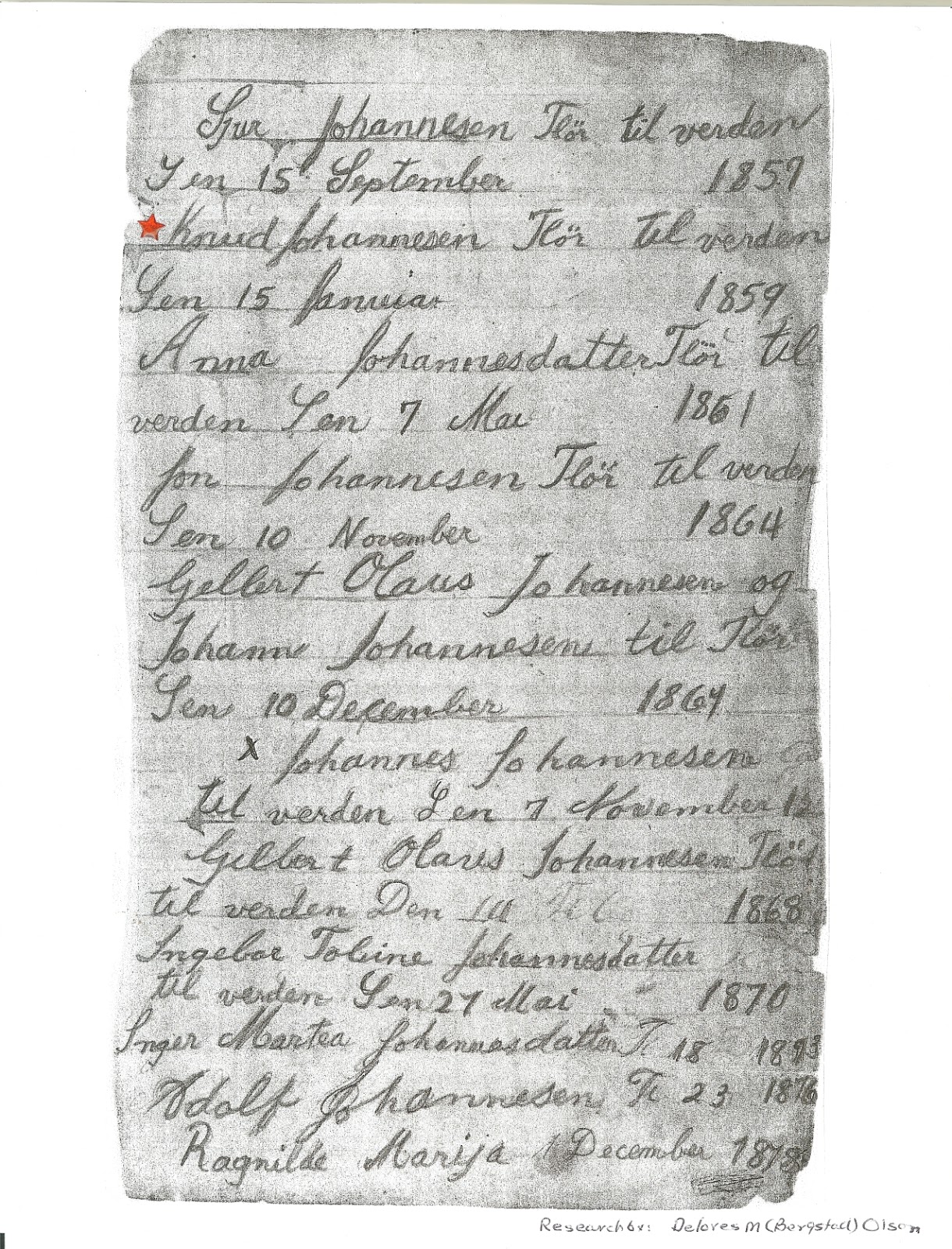
3. Bergstad family Bible page
Several years ago, I got a phone call from someone who said they were related to me. They'd gotten my cell number from an old genealogy website I'd put up, and wanted to send me some info on my/our Bergstad ancestors. I was really excited, but didn't want to get my hopes up too much, because she wouldn't say exactly what she was sending. The package arrived, and the contents knocked my socks off! Picture after picture after picture of my ancestors and their families, with people identified clearly; typewritten histories of various people; and this - a scan of a page from the Bergstad family Bible! This was the first time I'd ever heard of there being a family Bible on any of my ancestral lines. This page covers one generation, and I don't know whose handwriting it is, but it's all in Norwegian, and doesn't even mention the Bergstad name (which first appears as their surname in 1880). It was fascinating to see them listed in the old Norwegian patronymic style. It just drove it home in my mind that these were new Americans, still living their old culture in their new home.

 
 4. Harris family photos
When I was 19, I was serving a mission for my church in Japan, when I got a letter from my Grandma Sally Crawford. In it, she sent me a pedigree chart she put together of her ancestors, the first of any genealogy-related document I'd ever seen for my family. Attached to the unfamiliar names were actual photos, including the two above (Thomas W. Harris on the left, Frank and Charlotte (Scribner) Harris on the right). I'd never heard of these people or seen these pictures, and I had a sudden, intense desire to know more about them. I had to wait a couple years until my mission was finished, but when I got home, I delved right into researching my family tree, even making a presentation on the subject in college just a couple months later. It was fascinating stuff, and I'm even more captivated by it 17 years later.


5. John Gibson family - 1881 New Brunswick census
If I absolutely had to pick one favorite document, this would be it. This was my very first discovery in family history research. My mom told me my paternal great-great-grandparents, John and Catherine (Cain) Gibson came from Saint John, New Brunswick, Canada, and that my great-grandfather John Frederick Gibson was born there about 1884. I somehow found there were records for the area for the 1881 census. I pulled out the microfilm for Saint John, sat down at a microfilm reader and started cranking. Within just a few minutes, I found them! I thought to myself "this genealogy stuff is easy!" If I only knew... I am glad that first discovery came so readily, because it encouraged me to start really researching my family history.

So there you have it, my top five favorite family history documents. Let me know what your favorites are and why.

Monday, November 30, 2015

Military Monday - Don't mess with a soldier's mom

One of the great things about doing genealogy is finding stories about your relatives and the people they knew. Sometimes in researching an ancestor, something about a relative of theirs that I'm not directly related to will catch my eye for some reason, and I'll suddenly want to know all about that person. Such was the case last night.

I was going through another email from MyHeritage, sorting through the latest batch of record matches. Most of these were for Robert George Seadin, the first husband of Elsie Craddock, my great-grandmother Edna Craddock's sister. One of the records was the obituary of Elta (Hanifen) Wenger. Elta was the daughter of Daniel Hanifen and Mildred Seadin, Robert's older sister. That would make her Elsie's niece by marriage. The obituary listed a large number of family members as her survivors - her husband, Private First Class Merle Wenger, her parents, her brother and his family, her mother-in-law Mrs. Silvio Castiglioni, grandmother Mrs. Seadin, the names of her aunts and uncles (including Mr. and Mrs. Robert Seadin), her husband's father (listed at the bottom of the list, whereas his ex-wife was at the top), and all of her husband's siblings and their families. Family was obviously a very big deal for this family.

It struck me that Merle's parents were listed so far apart in the obituary, and that his mom was only mentioned (as was usual for the time) as Mrs. Silvio Castiglioni. I wanted to find out her first name, if only to complete Merle's immediate family in my records, so I went hunting. I soon found out that his mom, Irene Lucile Gibson (no relation to yours truly) was married four times! Her first marriage was to Fritz Wenger, and he was apparently the father of all her children. They divorced around 1941, and Irene married Jack Morello. They were married for less than two years when Jack died in March 1942 of endocarditis. Irene married again in December of that year, to Silvio Castiglioni. I also found another marriage record for Irene, in 1947 to a Robert Lomas. In it, her previous marriages were listed as "divorced (1) widowed (2)". I couldn't tell if that meant her first marriage was the divorce and her second ended with her being widowed (which meant she was leaving out a marriage, which I've seen happen several times), or that she was divorced once and widowed twice. I also wanted to find out what became of Silvio, so I went searching. What I found startled me.

I found a death certificate for Silvio, giving his date of death as 2 January 1945. So it seemed her marriage info to Robert Lomas did indeed mean she was divorced once (Fritz Wenger) and widowed twice (Jack Morello and Silvio). But what startled me was the cause of death - "inquest pending - due to shock and hemorrhage". The death was also labeled a homicide. Having Bertha Beilstein's story still fresh in my mind, I wanted to find out exactly what happened. I went to MyHeritage, as their newspaper collection is awesome and easily searchable. I soon found out what led to Silvio's death.

Merle was serving in the US Army at the time, but was home on an extended furlough to get some medical attention. While he was home, he received a phone call from his mother, saying her husband Silvio was beating her, that he had left the house and she was afraid to be alone. He went over to check on her, and then left to get his wife and car. When they returned to his mom's house, the door was locked. Merle shook the knob and asked who was there. Silvio came to the door with a pistol, and pointed it at Merle. Merle went for the gun, and the two fought over it, destroying windows and furniture in the process. The gun fired twice, one bullet hitting Merle in the right foot. Merle was able to get the gun from Silvio, and yelled for his wife and mother to get out of the house. While he checked to make sure they were safe, Silvio ran to his bedroom and came back - with a shotgun. How Merle had the nerve and courage to do this I don't know, but he stood his ground, firing once over Silvio's head, and told him to drop the shotgun. Silvio refused, and started shouting and waving the shotgun wildly. Merle shot Silvio in the side, stopping him. Merle stayed there until police and an ambulance came, and explained to the officers what had happened. Silvio was taken to a hospital, where he died a few hours later. The incident was still pending the inquest when the death certificate was issued, though I'm surprised no one updated it a few days later when the matter was resolved. A coroner's jury (who knew there was such a thing?) exonerated Merle of blame for the shooting.

I have to say I was very impressed by and proud of Merle for his heroism and bravery. He stepped right in to help his mother, and when a gun was pointed at his face, he didn't back down. He fought on despite personal injury (and he may have still been recovering from whatever malady prompted the extended furlough to begin with), and did what had to be done to protect his family. I don't know anything about his military service and what he did in the army. But I bet the last thing on his mind during his furlough was a life-and-death struggle with his stepfather when he was supposed to be resting and recovering. They say the World War II generation is the "greatest generation", and when I read of stories like this, it proves to me why they have that name - they earned it over and over again.